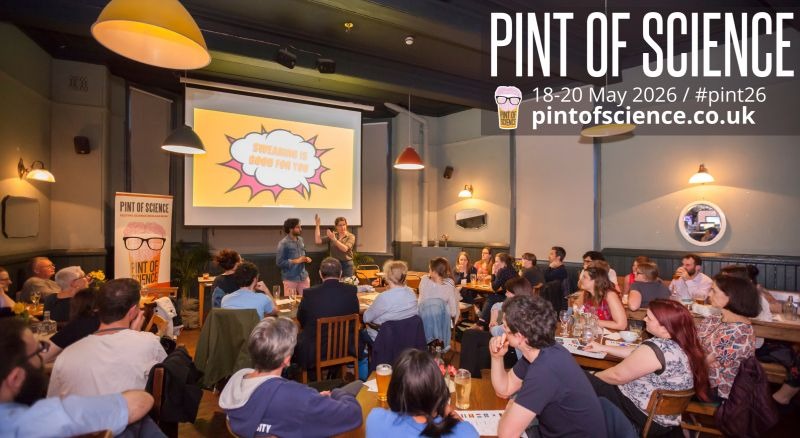
Pint of Science 2026 has arrived in India, bringing the world's largest pub-based science festival to cities including Bengaluru, Mumbai, Delhi, Hyderabad, and Pune. For three evenings in May, researchers, scientists, and curious minds gather in bars and cafés to make cutting-edge science accessible, conversational, and genuinely fun no lab coat or lecture hall required.
What Is Pint Of Science
Pint of Science is a global science communication festival founded in the United Kingdom in 2013 by neuroscientists Michael Motskin and Praveen Paul, who began by inviting patients to visit their labs and were struck by how desperately people wanted direct access to scientists. The concept move the science out of the institution and into the pub has since expanded to over 30 countries and 600 cities worldwide, making it the largest science festival of its kind on the planet. India joined the Pint of Science family in 2018, and the 2026 edition marks the country's most ambitious participation yet, with more cities, more venues, and a wider range of scientific disciplines represented than any previous year.
How It Works On The Night
Each Pint of Science event runs across three consecutive evenings in May, with researchers presenting their work in informal pub or café settings, followed by open Q and A sessions where the audience beer in hand can ask anything they want. Topics span neuroscience, climate science, artificial intelligence, space research, public health, biodiversity, and social science, presented without jargon and with an explicit mandate to entertain as well as inform. Tickets are deliberately kept affordable, typically between Rs 200 and Rs 500 per session, to ensure the festival remains accessible to students, working professionals, and curious non-specialists rather than only the academic community.
India's 2026 Edition At A Glance
Pint Of Science India Highlights
- Pint of Science 2026 runs across three evenings in May in Bengaluru, Mumbai, Delhi, Hyderabad, Pune, and additional Indian cities for the first time
- The festival was founded in 2013 by UK neuroscientists and has grown to over 30 countries and 600 cities globally, making it the world's largest pub science festival
- India's participation began in 2018 and the 2026 edition is the country's most expansive yet, with the highest number of venues and scientific themes
- Topics covered across Indian venues include artificial intelligence, space technology, neuroscience, climate change, biodiversity, mental health, and genomics
- All sessions are held in bars, cafés, and informal public venues deliberately chosen to remove the intimidation barrier of formal academic settings
- Tickets are priced between Rs 200 and Rs 500 per session, with student concessions available at most Indian venues
- Scientists and researchers from IISc, IITs, TIFR, NCBS, and several private research institutions are participating as speakers in the 2026 India edition
- The festival runs simultaneously in over 600 cities worldwide during the same three days in May, creating a global moment of public science engagement
- Organisers report a 40 percent increase in ticket bookings for India's 2026 edition compared to the previous year, reflecting growing public appetite for science communication
Why India Needs This Right Now
India produces one of the world's largest pools of scientific talent yet public understanding of and engagement with science remains uneven, often filtered through school textbooks rather than living, breathing research. Pint of Science addresses this gap by creating a space where a genomics researcher from NCBS Bengaluru can explain CRISPR over a craft beer to a curious software engineer, and where a climate scientist from IIT Delhi can field blunt, unscripted questions from someone who read a confusing headline that morning. In a country where science communication has historically been the domain of formal institutions and government campaigns, putting researchers in pubs is quietly revolutionary.
The Science Of Making Science Approachable
What distinguishes Pint of Science from a standard lecture or TED-style talk is the social architecture of the setting itself. A pub removes hierarchy the scientist is not on a stage above the audience, the audience is not sitting in exam-hall rows, and the presence of a drink in everyone's hand creates a psychological permission to ask stupid questions, challenge assumptions, and laugh at things that are genuinely funny about how little we still understand. Organisers train all speakers in science communication techniques specifically adapted for informal settings, ensuring the evening feels more like a great dinner conversation than a seminar.
Sources: Pint of Science Official Website, The Hindu, Indian Express, Deccan Herald, Science Media Centre India, Times of India Science, BBC Science Focus (May 2026)