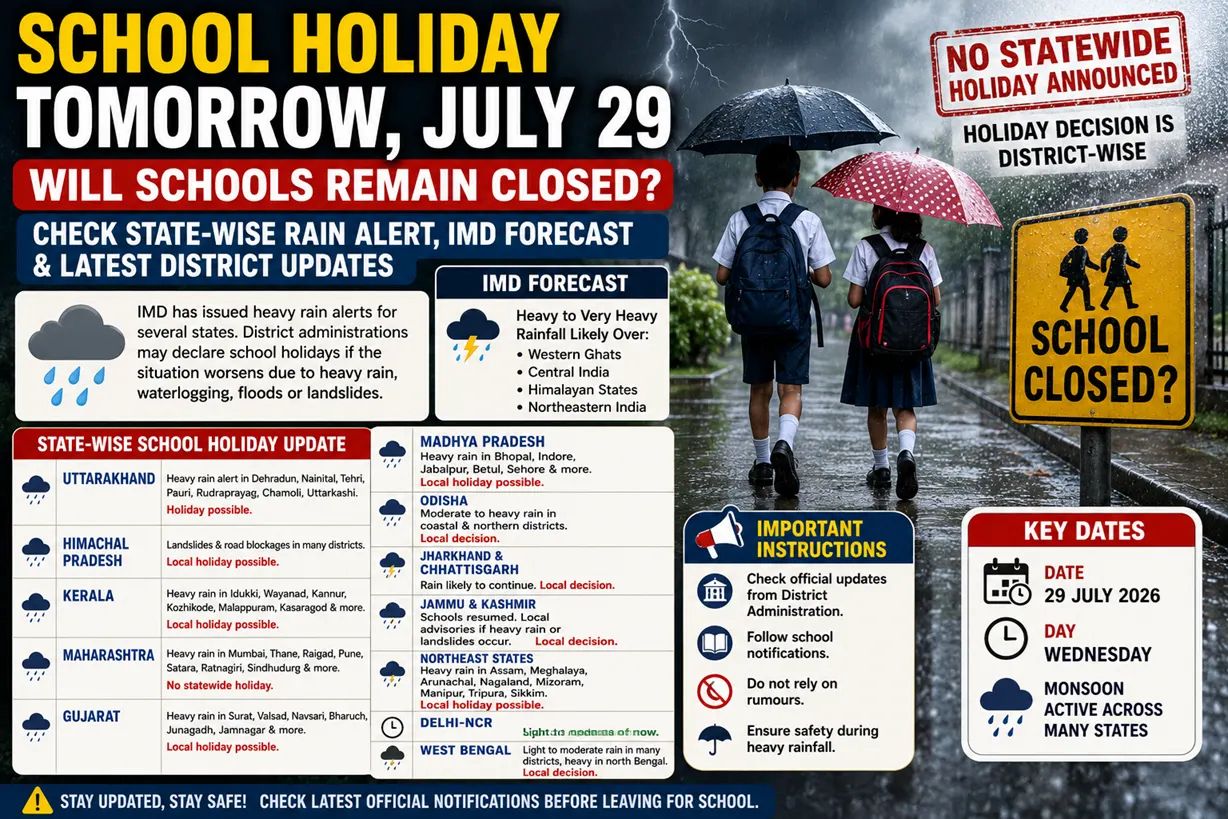
No statewide school holidays have been declared for July 29, 2026, even as the IMD issues heavy rainfall alerts across multiple states due to an active monsoon depression. While schools largely remain open, local district administrations hold the authority to announce localized closures based on immediate weather emergencies.
No statewide closures are announced as the IMD issues heavy rainfall alerts across multiple states for July 29, 2026.
As intense monsoon systems and a deep depression sweep across various parts of the country, students, parents, and school administrators have sought clarity regarding a potential school holiday on Wednesday, July 29, 2026. According to updates from the India Meteorological Department (IMD), heavy to extremely heavy rainfall alerts remain active for several regions, including Delhi, Chhattisgarh, Madhya Pradesh, Odisha, and parts of Maharashtra. Despite the widespread weather warnings, official announcements confirm that no statewide school closures have been mandated for July 29, leaving decisions regarding local holiday declarations strictly up to municipal and district authorities.
Assessing Regional Weather Alerts and Institutional Status
While regular academic schedules largely remain active nationwide, specific districts facing severe meteorological conditions are closely evaluating localized risks.
North and Central India Impact: Regions like Delhi, Haryana, Uttar Pradesh, Chhattisgarh, and Madhya Pradesh are experiencing vigorous monsoon activity, prompting district administrations to monitor waterlogging and transit safety closely.
Targeted Local Closures: Educational institutions in specific pockets—such as 221 schools and colleges along the Simhachalam Giripradakshina route in Visakhapatnam—have been granted localized holidays due to ongoing religious processions and heavy public movement, rather than weather alone.
Protocol for Severe Weather: State disaster management guidelines dictate that local district collectors hold the authority to declare emergency school holidays on a case-by-case basis if continuous downpours threaten student safety or cause severe urban flooding.
Implications for Families, Commuters, and Authorities
The dynamic nature of monsoon forecasting requires parents and school transport operators to stay alert to real-time administrative updates issued by local municipal bodies. While educational institutions in major metropolitan areas are expected to function normally unless localized waterlogging dictates otherwise, educational boards emphasize that student safety remains paramount. Local authorities continue to coordinate with meteorological monitoring cells to ensure swift advisories are distributed if conditions deteriorate rapidly.
Why It Matters
For millions of families and school-going children across affected states, tracking localized weather alerts prevents unnecessary travel risks during severe downpours. Understanding that holiday decisions rest with local district magistrates ensures parents rely on verified official channels rather than unconfirmed social media reports.
Key Facts at a Glance
Date: Wednesday, July 29, 2026.
Statewide Status: No universal or statewide school holiday has been declared.
IMD Alerts: Heavy to extremely heavy rainfall warnings issued for central, eastern, and northern states due to active monsoon currents and an inland deep depression.
Decision Authority: Local district collectors and municipal commissioners retain sole discretion over emergency school closures.
Frequently Asked Questions
Is there a nationwide school holiday on July 29?
No, there is no statewide or nationwide school holiday declared for Wednesday, July 29, 2026; most schools are expected to function normally.
Which states are under heavy rainfall alerts by the IMD?
The IMD has issued heavy to very heavy rainfall warnings for states including Chhattisgarh, Madhya Pradesh, Odisha, Uttarakhand, Himachal Pradesh, Delhi, and parts of Maharashtra.
Who decides whether schools will close due to heavy rain?
Local district administrations and municipal magistrates possess the authority to declare temporary school closures based on ground assessments of flooding, waterlogging, or severe weather emergencies.
Source: India Meteorological Department (IMD), The Economic Times