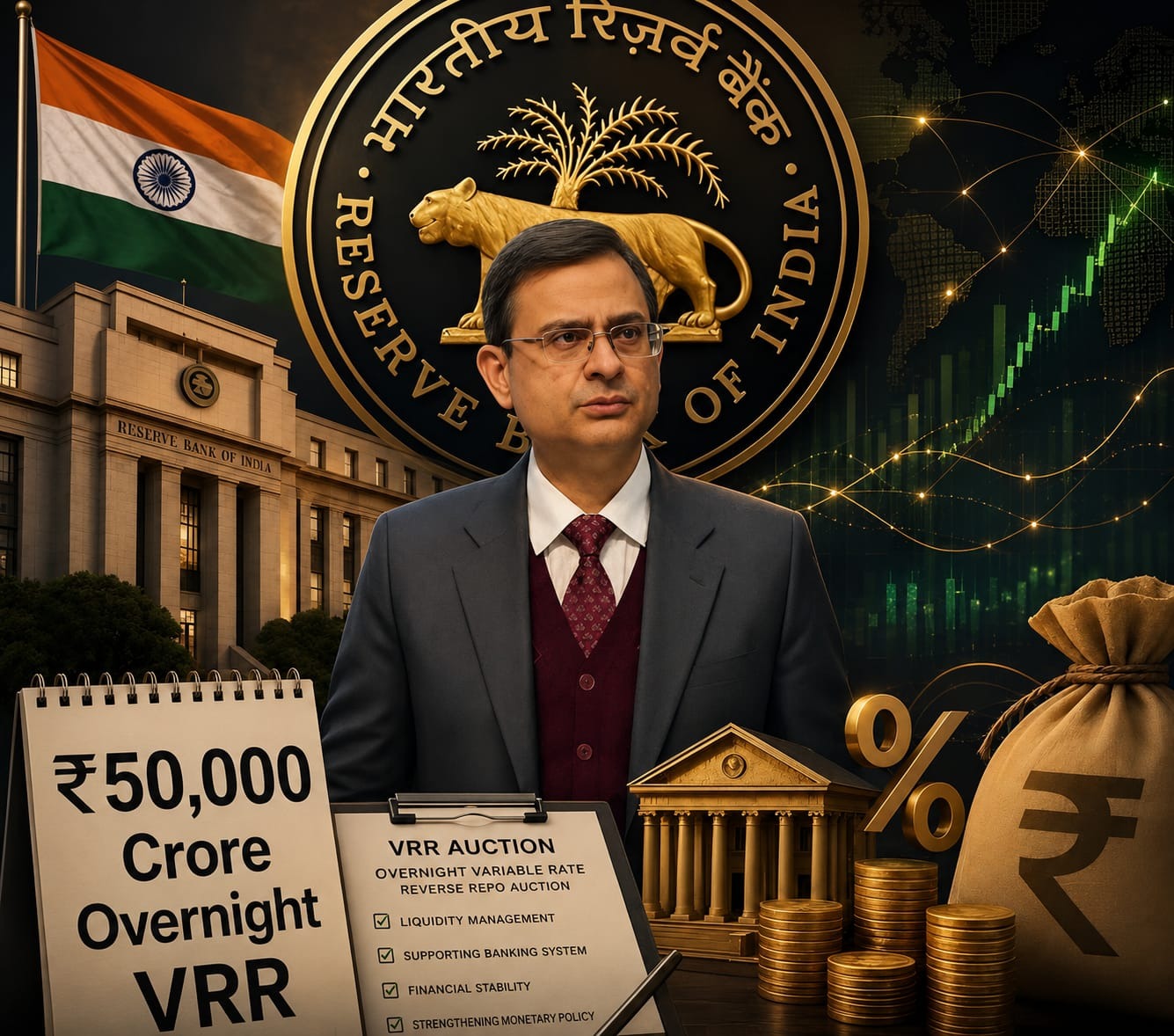
The Reserve Bank of India will conduct an overnight Variable Rate Repo (VRR) auction on July 9, 2026, for ₹500 billion. This operation is part of the central bank's ongoing strategy to fine-tune short-term liquidity in the banking system and keep market rates aligned with the policy repo rate.
The Reserve Bank of India is deploying a strategic liquidity adjustment as it continues to fine-tune short-term money market conditions.
MUMBAI — The Reserve Bank of India (RBI) announced it will conduct an overnight Variable Rate Repo (VRR) auction on July 9, 2026, to manage liquidity dynamics within the Indian banking system. The central bank will offer a notified amount of ₹500 billion to eligible market participants through its Liquidity Adjustment Facility (LAF) framework.
This move marks a continuation of the RBI’s active approach to "liquidity housekeeping." By utilizing VRR auctions, the central bank aims to ensure that the Weighted Average Call Rate (WACR)—the primary operating target of India’s monetary policy—remains closely aligned with the standing repo rate, which has been maintained at 5.25% since the February 2026 Monetary Policy Committee (MPC) review.
Managing Systemic Liquidity
The decision to hold this auction comes amid ongoing monitoring of evolving liquidity conditions. While banking system liquidity has recently shown a comfortable surplus—estimated at approximately ₹1.19 lakh crore as of early July—the RBI frequently employs these discretionary, auction-based tools to address frictional and transient liquidity mismatches.
Unlike fixed-rate repos where the interest rate is pre-set by the central bank, the VRR mechanism allows the interest rate to be discovered through competitive bidding. Banks and primary dealers bid for the funds, allowing the market to signal the immediate cost of short-term capital. This provides the RBI with a flexible "fine-tuning" instrument that supplements its standard liquidity management operations.
Operational Framework and Impact
The funds allocated during the July 9 auction are scheduled for reversal the following business day. For commercial banks, this provides a critical mechanism to bridge temporary funding gaps without necessitating long-term structural changes to their balance sheets.
Market analysts observe that such interventions are not indicative of a change in the overall monetary policy stance. Instead, they serve as a stabilizer for the interbank market, ensuring that credit flow remains consistent and that short-term interest rate volatility is minimized. By keeping the market well-supplied or absorbent depending on daily requirements, the RBI prevents sudden spikes or dips in borrowing costs that could otherwise affect retail and corporate credit pricing.
Official Sources
According to official circulars and statements released by the Reserve Bank of India, the auction is conducted under the established Liquidity Adjustment Facility (LAF) guidelines. The central bank maintains that its liquidity operations are data-driven, based on "current and evolving liquidity conditions" to maintain price stability and ensure efficient financial intermediation.
Why It Matters
For the broader economy, these operations are the "plumbing" of the financial system. While an overnight auction may not directly alter the Equated Monthly Installments (EMIs) for home or personal loans in the immediate term, the cumulative effect of these operations ensures that banks have stable access to funds. This stability allows lenders to maintain consistent interest rates for borrowers, supporting steady credit growth in sectors ranging from MSMEs to consumer retail.
Key Facts at a Glance
Instrument: Overnight Variable Rate Repo (VRR) auction.
Notified Amount: ₹500 billion.
Purpose: Fine-tuning short-term liquidity under the Liquidity Adjustment Facility (LAF).
Mechanism: Interest rates are determined via competitive bidding rather than being fixed by the RBI.
Context: Routine liquidity management following recent fluctuations in banking system surplus.
FAQ
What is a Variable Rate Repo (VRR) auction?
A VRR auction is an instrument that allows the RBI to inject short-term liquidity into the banking system. Unlike a fixed-rate repo, the rate is discovered through competitive bidding by banks.
How does this affect my bank loan?
It does not change your loan interest rate directly. These operations are interbank tools used to stabilize short-term borrowing costs, which helps keep repo-linked loan rates stable for consumers.
Why does the RBI conduct these auctions despite a surplus?
Even in a surplus environment, the RBI uses these auctions to ensure that liquidity is distributed efficiently across the system and that short-term market rates remain anchored to the official policy repo rate.
Is this a change in monetary policy?
No, this is a liquidity management operation. It is distinct from policy rate changes (like increasing or decreasing the repo rate), which are decided by the Monetary Policy Committee to address inflation or growth trends.
Source: Reserve Bank of India (RBI)