A 700-year-old banyan tree in Munger, Bihar, has been identified as the world's oldest scientifically dated specimen of its kind. Using high-precision radiocarbon analysis, researchers from the Birbal Sahni Institute of Palaeosciences proved the tree predates local historical structures, offering a new, standardized method for heritage tree conservation.
A 700-year-old banyan tree in Munger, Bihar, has been confirmed as the oldest accurately dated specimen of its kind using advanced radiocarbon analysis.
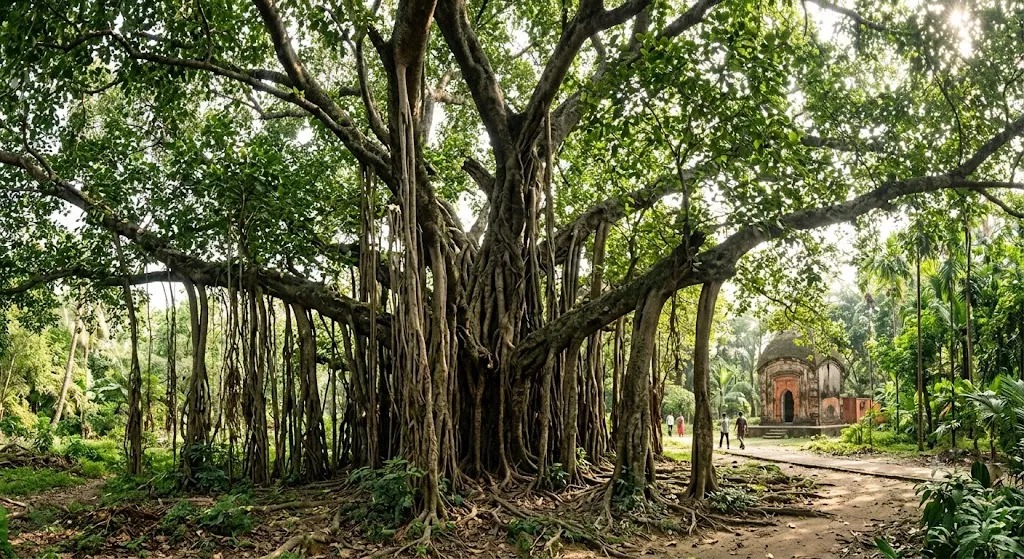
MUNGER, India — Researchers have officially identified a monumental banyan tree (Ficus benghalensis) in the Munger district of Bihar as the world’s oldest accurately dated banyan tree. Standing approximately 60 feet tall and spreading across 100 square meters, the tree has been estimated to be roughly 700 years old, providing a rare, scientifically verified link to India’s distant past.
The discovery, published in the international journal Quaternary Research, marks a significant departure from traditional methods of estimating the age of tropical trees, which have historically relied on folklore, local lore, and unverified historical records.
A Breakthrough in Dendrochronological Science
Determining the age of a banyan tree is notoriously difficult due to the species' complex root system and the absence of distinct annual growth rings found in temperate trees. To overcome this, a research team led by Dr. Trina Bose from the Birbal Sahni Institute of Palaeosciences (BSIP) in Lucknow, an autonomous institute under the Department of Science and Technology (DST), developed an innovative methodology.
Invited by the Bihar Forest Department to investigate the tree, the team—including Dr. Mayank Shekhar and Dr. Akhilesh K. Yadava—extracted alpha-cellulose from wood samples taken near the pith of both a secondary trunk and an ancient primary branch. The pith represents the earliest wood formed during the juvenile stage of the tree’s secondary growth.
These samples were analyzed using high-precision Accelerator Mass Spectrometry (AMS) radiocarbon dating. The results were then calibrated against the latest IntCal20 calibration curve and OxCal software to produce a robust, scientifically validated age estimate.
Rewriting Local History
The scientific findings have fundamentally altered the historical understanding of the site. It was previously assumed that the Munger banyan was planted when the nearby historic "Burra Bunglow" was constructed, a structure dating back to the late Mughal or early British period, approximately 300 to 350 years ago.
However, the radiocarbon analysis establishes that the tree predates the building by several centuries. According to the researchers, the banyan is likely a surviving remnant of a natural forest that once covered the region, meaning the tree actually witnessed the construction of the Burra Bunglow itself.
Impact on Heritage Conservation
The breakthrough provides a standardized protocol for forest departments and conservation agencies to accurately date heritage trees. This methodology is expected to be vital for protecting ecologically and culturally significant flora across South Asia.
"This research represents a major breakthrough in the scientific dating of ancient trees in tropical regions," researchers noted in their report. The ability to verify the age of such "living archives" supports efforts in biodiversity protection, climate research, and the management of historical landscapes.
Key Facts at a Glance
Scientific Milestone: Confirmed as the world's oldest accurately dated banyan tree at approximately 700 years.
Methodology: Age verified through high-precision Accelerator Mass Spectrometry (AMS) radiocarbon dating of alpha-cellulose.
Historical Correction: The tree predates the adjacent 350-year-old "Burra Bunglow," refuting local beliefs that it was planted during the building's construction.
Ecological Significance: The tree stands nearly 60 feet tall with a canopy spread of 100 square meters and survived major events, including the 1934 earthquake.
FAQ
Why was radiocarbon dating necessary for this tree?
Most tropical broadleaf trees, like the banyan, do not form clear annual growth rings, making conventional ring-counting methods ineffective. Radiocarbon dating provides a reliable alternative based on chemical analysis.
Where is the tree located?
The banyan tree is located on the ITC campus in Munger, Bihar.
What are the implications of this discovery?
Beyond verifying the age of one tree, the study provides a new, scientifically validated protocol for conservationists to accurately identify and preserve heritage trees worldwide, moving beyond oral traditions.
Source: Ministry of Science and Technology, Birbal Sahni Institute of Palaeosciences (BSIP), Quaternary Research Journal