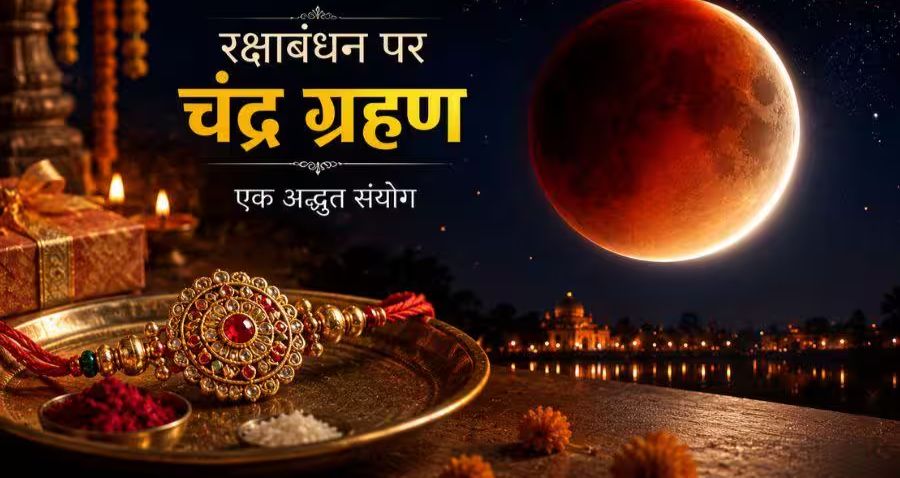
A rare partial lunar eclipse will coincide with Raksha Bandhan on August 28, 2026. Astronomical tracking shows the Chandra Grahan occurs during daytime hours in India, meaning zero visibility locally and no applicable Sutak restrictions. Families across the country can perform traditional Rakhi rituals without disruption.
Backed by official astronomical charts and panchang details, this year's festival of siblings crosses paths with a deep partial lunar eclipse.
Celestial Timing and Daytime Concurrence in India
The upcoming festive calendar brings a rare celestial overlap as a partial Chandra Grahan (lunar eclipse) is scheduled to coincide with Raksha Bandhan on Friday, August 28, 2026. According to calculations from the Hindu Panchang and global astronomical reports, the lunar event will begin during the early morning hours and conclude by afternoon.
However, because the eclipse unfolds entirely during daytime hours in the Indian Standard Time (IST) zone, the Moon will remain entirely below the horizon for observers across the country. Consequently, the astronomical event will not be physically visible anywhere in India, leaving daytime skies completely unaffected for millions celebrating the traditional sibling festival.
Timings, Visibility, and Traditional Rules
Understanding how the eclipse interacts with local religious customs involves examining the precise schedule and traditional parameters outlined by scriptural scholars and astronomical observatories:
Eclipse Contact Timings: Penumbral phases begin at 06:53 AM IST, with the partial eclipse running from 08:03 AM IST to 11:21 AM IST, peaking at 09:43 AM IST, and ending fully at 12:31 PM IST.
Global Visibility: While Indian observers experience normal daylight, the deep partial eclipse—featuring an umbral magnitude exceeding 0.93—will be fully visible across North and South America, alongside partial visibility in parts of Europe and Africa.
Absence of Sutak Restrictions: According to traditional Vedic guidelines, ritual restrictions like Sutak Kaal are only observed when an eclipse is visible in a given region. Because visibility in India is zero, traditional Sutak rules do not apply.
Unaffected Festival Rites: Families can conduct their customary Rakhi tying ceremonies and morning pujas without ritual interruptions.
Why It Matters
The practical implications of this celestial coincidence reassure millions of households planning family gatherings. Because daytime occurrences shield Indian regions from visibility and associated ritual observances, citizens can proceed with travel plans, gift purchases, and traditional sibling ceremonies entirely unhindered by astrological anxiety.
Key Facts at a Glance
Event Date: Friday, August 28, 2026 (Shravan Purnima).
Eclipse Type: Deep partial lunar eclipse (umbral magnitude ~0.93).
Indian Timings: Commences at 06:53 AM IST and concludes at 12:31 PM IST.
India Visibility: Not visible; occurs entirely during daytime hours.
Sutak Status: Not applicable in India due to non-visibility.
FAQ Section
Will the Chandra Grahan be visible in India on August 28, 2026?
No, the lunar eclipse will not be visible in India because it occurs entirely during daytime hours when the Moon is below the horizon.
Does the lunar eclipse affect Raksha Bandhan rituals or timings?
No, rituals remain completely unaffected. Families can celebrate freely as traditional restrictions do not apply when an eclipse is invisible locally.
Is Sutak Kaal applicable during this eclipse for Indian residents?
No, according to Vedic traditions, Sutak is only observed if the eclipse is physically visible in the region. Since visibility is zero, no Sutak is observed.
Where will the partial lunar eclipse be visible globally?
The celestial event will be fully visible across North and South America, with partial visibility extending into parts of Europe, Africa, and West Asia.
Source: Zendar Universe, AstroZindagi, Narayan Seva Sansthan, Economic Times