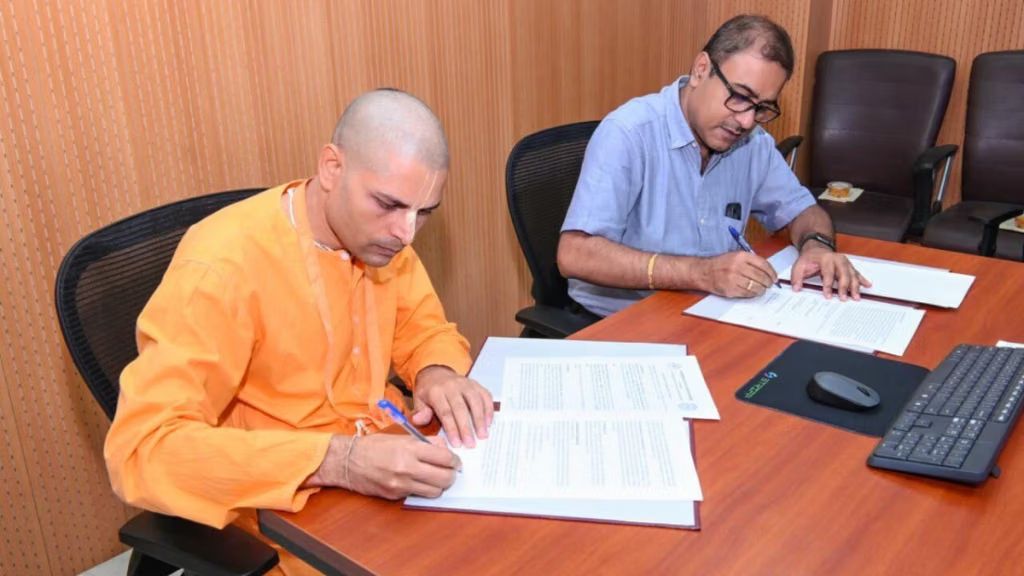
IIT Kanpur faced heavy public backlash after signing a two-year Memorandum of Understanding (MoU) with ISKCON to provide voluntary stress management and value-based education programs for students. According to official statements and media disclosures released on August 31, 2026, the institute subsequently deleted its social media announcement amid intense debate over secularism and scientific temper.
Backed by official institutional disclosures, a wellness partnership between IIT Kanpur and ISKCON has ignited a nationwide debate over campus secularism.
Striking a raw nerve across academic and public spheres, a newly formalized administrative partnership has thrust issues of mental health and institutional identity into the spotlight. According to official announcements and administrative records from Kanpur, the Indian Institute of Technology Kanpur (IIT Kanpur) signed a two-year Memorandum of Understanding (MoU) with the International Society for Krishna Consciousness (ISKCON) to deliver voluntary educational courses focused on stress management, self-esteem, and personal development.
The collaboration, announced via social media channels on August 29, 2026, quickly drew sharp criticism from alumni, students, and observers who questioned the propriety of a premier scientific institution partnering with a religious organization. Amid mounting online friction, IIT Kanpur removed the announcement posts by Monday, August 31, 2026.
Evaluating the Institutional Rationale and Public Backlash
The controversy unfolds against a backdrop of mounting concern over student burnout, academic pressures, and rising mental health crises across India's premier technical institutes. According to official statements and public feedback, key dimensions of the debate include:
The Program Structure: The agreement intended to offer eight-session certified courses covering wellness, emotional self-management, and personal growth on a strictly voluntary basis.
Institutional Defense: Defending the pact, IIT Kanpur Director Professor Manindra Agrawal stated that the initiative was undertaken at the specific request of the student body and emphasized that meditation and stress-relief techniques carry well-documented cognitive benefits.
Criticism of Secular Boundaries: Dissenting alumni and student critics argued that partnering with a faith-based entity compromises the scientific temper and secular character mandated for premier research universities.
Alternative Demands: Critics emphasized that campus mental health pressures should be addressed exclusively through professional psychological counseling, clinical psychiatry, and secular behavioral science.
Why It Matters
The practical implications of the IIT Kanpur-ISKCON controversy reflect the delicate balancing act required when addressing student mental health in hyper-competitive academic environments. For university administrators, navigating student welfare programs while maintaining strict institutional secularism remains a complex challenge. For the broader academic community, the episode underscores deep sensitivities regarding how elite technical institutes deploy external resources to combat student stress and burnout.
Key Facts at a Glance
Institution: Indian Institute of Technology Kanpur (IIT Kanpur).
Partner Organization: International Society for Krishna Consciousness (ISKCON).
Agreement Scope: Two-year MoU for voluntary wellness and stress-management courses.
Controversy Triggers: Public debate over scientific temper versus faith-based student programs.
FAQ Section
What was the purpose of the MoU signed between IIT Kanpur and ISKCON?
The MoU aimed to establish a framework for ISKCON to conduct voluntary educational courses focusing on stress management, self-esteem, and personal development for IIT Kanpur students.
Why did the partnership spark a public controversy?
Critics, including alumni and students, questioned the involvement of a religious organization in a premier scientific institute, raising concerns about maintaining scientific temper and secular boundaries.
What was IIT Kanpur's official response to the backlash?
Director Professor Manindra Agrawal defended the MoU by noting that it originated from student body requests and focused on practical mental wellness and meditation tools.
Did IIT Kanpur retract the partnership following the row?
While the institute deleted its initial announcement posts on X by Monday, August 31, 2026, formal statements emphasized the voluntary nature of the wellness sessions.
Source: ThePrint, The Siasat Daily, Rediff News