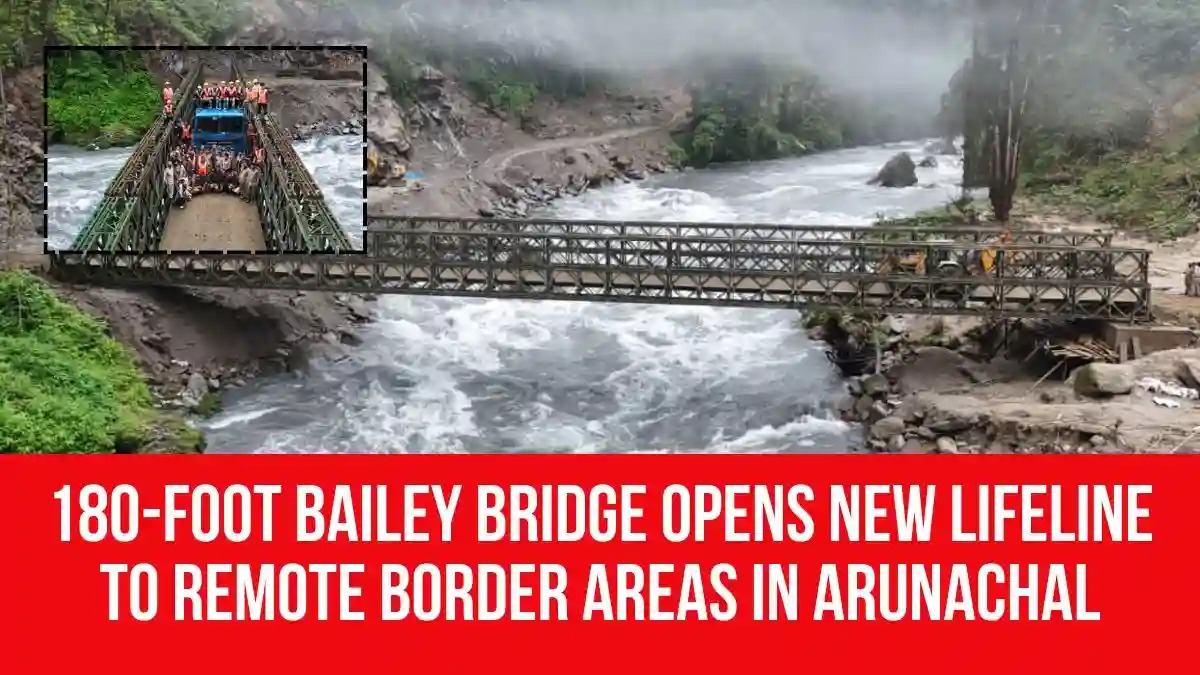
The Border Roads Organisation has completed a 180-foot, triple-double reinforced Bailey bridge in Arunachal Pradesh’s Kurung Kumey district. Built by Project Arunank units amid heavy monsoon rains, the strategic crossing restores all-weather connectivity near the Line of Actual Control, boosting military mobility and linking remote border villages.
ITANAGAR — The Border Roads Organisation (BRO) has successfully completed the construction of a strategically important 180-foot Bailey bridge in the remote Kurung Kumey district of Arunachal Pradesh. The infrastructure development, announced officially by defence representatives on July 2, 2026, restores vital surface communication links to isolated border settlements and crucial forward military outposts along the Line of Actual Control (LAC). Undertaken as part of India's accelerated push toward frontier self-reliance, the modular steel crossing replaces a previously damaged link that had severed logistical corridors, safeguarding both national security parameters and civilian movement ahead of the mid-monsoon peak.
Technical Feat Executed Amid Severe Seasonal Monsoon
The newly operational triple-double reinforced (TDR) Bailey bridge marks a major engineering success for the BRO's regional deployment. Construction teams faced severe, high-risk environmental obstacles, working continuous shifts through dense high-altitude fog, torrential rain, and the persistent threat of localized flash floods and landslips typical of northeastern India's wet season.
The technical execution was spearheaded by Team 85 Road Construction Company (RCC) alongside the 756 Border Roads Task Force (BRTF). Both units operate under the administrative umbrella of Project Arunank—the BRO’s specialized initiative task-managed with creating, expanding, and fortifying high-priority transport infrastructure across Arunachal Pradesh's most rugged and hostile geographic sectors.
Strengthening Defense Mobility and Border Logistics
From an operational standpoint, the 180-foot structure provides a massive lift to the logistics grid of the Indian Armed Forces. The Kurung Kumey sector, which directly borders sensitive northern territories, requires continuous replenishment of materials, heavy equipment, and personnel tracking.
Prior to the completion of this structural link, damaged transport lanes introduced vulnerabilities by slowing down transit speeds. The load capacity and build specification of the TDR Bailey design allow for the unhindered movement of multi-tonne military convoys and tactical vehicles, cutting deployment times significantly and ensuring deep-frontier defensive readiness.
Furthermore, Project Arunank's engineers integrated the bridge smoothly into the existing regional transit loop, which includes the highly vital Hapoli–Sarli–Huri road network, creating a continuous, dependable logistical chain up to forward tactical lines.
Official Sources Section
According to official data and formal project logs released by the Border Roads Organisation and confirmed via the Guwahati-based Defence Public Relations Officer (PRO), the installation utilized prefabricated steel trusses. This engineering framework allows swift on-site modular assembly without demanding extensive deep-foundation machinery, which would be impossible to maneuver under current weather conditions. The project aligns under the central government’s wider border-fortification mandate and the Aatmanirbhar Bharat initiative.
Quote Section
In statements addressing the completion of the forward infrastructure project, military and administrative leaders emphasized the dedication required to secure the site.
According to officials and defence spokespersons:
"Our teams showed unwavering commitment to overcome severe logistical and environmental obstacles. The successful completion of this triple-double reinforced Bailey bridge is crucial to reinforcing national security infrastructure and providing a lifeline to the local populations residing in remote border pockets."
Socio-Economic Impact on Remote Villages
Beyond its defense applications, the bridge directly changes the daily reality for thousands of citizens living in isolated frontier enclaves. During peak monsoon months, entire villages across Kurung Kumey are historically prone to seasonal isolation when flooded streams cut off unpaved roads.
The completion of this permanent all-weather link guarantees:
Emergency Medical Relief: Uninterrupted access for ambulances and medical supply lines to rural health clinics.
Economic Integration: Local farmers gain consistent transit options to move cash crops and livestock to markets down-state.
Essential Commodity Flow: Smooth supply chains for government-subsidized food rations, educational materials, and fuel.
Why It Matters
Developing strategic all-weather infrastructure along the Line of Actual Control prevents territorial isolation and deters external security pressures. By ensuring that high-load transport paths remain functional 365 days a year, the state cements its internal security posture while simultaneously offering sustainable economic equity to vulnerable tribal populations who secure India's farthest borders.
Key Facts at a Glance
The Structure: A 180-foot triple-double reinforced modular Bailey bridge.
The Location: Remote Kurung Kumey district, Arunachal Pradesh, close to the Line of Actual Control.
The Agencies: Constructed by Team 85 RCC and 756 Task Force under Project Arunank.
Strategic Intent: Restores missing transport loops, improves heavy military transit speed, and serves as a socioeconomic lifeline.
FAQ Section
Q: What is a Bailey bridge and why was it chosen for this location?
A: A Bailey bridge is a portable, prefabricated steel truss bridge that can be assembled quickly without heavy machinery. It is highly suited for remote regions like Kurung Kumey where rugged terrain and rapid flash floods prevent traditional concrete pouring.
Q: Where exactly is this bridge located?
A: The bridge spans a critical water crossing within the Kurung Kumey district of Arunachal Pradesh, reinforcing the sensitive Hapoli–Sarli–Huri road corridor leading to India's northern borders.
Q: How does this project benefit local civilians?
A: It provides all-weather connectivity to isolated frontier villages, guaranteeing uninterrupted access to healthcare, education networks, and consumer markets during severe monsoon seasons.
Source: Official project notifications from the Border Roads Organisation (BRO), operational statements from the Guwahati Defence PRO, and regional updates from the Ministry of Defence.