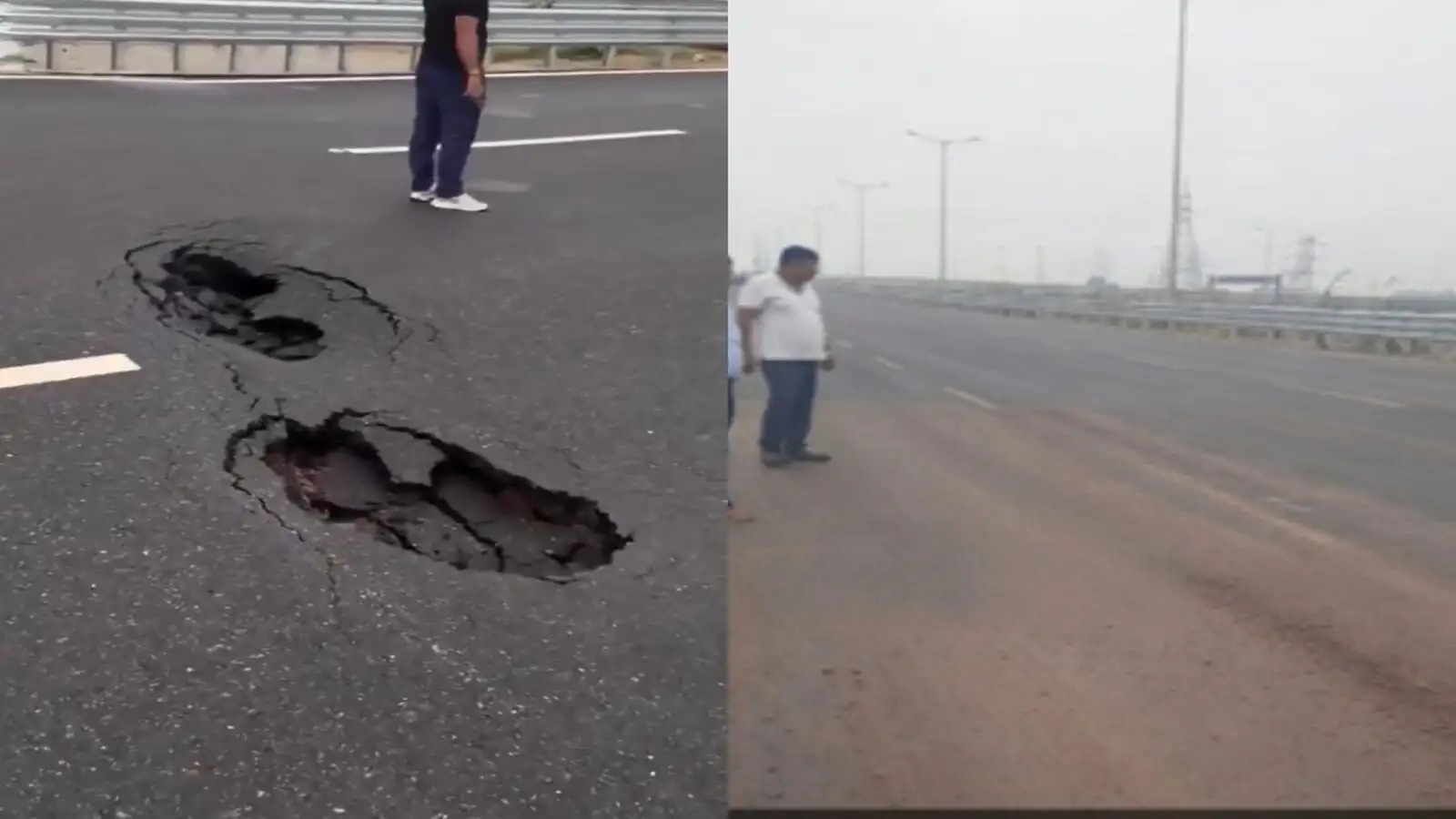
The National Highways Authority of India has suspended two senior officials and issued show-cause notices to a contractor after a section of the newly opened Delhi-Dehradun Expressway caved in near Shamli. Heavy monsoon rains combined with local drainage blocks caused the subsidence, prompting immediate engineering fixes and accountability probes.
NEW DELHI — The National Highways Authority of India (NHAI) has suspended senior project officials following a major road surface cave-in on the newly inaugurated Delhi-Dehradun Expressway. The disciplinary action, announced in an official ministry statement, comes after videos showing massive depressions on the transit route went viral on social media platforms, triggering widespread public criticism regarding infrastructure quality control. The structural failure, which occurred at kilometer marker 55+480 near Shamli district in Uttar Pradesh, has been attributed to heavy monsoon rains and localized drainage bottlenecks. NHAI has moved to fix administrative accountability while launching immediate repairs to restore traffic flow.
Disciplinary Action Taken Against Engineering and Contractor Teams
Following a preliminary assessment of the road subsidence, NHAI management executed a series of targeted suspensions and show-cause notices. The authority announced the immediate suspension of Kuldeep Razdan, the team leader of the independent authority engineer, alongside Nagendra Pal Singh, the project manager representing the Engineering, Procurement, and Construction (EPC) contractor.
To broaden the accountability net, formal show-cause notices were served to the regional project director, the general authority engineer, and the primary contractor company, Chaitanya Projects Consultancy. The contractor must respond within three days to explain why the firm should not be classified as a non-performer and officially debarred from participating in future federal highway bidding processes.
Drainage Constraints and Local Disputes Exposed
According to an official technical clarification published by the Ministry of Road Transport and Highways, the cave-in was primarily triggered by severe water stagnation during the region's first heavy overnight monsoon showers. Investigators discovered that rainwater runoff could not escape the highway deck because a critical, pre-designed balancing culvert at the Shamli stretch remained non-operational.
NHAI reported that the cross-drainage infrastructure could not be commissioned or integrated smoothly due to persistent, ongoing resistance from local village residents. Rather than allowing the culvert to serve its intended hydrological drainage purpose, local communities had reportedly blocked its channels to use the opening as an unauthorized vehicular underpass crossing. Furthermore, permanent slope protection and chute drain construction works at the site have faced extended delays due to an unresolved land-related arbitration dispute with local landowners.
Technical Remediation Measures Implemented
To counter the drainage failure and prevent subsequent asphalt erosion, NHAI engineering teams launched rapid remedial works over the weekend:
Carriageway Restoration: The damaged portion of the road surface was filled, reinforced, and resurfaced within 24 hours, allowing normal traffic movement to resume.
Interim Drainage Grid: Construction has commenced on a 1.5-kilometer temporary parallel drain designed to safely divert standing rainwater away from the structural base layers.
Gradient Redesign: Engineers are re-profiling the localized drainage gradient to guide runoff directly toward a verified exit point located at kilometer marker 56+500.
Official Sources Section
Administrative updates and data points regarding the structural failures on the Delhi-Dehradun Economic Corridor are cited directly from public statements issued by the National Highways Authority of India (NHAI) and official press notifications disseminated through the Press Information Bureau (PIB) Delhi.
Quote Section
The central government has maintained a firm stance regarding compliance with civil engineering and road safety mandates.
According to officials and formal releases issued by the Ministry of Road Transport and Highways:
"NHAI regrets the inconvenience caused to National Highway commuters due to the road surface cave-in at a location on the Delhi-Dehradun Economic Corridor following rainfall. Taking serious cognizance of the incident, show-cause notices have been issued to the concerned project director, authority engineer, and EPC contractor, while key team leaders have been suspended."
Narendra Singh, the NHAI project director managing the operational section, commented on the rapid field response:
"Action has been taken regarding the road subsidence on the Delhi-Dehradun Expressway and further action will be taken soon. The section has been restored and opened for regular traffic movement."
Why It Matters
The rapid structural wear on a critical logistics corridor highlights systemic vulnerabilities in immediate post-inauguration monsoon preparedness. For logistics companies, commercial transport operators, and daily commuters traveling between Delhi, Uttar Pradesh, and Uttarakhand, maintaining the structural integrity of this expressway is vital. Swift intervention by regulatory authorities safeguards major public funding investments and reinforces strict execution standards for private infrastructure development firms nationwide.
Key Facts at a Glance
Project Scope: The 213-kilometer, six-lane access-controlled Delhi-Dehradun Expressway was built at an estimated cost of over ₹12,000 crore and opened on April 14, 2026.
The Incident: Intense monsoon rainfall caused a localized road surface cave-in at kilometer marker 55+480 near Shamli.
Suspensions: The independent authority engineer's team leader and the contractor's project manager have been suspended for structural oversight failures.
The Root Cause: Waterlogging induced by blocked cross-drainage culverts, mixed with incomplete slope protection due to local land disputes.
Current Status: The damaged asphalt has been repaired, traffic is flowing normally, and a temporary 1.5-km parallel drain is being built.
FAQ Section
Q: Has the traffic route between Delhi and Dehradun been closed due to the cave-in?
A: No. NHAI emergency response teams isolated the damaged section immediately on July 1, completed structural repairs, and reopened all six lanes for regular traffic movement.
Q: Why did the drainage system fail to clear the rainwater?
A: The permanent balancing culvert could not be integrated into the active highway system because local residents persistently blocked the opening to use it as an informal vehicle crossing point.
Q: What steps are being taken to prevent future road cave-ins on this highway?
A: NHAI is constructing a temporary 1.5-kilometer parallel drain to safely channel rainwater away from the expressway structure until ongoing land arbitration disputes are resolved and permanent slope defenses are finished.
Source: Official statements, technical briefs, and disciplinary logs provided by the National Highways Authority of India (NHAI), public notifications from the Ministry of Road Transport and Highways, and press statements hosted on the Press Information Bureau (PIB) India platform.