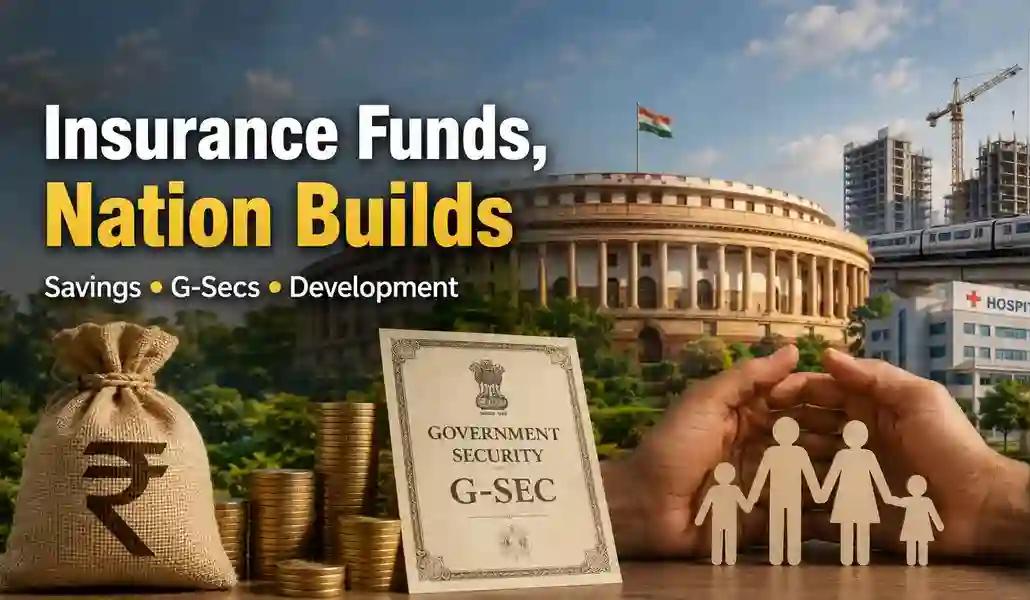
India’s life insurance sector acts as the primary domestic financier of government borrowing. By investing policyholder premiums into long-term sovereign securities, companies like LIC provide stable, counter-cyclical capital for infrastructure and welfare, playing a critical, systemic role in maintaining India’s fiscal stability and economic development.
India's life insurance sector, led by LIC, has quietly become the most stable institutional financier of the nation’s sovereign debt.
NEW DELHI — While global attention often focuses on foreign institutional investors and domestic equity markets, a massive, structural force has been anchoring India’s fiscal stability from behind the scenes. Life insurance companies in India, which manage household savings through long-term policies, have emerged as the single largest institutional holders of Indian government debt, effectively serving as the primary financiers of public infrastructure and welfare expenditure.
Data from the Reserve Bank of India (RBI) and the Insurance Regulatory and Development Authority of India (IRDAI) reveals that life insurers collectively hold nearly one-quarter of all outstanding Central Government dated securities. This stable, long-duration funding source has allowed the government to finance roads, railways, and social welfare programs without constant reliance on volatile international capital flows.
A Structural Engine for Fiscal Stability
The role of life insurers in funding government expenditure is not a discretionary policy choice but a structural necessity rooted in the nature of their business. Because life insurance policies carry tenures of 20 to 40 years, insurers require asset classes that match these long-term liabilities.
"Government securities are the only asset class that absorbs funds of this scale at matching tenures without distorting the market," notes industry analysis. By channeling the premiums of millions of policyholders into sovereign bonds, insurers perform a "counter-cyclical" function. Unlike foreign portfolio investors who may exit markets during geopolitical shocks or rising oil prices, life insurance companies—led by the Life Insurance Corporation of India (LIC)—consistently buy and hold these securities, significantly reducing the government’s "rollover risk" when sovereign debt matures.
LIC: The Systemic Sovereign Financier
The Life Insurance Corporation of India (LIC) remains the cornerstone of this arrangement. As of March 2025, LIC’s regulatory filings confirm it holds approximately ₹20.2 lakh crore in central government securities alone. With total government and government-guaranteed holdings exceeding ₹32.3 lakh crore, LIC stands as the single largest institutional investor in India’s debt.
Recognizing this critical role, the IRDAI annually designates LIC as a Domestic Systemically Important Insurer (D-SII). This status acknowledges that LIC’s role in the financial ecosystem is comparable to that of a systemically important bank; its ability to provide "patient capital" ensures that the government can borrow at manageable costs, even during periods of global economic uncertainty.
Impact on the Indian Economy
For the average citizen, this mechanism means that life insurance policies do more than provide family protection—they act as a bridge between personal financial security and national development.
Infrastructure Financing: Premiums are deployed into long-term capital projects like highways and power grids.
Reduced Borrowing Costs: Stable demand for government bonds from insurers lowers the overall interest burden on the exchequer.
Financial Market Stability: By acting as "anchor investors" in sovereign debt, insurers insulate the economy from the volatility typical of shorter-term speculative capital.
Why It Matters
This sovereign-financing function has rarely been a subject of public policy discourse, which traditionally frames insurance regulation almost exclusively around consumer protection. However, regulatory interventions that compress new insurance business—such as those seen between 2023 and 2024—can inadvertently divert household savings away from this stable funding base. Understanding this relationship is vital for policymakers, as the cumulative "fiscal-stability cost" of insurance sector regulation is a major variable in India's long-term macro-financial health.
Key Facts at a Glance
Sovereign Debt Share: Life insurers hold nearly 25% of all outstanding Central Government dated securities.
LIC’s Dominance: LIC alone holds approximately 19% of all central government debt.
Patient Capital: Insurers provide long-duration funding (10–40 years), which is essential for massive infrastructure projects.
Counter-Cyclical Role: Insurers continue buying government securities regardless of market volatility, providing stability to the borrowing program.
FAQ
How do life insurance premiums fund government projects?
Insurers invest the premiums paid by policyholders into Government Securities (G-Secs) to ensure safe, predictable, long-term returns that match their future payout liabilities.
Are these investments safe for policyholders?
Yes. Government securities are "gilt-edged" instruments, meaning they carry a sovereign guarantee and practically zero risk of default, making them the safest assets for holding policyholder money.
Does this funding affect the government's cost of borrowing?
Yes, by providing a steady, reliable base of demand for government debt, life insurers help moderate the government's overall cost of borrowing, which indirectly benefits the taxpayer.
Source: Civilsdaily, KPIAS Academy, LIC India