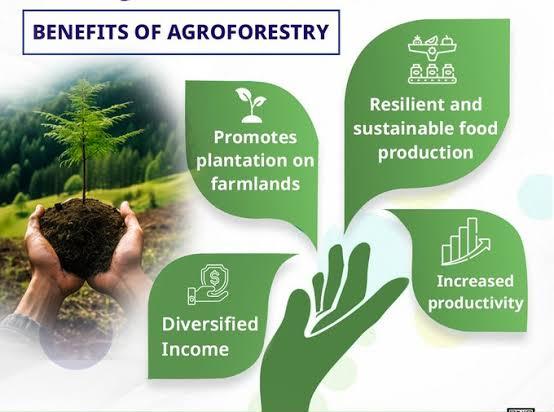
India's agroforestry sector — spanning nearly 28 million hectares — stands at a rare crossroads where carbon sequestration goals and smallholder income growth converge, offering a practical, nature-based solution to two of the country's most pressing challenges. This newsletter explores why planting trees alongside crops is no longer just farming wisdom — it's national climate strategy.
The Big Picture
India has set an ambitious target to expand agroforestry from its current 28 million hectares to 50 million hectares by 2050. With tree-based systems already accounting for nearly 20% of India's national carbon stocks, the push is gaining both scientific and policy momentum. Yet, a critical funding gap persists — less than 5% of agricultural credit currently supports agroforestry.
What Is Agroforestry, Really
Agroforestry is the deliberate integration of trees with crops or livestock on the same piece of land. It is not a new concept in India — the National Agroforestry Policy (NAP) of 2014 was the first of its kind globally to promote tree-based farming at a national scale. What is new is the urgency: India now needs agroforestry to deliver measurable climate outcomes while simultaneously lifting incomes for its 86% marginal farmers.
The Carbon Equation
A nine-year ICAR field study in Odisha's Eastern Ghats found that one-acre agroforestry farms can sequester up to 154.5 Mg CO₂e over nine years — a striking figure for a small landholding. At a national scale, agroforestry in India has the potential to sequester approximately 68 million tonnes of CO₂ annually. Pilot interventions across six districts of the Indo-Gangetic Plains demonstrated a 25–35% increase in soil organic carbon over just three years, adding 2.1–2.8 tCO₂e per hectare per year.
Trees That Pay: The Income Story
Beyond climate value, agroforestry directly boosts farm earnings. Farmers in ICAR's Odisha study earned ₹1.1–1.13 lakh annually while maintaining regular crop yields. At a carbon credit price of $20 per Mg CO₂, potential credits could reach ₹2.56 lakh per acre over nine years. Cashew and mango emerged as the top dual-benefit species — combining high carbon biomass with strong market returns.
Green Gains Highlights
- India can avoid tens of millions of tonnes of GHG emissions annually through expanded agroforestry
- Agroforestry reduces soil erosion by up to 50% and increases soil carbon by 21%
- Tree roots reduce dependency on chemical fertilisers by 20–30%
- Carbon credits from agroforestry farms could transform marginal land into verified climate assets
- Tamil Nadu's agroforestry areas recorded a 25% increase in bird species richness, signalling biodiversity co-benefits
- India currently imports over $7 billion worth of wood annually — a gap domestic agroforestry is well-positioned to close
The Roadblock Reality
Despite robust scientific evidence, agroforestry's scale-up faces real structural barriers including weak institutional credit flow, complex tree harvesting regulations, and the misalignment of carbon markets with smallholder realities. According to CIFOR-ICRAF's India Country Director Manoj Dabas, the next phase of growth will require aligning carbon markets, digital traceability, and private-sector procurement with farmer realities. Voluntary carbon market platforms also lack standards suited to India's fragmented landholding patterns.
The Path Forward
India's roadmap calls for simplifying transit regulations on timber, improving access to institutional credit for long-gestation tree systems, and scaling benefit-sharing models that have already shown success in Uttarakhand. Researchers propose transforming farmer-managed agroforestry plots into structured corporate carbon sinks — effectively letting multinationals offset their Scope 3 emissions while boosting smallholder incomes. It is a rare win-win that India's climate and agriculture agendas cannot afford to ignore.
Sources: ICAR, PMFIAS, Down To Earth, NextIAS, Indian Journals, RSIS International, Agri-Conferences 2026, CIFOR-ICRAF, CEEW