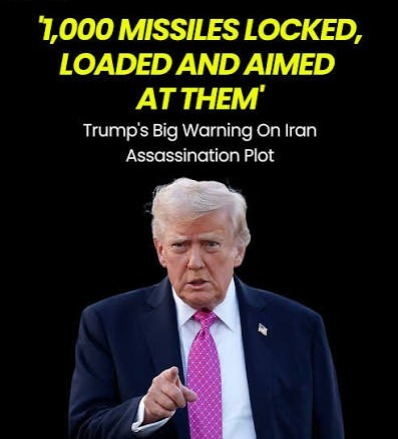
U.S. President Donald Trump has warned that 1,000 missiles are aimed at Iran, promising immediate military retaliation if Tehran targets the American presidency. The statement follows the collapse of a recent ceasefire, recent commercial shipping conflicts in the Strait of Hormuz, and threats made during Ayatollah Khamenei’s funeral.
WASHINGTON — U.S. President Donald Trump announced on Saturday, July 11, 2026, that the United States military has positioned 1,000 missiles aimed at Iran, issuing an ultimatum that any attempt by Tehran to target him or the American presidency will trigger an immediate, devastating military response. The declaration follows a dramatic breakdown of the June 17 ceasefire between Washington and Tehran, fueled by recent naval skirmishes in the strategic Strait of Hormuz and open calls for retaliation during the funeral of Iran’s late Supreme Leader Ayatollah Ali Khamenei. This development sharply elevates regional conflict risks, threatening global energy corridors and prompting immediate security warnings for international commerce and maritime transit.
Escalating Rhetoric Follows Khamenei Funeral
The sudden escalation stems from events surrounding the funeral procession of former Iranian Supreme Leader Ayatollah Ali Khamenei earlier this week. According to state intelligence reports, public displays during the mourning ceremonies in Mashhad openly called for lethal action against U.S. leadership, including President Trump, Vice President JD Vance, and Defense Secretary Pete Hegseth.
In a public statement released on his Truth Social platform, President Trump detailed that the U.S. armed forces have been placed on heightened operational readiness. He asserted that the pre-targeted array of 1,000 missiles aimed at Iran represents an immediate deterrent force, with thousands more prepared to follow if operational thresholds are crossed.
The presidential warning coincides with reports that Israel recently shared refreshed tactical intelligence with the White House, alleging that elements within the Islamic Revolutionary Guard Corps (IRGC) have developed active operational frameworks targeting U.S. officials. The administration noted that these threats extend from long-standing grievances dating back to the 2020 U.S. strike that killed Iranian General Qasem Soleimani.
Collapse of the June Ceasefire and Shipping Disruptions
The current standoff marks the formal end of the brief diplomatic reprieve established by the June 17 bilateral memorandum of understanding. Tensions flared early this week when the U.S. military conducted targeted airstrikes against coastal radar installations, drone storage facilities, and logistics nodes controlled by the IRGC. The American strikes were initiated after three commercial oil tankers transiting the Strait of Hormuz were disrupted by sea mines and fast-attack watercraft.
While Tehran privately communicated to intermediary diplomats that the shipping disruptions were an unauthorized action by an errant domestic faction, Washington has demanded a public guarantee regarding the safety of international transit. The White House subsequently gave Tehran an ultimatum to declare the waterway open and halt all maritime operations against commercial vessels.
Iran’s Ministry of Foreign Affairs has resisted these terms. Iranian Foreign Minister Abbas Araghchi publicly counter-accused Washington of violating the terms of the June memorandum, specifically alleging that the deployment of supplementary U.S. naval forces to regional waters breached existing security protocols.
Broader Economic and Sanctions Impact
As the military standoff intensifies, the U.S. government is concurrently expanding its economic pressure campaign. The U.S. Department of the Treasury announced fresh financial sanctions targeting the inner circle of Iran’s newly appointed Supreme Leader, Ayatollah Mojtaba Khamenei.
The new regulatory measures isolate 14 key individuals and affiliated banking entities from the global financial system, focusing primarily on institutional asset managers who facilitate foreign currency conversions for the regime. Treasury officials stated that these actions aim to constrain the funding mechanisms supporting the IRGC's regional operations.
The heightened threat of kinetic conflict has immediately impacted global energy markets, causing a minor spike in crude oil futures due to fears of protracted closures along the Strait of Hormuz. Maritime transport firms have begun altering navigation routes, increasing logistics insurance premiums for vessels operating throughout the Persian Gulf.
Official Sources Section
According to formal press releases from the [suspicious link removed] and official diplomatic cables published by the Ministry of Foreign Affairs of the Islamic Republic of Iran, both nations remain engaged via third-party diplomatic intermediaries, despite the collapse of the formal truce. Envoys from Qatar and Pakistan are reportedly conducting technical discussions in Muscat and Islamabad to explore de-escalation pathways.
Quote Section
The administration has made it clear that military protocols are established for an extended duration.
"Orders have already been given, and the U.S. Military is ready, willing, and able, for a one-year period of time, subject to extension, to completely decimate and destroy all areas of Iran," President Trump stated in his official publication.
Conversely, Iranian parliamentary speaker Mohammad Baqer Qalibaf warned on state television that Tehran is fully mobilized. According to officials in Tehran, the country is prepared for an "all-out defense" should its sovereign borders or maritime authorities be compromised by external forces.
Why It Matters
The deployment of 1,000 missiles aimed at Iran indicates a shift from proxy skirmishes to direct state-level deterrence. For international commercial entities, the volatility threatens approximately 20% of the world’s daily petroleum supply passing through the region. For domestic citizens, the collapse of the ceasefire heightens defensive postures at regional military facilities, altering travel security advisories across the Middle East.
Key Facts at a Glance
Military Status: 1,000 U.S. missiles are targeted at Iranian locations under standing executive orders.
Diplomatic Standstill: The June 17 ceasefire is declared void following naval conflicts and drone skirmishes.
Intelligence Warning: Renewed threats emerged following public displays at the funeral of Ayatollah Ali Khamenei.
Economic Action: The U.S. Treasury has instituted sweeping sanctions against the network of the new Supreme Leader.
Mediation Efforts: Diplomatic channels via Qatar and Pakistan remain active to avert an open regional war.
FAQ Section
Q1: Why did the ceasefire between the U.S. and Iran collapse?
A1: The truce ended after commercial oil tankers were attacked in the Strait of Hormuz, prompting U.S. retaliatory airstrikes on Iranian coastal infrastructure and subsequent tit-for-tat missile exchanges.
Q2: What prompted the specific threat regarding the 1,000 missiles aimed at Iran?
A2: The warning was issued in response to explicit calls for the assassination of top U.S. officials during the funeral of late Supreme Leader Ayatollah Ali Khamenei, combined with recent intelligence detailing potential threats.
Q3: Is the Strait of Hormuz currently closed to commercial shipping?
A3: The waterway remains physically open, but the U.S. has demanded public guarantees of safe passage from Tehran, while maritime insurers have raised premium rates due to the risk of sea mines.
Q4: Who is the current Supreme Leader of Iran managing this crisis?
A4: Following the passing of Ayatollah Ali Khamenei, leadership has transitioned to his son, Ayatollah Mojtaba Khamenei, whose financial networks are the target of new U.S. sanctions.
Source: U.S. Department of the Treasury Financial Sanctions Registry, Ministry of Foreign Affairs of the Islamic Republic of Iran Diplomatic Archive