In the monsoon-laced heart of Kolkata, a silent revolution is at last yielding visible change. For more than 150 years, the city’s British-built underground sewerage network — a marvel of 19th-century civil engineering rivaled only by London and Hamburg — had buckled under relen...
In the monsoon-laced heart of Kolkata, a silent revolution is at last yielding visible change. For more than 150 years, the city’s British-built underground sewerage network — a marvel of 19th-century civil engineering rivaled only by London and Hamburg — had buckled under relentless pressure from population, pollution, and climate upheaval. In recent years, however, a sustained, multi-crore rejuvenation effort has transformed Kolkata’s flood fortunes, giving some of its oldest neighborhoods the protection they had never before known in living memory.
Drowning to Draining: The Turning Point
Until just a few years ago, tales of perennial waterlogging dominated Kolkata’s monsoon narrative. As recently as the early 2010s, a moderate shower — even just 15-20mm — would swamp lanes, submerge streets, and force residents to wade waist-deep on their commutes. “Muktaram Babu Street, Manicktala, Thanthania, MG Road, and Chittaranjan Avenue were flooded even after a light rain,” recalls Amalendu Biswas, a retired government employee. Boats in Alipore’s Bodyguard Lines, ferrying police through flooded barracks, made the front pages yearly.
But July 2025 told a strikingly new story. Kolkata saw its second-highest rainfall for the month since 2010 — 669mm, nearly double the monthly average — yet waterlogging was scarce, ankle-deep at worst, and quickly receded even after intense, short-duration downpours. “Now, we don’t panic even in heavy rain,” says Sayantani Basu, a longtime Alipore resident.
Engineering Feat: Restoration Without Replacement
What changed? Experts and engineers point to a revolutionary restoration project, rooted in technology as much as targeted pragmatism.
The original system, designed by British engineer William Clark between 1860 and 1875, was the third of its kind globally — and the oldest still functioning such network in India.
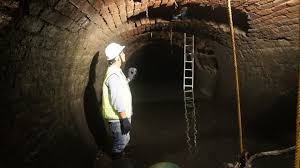
By the late 20th century, decades of neglect and relentless siltation had reduced its hydraulic capacity dramatically. In some stretches, up to 90 percent of tunnels were all but blocked; the iconic brickwork was dangerously weak, sometimes on the verge of collapse.
Laying entirely new pipes was deemed impossible for two reasons: the enormous cost (thousands of crores) and Kolkata’s urban density, now over 24,000 people per square kilometer. With only 7 percent of road space, digging up the city was a non-starter.
The Rejuvenation Process: Silt Out, Technology In
Kolkata’s solution was laborious but brilliant: clean, reinforce, and rejuvenate.
Step 1: Mega-Scale Desilting
Massive mechanized desilting operations began in earnest after 2007-08 and were drastically scaled up over the last decade.
KMC (Kolkata Municipal Corporation) deployed a new fleet of advanced machines: the number of gully-pit emptiers soared from 15 to 40, jet-cum-suction machines from 7 to 63, and blow-vac machines from just 1 to 8 by 2025.
In the last decade alone, over 1.77 million metric tonnes (MT) of silt were hauled out — 36,500MT in 2014-15, spiking to 228,600MT in 2024-25. In some places, the silt was so hardened it had to be jackhammered by hand teams working in dangerous conditions.
Step 2: Trenchless, Targeted Repair
Damaged brick tunnels were dried, repaired, and relined with glass-reinforced polymer (GRP), a material smoother and more durable than brick. The classic “egg-shaped” profile — essential for optimal flow in dry and wet seasons — was meticulously restored.
Reinforced stretches now see stormwater evacuating twice as quickly as before. “The mechanisation helped in faster and more efficient desilting,” notes KMC engineer Shantanu Kumar Ghosh.
Over ₹5,000 crore has been invested in the last ten years from local, state, central, and Asian Development Bank sources, focusing particularly on the most flood-prone zones.
Step 3: Upgrading Pumping & Expanding Capacity
The number and power of citywide stormwater pumping stations were doubled. In August 2024, after a three-hour, 120mm deluge, water in most zones receded in less than six hours, thanks to this overhaul.
Impact: From Panic to Prepared
The results have been transformative:
-
Waterlogging, even in historic hotspot neighborhoods, is now limited and quickly resolved.
-
Kolkatans — young and old — who once feared every forecast, now view the monsoon with new confidence.
-
The ecological benefits are immense: less untreated runoff contaminates the Hooghly, and renewed attention is now turning towards holistic, sustainable river and canal restoration.
Looking Ahead
While the city’s core now enjoys vastly improved resilience, experts warn that ongoing vigilance, regular maintenance, and continued investment are vital. As Kolkata’s population grows and climate risks mount, sustaining the 150-year-old marvel will take both community commitment and technological innovation.
Quotes
“Unclogging the sewers and reinforcing them with GRP gave the sewers a fresh lease of life.”
— Prof. Pankaj Kumar Roy, Jadavpur University, School of Water Resource Engineering
“With heavy investment and new technology, Kolkata has set a benchmark for other urban centers prone to flooding.”
— Infrastructure Specialist, Asian Development Bank
As Kolkata’s remarkable transition shows, restoring the past can sometimes best protect our future.
Relevant Sources: Hindustan Times, Institution of Civil Engineers, Times of India, Earth5R, Economic Times, Asian Development Bank:, Columbia GSAPP, Serval