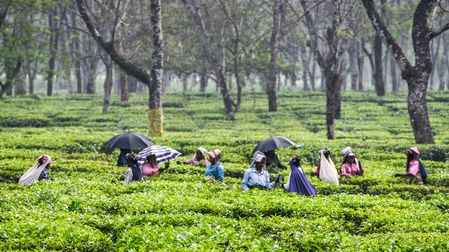
More than 80 tea processing factories in Nepal have shut down following strict quality-testing rules enforced by the Tea Board of India. The mandatory, vehicle-by-vehicle laboratory testing has stranded over one million kilograms of tea at the border, halting regional supply chains and threatening the livelihoods of 3,000 farming families.
KATHMANDU, Nepal — In a major escalation of cross-border trade friction, more than 80 tea processing factories across eastern Nepal have shut down operations. The industry-wide shutdown follows India's implementation of stringent, mandatory quality-testing rules, which local producers say have effectively frozen exports and choked the region's supply chain.
Stiff Inspection Rules Strain Himalayan Tea Trade
The mass closure represents a near-total halt of processing capacity in Nepal’s primary tea-growing regions, hitting during the high-value "first flush" harvest season. Industry representatives report that local warehouses have hit maximum storage capacity because finished tea cannot be moved across the border.
The dispute stems from a Standard Operating Procedure (SOP) enacted by the Tea Board of India on May 1, 2026. The mandate requires comprehensive laboratory testing for every individual vehicle carrying imported tea. While the testing rules were briefly eased in mid-May, Nepali exporters state that strict laboratory enforcement resumed in early June, prompting Indian buyers to suspend all procurement due to commercial risks.
Under the previous trade arrangement, testing a single truckload from a batch sufficed as clearance for up to ten vehicles from the same lot. The updated SOP treats every truck as an independent consignment, requiring separate sampling, documentation submitted via the Indian Tea Council portal, and a testing fee of ₹11,120 (plus GST) per sample.
Supply Chain Paralysis Hits Border Warehouses
According to local industry groups, the shift from selective to blanket testing has created severe administrative backlogs. Samples collected at Indian customs points, such as Kakarvitta, are routed to the central food laboratory in Kolkata. Due to high testing volumes, results take 15 to 20 days to be issued.
"We have been forced to close down our units because processed tea is simply piling up," said Gopal Kattel, General Secretary of the Suryodaya Orthodox Tea Producers Association, in an official statement. "More than 200,000 kilograms of Nepali tea are currently stranded in warehouses in India awaiting laboratory clearance, while another 900,000 kilograms are piled up in our domestic factories."
The operational freeze began on Monday, June 15, 2026, when 56 orthodox tea processing factories in the Ilam district suspended leaf procurement and manufacturing. Representatives from the Nepal Tea Planters Association confirmed that 30 additional Crush, Tear, and Curl (CTC) factories in the low-lying Jhapa district will halt operations by mid-week, bringing the total number of closed facilities to 86.
Impact on Farmers and Regional Trade
The halt in factory operations has triggered an immediate crisis for rural communities in the eastern Himalayan foothills. More than 3,000 farming families in Ilam who rely on selling green tea leaves to commercial processors have lost their primary source of income during peak harvest.
The financial risk is compounded by the strict terms of India's import policy. If a consignment fails to meet chemical or pesticide residue standards upon lab inspection, it faces mandatory destruction or confiscation by Indian customs, rather than being returned to Nepal. This policy has deterred Indian importers from placing new orders.
Officials from the National Tea and Coffee Development Board of Nepal emphasized that India is the irreplaceable lifeline for the sector. Statistics from the state board show that India buys 90 percent of Nepal's premium orthodox tea and 60 percent of its CTC tea, generating roughly $27 million (NPR 4.59 billion) in annual revenue.
Official Stance: "This new testing regime severely disrupts Nepal's tea export cycle, impacting everyone from smallholder farmers and factory laborers to our broader national economy. The Ministry of Industry, Commerce and Supplies is actively seeking a high-level diplomatic solution with Indian authorities."
— Deepak Khanal, Director, National Tea and Coffee Development Board
Key Facts at a Glance
Mass Closures: 86 tea processing factories (56 orthodox factories in Ilam and 30 CTC factories in Jhapa) have completely shut down operations.
Testing Backlog: Over 1.1 million kilograms of processed Nepali tea are stranded or unsold across border checkpoints and regional warehouses.
The Rule Change: India's new SOP enforces 100 percent testing for every single delivery vehicle, carrying a processing fee of ₹11,120 per sample and a 20-day delay for laboratory verification.
Economic Dependence: Nepal exports roughly 15,600 metric tons of tea to India annually, representing up to 90 percent of its total premium orthodox tea output.
Frequently Asked Questions
Why did Nepal's tea factories decide to shut down?
Factories ran out of storage space and cash flow. Because India's new testing rules delayed sales for weeks, processed tea could not be shipped or sold. Producers could no longer store new inventory or afford to pay farmers for fresh green leaves.
What is the specific rule change introduced by India?
Effective May 1, 2026, the Tea Board of India mandated that every truck carrying imported tea must undergo individual laboratory sampling and quality testing. Previously, a single sample cleared a batch of up to ten trucks.
How long do the quality test results take?
Test samples are sent to central food laboratories in Kolkata, where heavy testing volumes mean reports take 15 to 20 days to be processed and uploaded online.
How does this affect small farmers in Nepal?
Tea leaves must be processed immediately after picking. Since factories have stopped buying green leaves, more than 3,000 farming families in the eastern hills face total income loss during the prime harvest season.
Source: National Tea and Coffee Development Board of Nepal, Tea Board of India, official press releases from the Suryodaya Orthodox Tea Producers Association, and the Ministry of Industry, Commerce and Supplies (Kathmandu).