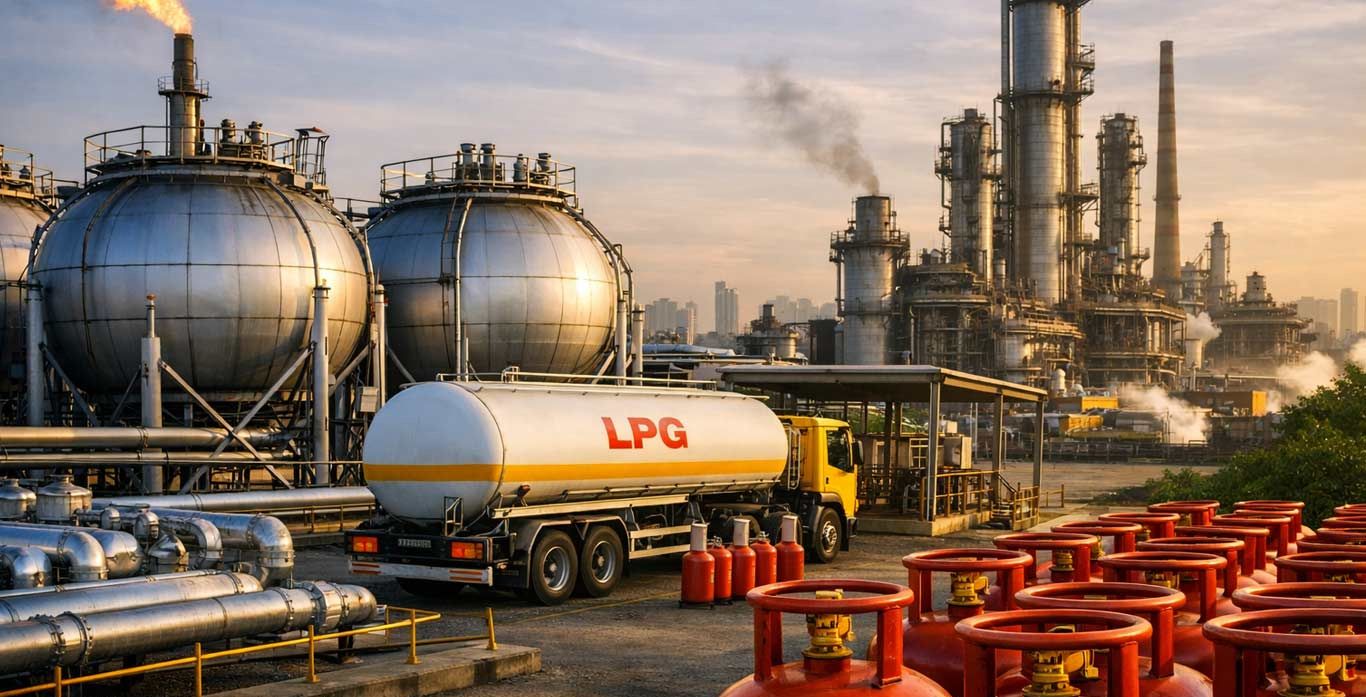
India’s LPG import landscape experienced a dramatic realignment between March and May 2026. Maritime conflict in West Asia slashed traditional Gulf supplies by nearly half. To secure domestic cooking gas, Indian state refiners turned to the United States, which quickly escalated its market share to supply 55% of India's total imports.
NEW DELHI — A major geopolitical realignment has reshaped India's energy landscape over the last three months. Driven by escalating conflict in West Asia and severe shipping blockages around the Strait of Hormuz, the United States has rapidly displaced traditional Gulf exporters to become India’s largest supplier of Liquefied Petroleum Gas (LPG). Ship-tracking data compiled through May 2026 reveals that India’s monthly LPG imports plunged from over 2 million tonnes in January and February to between 1 million and 1.2 million tonnes during the March–May window. To prevent domestic shortages of cooking fuel for millions of households, Indian State-Owned Enterprises (SOEs) aggressively scaled up spot purchases from the US Gulf Coast, capturing market share long dominated by regional giants like Saudi Arabia and Kuwait.
The Great Energy Pivot: US Sourcing Surges
According to global energy cargo tracker Kpler, India's LPG imports from the United States more than doubled to 666,000 tonnes in May 2026 compared to February baselines. This rapid shift allowed American shipments to account for a staggering 55% of India's total LPG import basket for the month.
Prior to the outbreak of the regional conflict on February 28, 2026, West Asian exporters collectively controlled nearly 90% of India's inbound cooking gas market. However, intensifying security threats along maritime chokepoints forced Indian state refiners—including Indian Oil Corporation (IOC), Bharat Petroleum Corporation Limited (BPCL), and Hindustan Petroleum Corporation Limited (HPCL)—to reroute their time-chartered Very Large Gas Carriers (VLGCs) toward the Atlantic Basin.
While the three oil marketing majors had entered initial 2026 term agreements with US suppliers covering 2.2 million tonnes—intended to meet roughly 10% of India's annual demand—the persistent closure of key trade routes accelerated spot buying. Deliveries are currently being fulfilled on a delivered basis via major global energy suppliers including Chevron, Phillips 66, and TotalEnergies.
Regional Fallout and Unconventional Diversification
The drop in availability from historical Gulf allies has forced the Ministry of Petroleum and Natural Gas to implement sweeping demand-side management and supply diversification strategies. Outside of the massive influx of US shipments, India completed an unexpected diplomatic maneuver by resuming LPG imports from Iran after a seven-year hiatus brought on by past Western sanctions. Iran supplied 145,000 tonnes to Indian ports in May, carving out a 12% market share as India's second-largest individual supplier.
To guarantee supply security, smaller spot cargoes have also been cleared from non-traditional jurisdictions, including Russia, Australia, Argentina, Angola, and Nigeria. Concurrently, domestic production has been maximized. Ministry officials confirmed that domestic refinery yields of LPG were accelerated to a record high of 52,000 tonnes per day in May, up from 50,000 tonnes per day in April, by systematically diverting feedstocks away from local petrochemical units back into the household fuel network.
Government Mandates Strategic 30-Day Cooking Gas Reserve
The structural vulnerability exposed by the West Asian conflict has prompted swift regulatory action from New Delhi. Joint Secretary of the Petroleum Ministry, Sujata Sharma, announced that the government has formally directed state refiners to draft a strategy to establish a permanent 30-day LPG storage reserve.
Historically, domestic inventories managed at coastal import terminals hold about 1 million tonnes, providing an emergency buffer of roughly 10 days. Building out a full 30-day strategic safety net will require an estimated 2.8 million tonnes of storage capacity based on India's current daily consumption rates of approximately 92,000 tonnes. Analysts note that satisfying this mandate will ensure high-volume purchasing from Atlantic Basin producers remains elevated through the remainder of the fiscal year.
"India has successfully navigated these severe supply disruptions through a combination of diversified sourcing, higher Atlantic Basin arrivals, strategic inventory drawdowns, and demand-side adjustments," stated Sumit Ritolia, Lead Energy Analyst at Kpler. "If the logistical gridlock in West Asia persists, India will have no choice but to rely permanently on US, Russian, and Latin American barrels."
Official Sources Section
The findings and metrics detailed in this report are compiled from official regulatory disclosures, ship-tracking data aggregates, and formal statements issued by:
The Indian Ministry of Petroleum and Natural Gas
Energy intelligence firm Kpler
Commercial shipping logs from state-run refiners (IOCL, BPCL, HPCL)
Why It Matters
For Indian consumers, the massive pivot to US supply routes has successfully warded off acute retail shortages and panic buying of cooking gas cylinders. For global markets, it underscores a permanent structural shift: the US has cemented its role as a frontline energy guarantor to South Asia, permanently eroding the absolute dependency India once maintained on the Persian Gulf.
Key Facts at a Glance
55% Market Share: The United States supplied over half of India’s total LPG imports in May 2026, totaling 666,000 tonnes.
50% Supply Drop: Inbound LPG flows from West Asia collapsed from 2 million tonnes per month to 1–1.2 million tonnes between March and May due to Strait of Hormuz disruptions.
30-Day Mandate: The government has ordered state refiners to build a new 2.8-million-tonne strategic cooking gas reserve.
Refinery Record: Indian domestic LPG output hit a record 52,000 tonnes per day in May to offset shipping shortfalls.
FAQ Section
Why did India change its primary source of LPG imports?
Military conflict in West Asia severely disrupted traditional shipping lanes near the Strait of Hormuz. To ensure an uninterrupted supply of household cooking gas, India shifted its procurement to the Atlantic Basin, primarily targeting the United States.
Will this supply disruption increase the price of domestic cooking gas?
While sourcing from the Atlantic Basin incurs higher logistical costs, aggressive domestic production hikes and diversified sourcing have stabilized local inventories, protecting retail consumers from sudden price spikes.
How long can India survive on its current LPG reserves?
Current storage capacities at major import terminals provide roughly 10 days of emergency cover. However, the government has recently mandated state oil companies to construct infrastructure capable of holding a 30-day buffer.
Source: Indian Ministry of Petroleum and Natural Gas, Kpler Energy Cargo Tracking, Indian Oil Corporation Regulatory Filings.