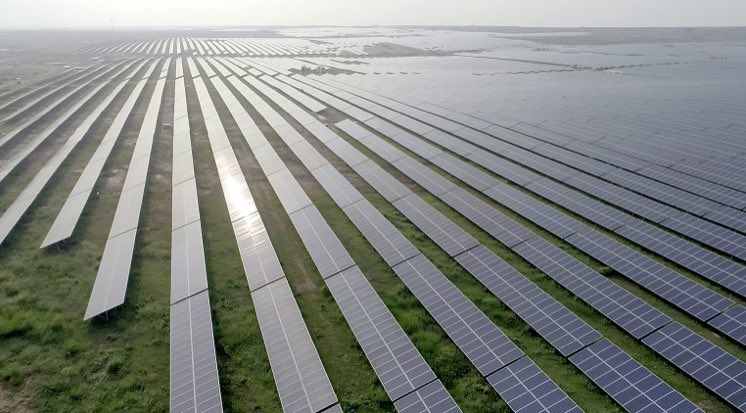
Uttar Pradesh has made history as the first Indian state to surpass 50,000 rooftop solar installations for three consecutive months (March–May 2026). Under the PM Surya Ghar scheme, the state has added 2,000 MW of clean capacity, cutting household bills and generating ₹40–₹50 crore in daily business.
The state breaks renewable energy records by crossing the 50,000 residential installation milestone for three consecutive months, accelerating India’s green transition.
LUCKNOW — Uttar Pradesh has established an unprecedented national record by becoming the first state in India to log more than 50,000 residential rooftop solar installations per month for three consecutive months. Official data released during a comprehensive progress review meeting in June 2026 confirms that the state surpassed this benchmark in March, April, and May 2026. This rapid scaling, executed under the central government’s Pradhan Mantri Surya Ghar: Muft Bijli Yojana (PMSGY), cements Uttar Pradesh's position as a primary driver of decentralized green energy deployment, altering the state’s domestic energy infrastructure.
Strategic Momentum Drives Historic Solar Deployment
The achievement highlights a dramatic acceleration in implementation efficiency. According to the review report presented by state authorities, the operational pace of rooftop solar deployment surged from roughly 500 installations per day in June 2025 to nearly 2,100 installations per day by May 2026. Notably, the most recent block of 50,000 installations was finalized in a span of just 22 days.
This operational efficiency has allowed Uttar Pradesh to capture approximately 17% of India's total rooftop solar installations under the PMSGY scheme. Cumulatively, the state has now surpassed 6.2 lakh residential installations, successfully achieving over 50% of its total target to transition 11.27 lakh households to clean energy.
Macro-Economic Gains and Industrial Impact
The industrial and economic ramifications of this solar expansion extend beyond environmental metrics. The state's rapid solarization has injected immense capital into the local economy while drastically shifting household energy dynamics.
Grid Capacity and Environmental Offsets
The systematic rollout has added more than 2,000 megawatts (MW) of rooftop solar capacity to the state's regional grid network. Operationally, these decentralized systems generate between 6.8 million and 7.0 million units of green electricity every single day. Environmental impact metrics indicate that this large-scale deployment has offset the need for ground-mounted plants that would have occupied approximately 6,000 acres of land.
Local Business and Job Creation
Financially, the rooftop solar sector in Uttar Pradesh is now generating active local business worth ₹40 crore to ₹50 crore daily. This green energy ecosystem directly supports employment for more than 80,000 people across technical, logistical, and assembly roles, providing long-term economic stability for local communities.
Administrative Mandates to Sustain Future Growth
To maintain this unprecedented momentum, the Uttar Pradesh New and Renewable Energy Development Agency (UPNEDA) has instituted strict institutional guidelines to optimize the processing pipeline.
Resolving Banking and Supply Bottlenecks
The administration has directed immediate steps to ensure that consumer applications convert directly into active deployments without bureaucratic lag. These institutional directives prioritize:
Accelerated FinTech Integration: Ensuring local banking institutions approve solar loan applications within stipulated timeframes and release approved funds instantly.
Vendor Ecosystem Optimization: Reactivating silent or underperforming vendors while simultaneously empaneling fresh corporate vendors to accommodate rising consumer demand.
Official Sources Section
The corporate, economic, and regional statistical indicators presented in this journalistic report are drawn directly from official public evaluations, administrative briefs, and institutional statements issued by the following regulatory bodies:
The Ministry of New and Renewable Energy (MNRE) via the official Press Information Bureau (PIB) network.
The Uttar Pradesh New and Renewable Energy Development Agency (UPNEDA) administrative directories.
The National Portal for Rooftop Solar progress tracking indicators.
Official Commentary
"Uttar Pradesh has created a new national record by installing solar energy-based plants in more than 50,000 households during each of the three consecutive months of March, April, and May 2026," stated Ravinder Singh, Director of UPNEDA. "Our objective remains to systematically convert every single pending application into a physical installation. Financial institutions have been instructed to clear pending loan disbursals immediately following approval so that no application is delayed for arbitrary reasons."
Why It Matters
For citizens and residential consumers, the continuous expansion of rooftop solar infrastructure yields immediate financial relief, reducing typical domestic electricity bills by 70% to 90% while providing up to 300 units of free power monthly. For businesses, developers, and investors, the state’s multi-crore daily market serves as a blueprint for viable, self-sustaining green energy ecosystems. The reduced strain on coal-dependent thermal power plants enhances overall grid reliability, reducing industrial load-shedding risks and advancing regional carbon-neutral goals.
Key Facts at a Glance
Tri-Month Record: Uttar Pradesh is the first state to exceed 50,000 residential solar installations in each of three consecutive months (March, April, and May 2026).
National Share: The state accounts for roughly 17% of all domestic rooftop solar installations under India's PM Surya Ghar initiative.
Economic Footprint: The sector drives between ₹40 crore and ₹50 crore in daily commercial transactions and employs over 80,000 individuals across the state.
Capacity and Savings: Over 2,000 MW of clean capacity has been deployed, yielding consumer savings estimated between ₹4 crore and ₹4.5 crore daily.
Frequently Asked Questions
Q: Which scheme is driving this massive solar expansion in Uttar Pradesh? A: The expansion is driven by the Pradhan Mantri Surya Ghar: Muft Bijli Yojana (PMSGY), a central government initiative designed to bring rooftop solar systems to one crore households across India.
Q: What are the financial advantages of these rooftop installations for regular households? A: Residential consumers receive significant central and state subsidies to offset upfront costs. Once installed, the systems provide up to 300 units of free electricity per month, reducing standard household power expenses by 70% to 90%.
Q: How does this development impact the broader regional economy of the state? A: The solar push has created a robust industrial ecosystem, generating close to ₹50 crore in daily market business and creating stable, green-collar jobs for over 80,000 technicians, engineers, and local vendors.
Sources