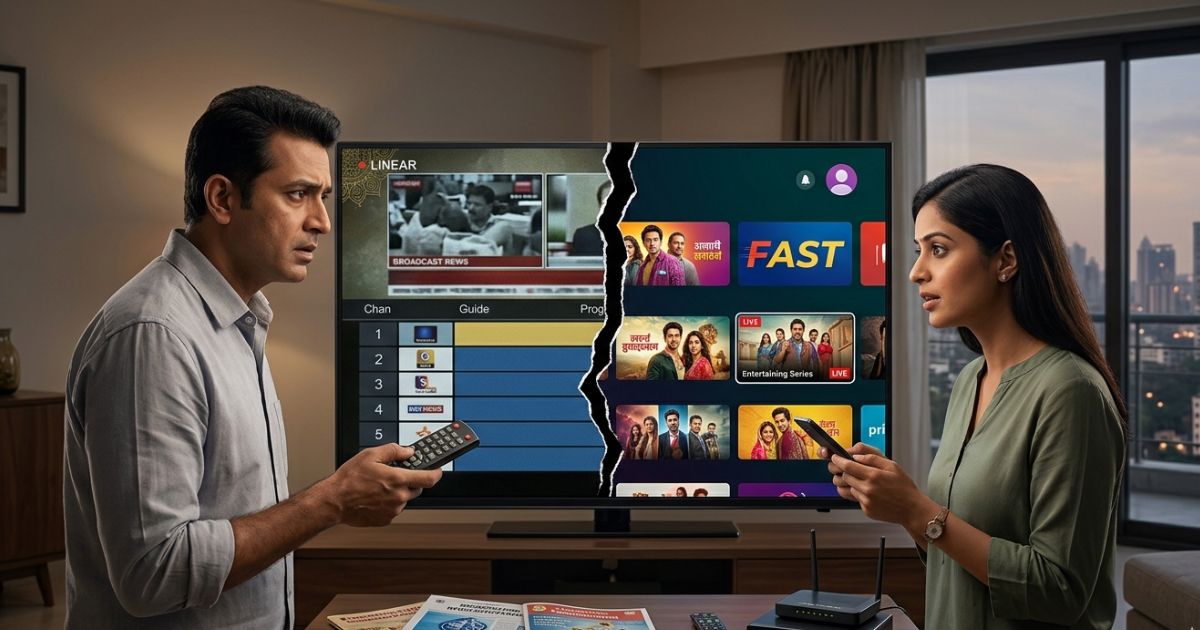
TRAI’s ongoing consultation on Free Ad-Supported Streaming Television (FAST) and Application-based Linear Television Distribution (ALTD) has sparked a major industry debate: who controls the connected TV screen? Broadcasters argue for parity with traditional TV rules, while digital-first players insist FAST is an OTT service that should remain outside broadcast licensing.
The Telecom Regulatory Authority of India (TRAI) released a consultation paper in April 2026 on regulating FAST and ALTD services. These platforms deliver scheduled, linear TV-like channels via apps and smart TVs, often free and supported by ads. The consultation has exposed sharp divisions between traditional broadcasters and OTT platforms.
The Core Debate
Broadcasters and DTH operators (Zee, Airtel, Dish TV) argue FAST platforms create a regulatory imbalance by distributing linear channels without following the same licensing, tariff, and content codes as cable or DTH. They want FAST classified as distribution platform operators under a formal authorisation framework.
OTT and digital players (Jio, Sony, Tata Communications) counter that FAST sits at the application layer, delivered over the open internet, and should remain under the Information Technology Rules, 2021. They warn that extending broadcast rules to internet services risks collapsing the distinction between OTT and licensed broadcasting.
Why It Matters
The consultation highlights a fundamental question: does something become broadcasting because it is linear and scheduled, or because it rides licensed satellite and carriage infrastructure? FAST channels look like TV, monetise like digital video, and distribute like OTT. A broadcast-style framework could choke internet-native services, while a pure OTT framework may under-govern repurposed TV feeds.
Industry Context
- Consumer shift: DTH subscribers declined from 66.6 million in December 2022 to 51 million in December 2025, while connected TV adoption surged.
- Advertising economics: FAST platforms monetise with targeted ads and revenue-sharing, unlike DTH operators who receive no share of ad revenues.
- Regulatory fault line: The debate is no longer technical—it reflects two opposing visions of Indian television’s future.
Screen Control Highlights
• TRAI consultation on FAST and ALTD released April 2026
• Broadcasters want FAST regulated like cable/DTH with licensing and parity rules
• OTT players argue FAST is OTT, governed by IT Rules 2021
• DTH subscribers fell to 51 million by Dec 2025, connected TV surged
• Advertising skew: FAST platforms monetise with targeted ads, DTH operators excluded
• Debate centres on whether linear scheduling equals broadcasting or internet service
Sources: TRAI Consultation Paper, Best Media Info, MediaNama, The Financial Express, exchange4media