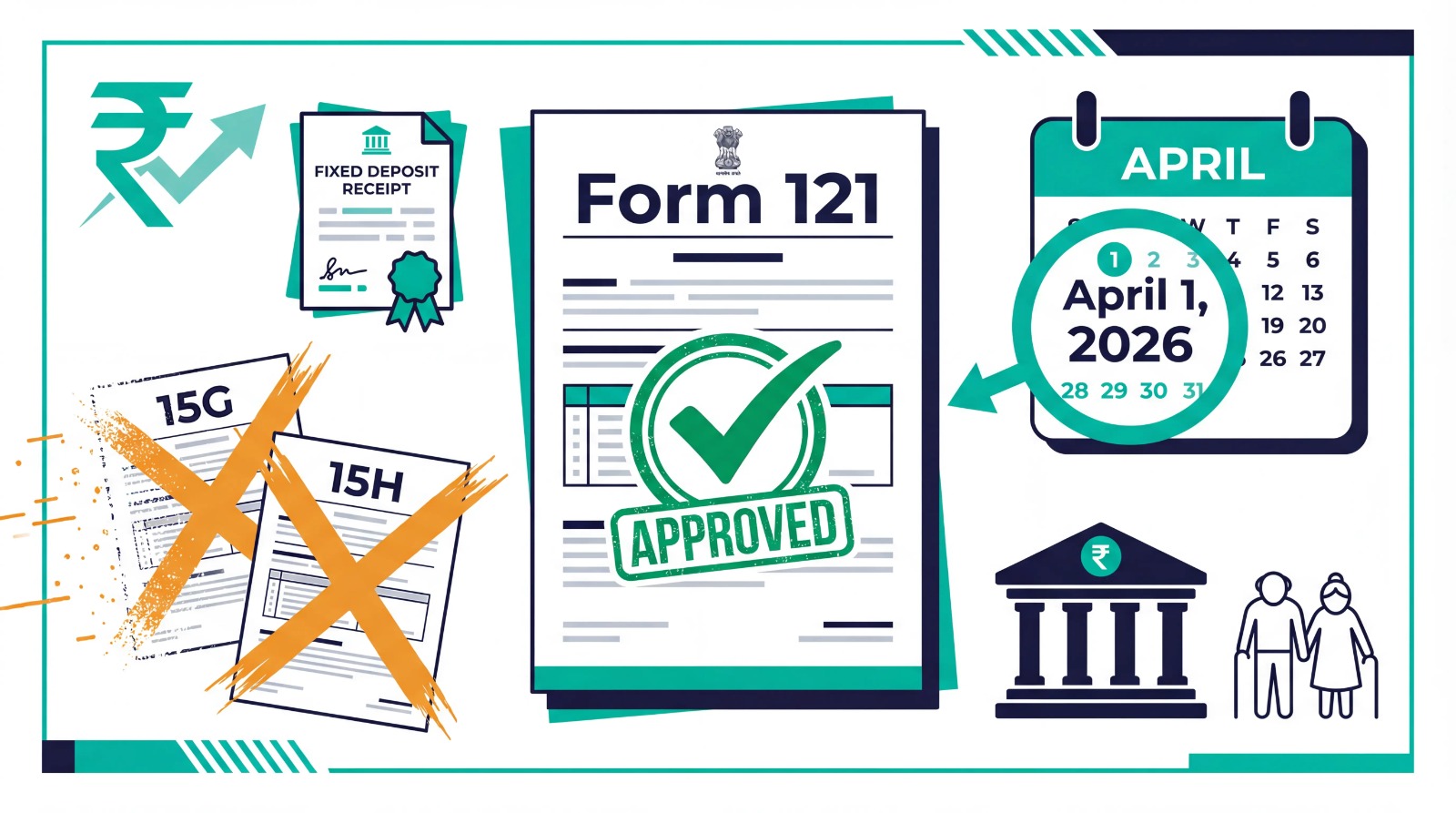
The Central Board of Direct Taxes has introduced Form 121, a unified self-declaration document replacing legacy Forms 15G and 15H. Eligible resident individuals and HUFs with zero net annual tax liability must submit this single form to banks to claim a TDS waiver on interest income from fixed deposits.
The Central Board of Direct Taxes (CBDT) has officially overhauled its regulatory mechanism for tax deduction at source (TDS) on interest income by introducing a single, unified declaration document. Effective for the current tax cycle, Indian retail investors earning fixed deposit (FD) interest must now submit the newly structured Form 121 to their respective banking institutions to prevent automated TDS withholding.
This administrative transition supersedes the decade-old system that split individual declarants across two distinct paths: Form 15G for individuals aged under 60 years and Form 15H for senior citizens. The unified regulatory framework impacts millions of domestic retail depositors, co-operative societies, and Hindu Undivided Families (HUFs) who maintain interest-bearing accounts but possess net annual taxable incomes falling entirely below the basic exemption thresholds.
Decoupling Age From Tax Declarations via Unified Document
The operational deployment of Form 121 follows specific provisions laid out under Section 393(6) of the Income-tax Act. Under long-standing rules, banking institutions are legally mandated to deduct a flat 10% tax at source if total annual interest income accrued from term deposits across all branches exceeds ₹40,000 for regular individuals, or ₹50,000 for senior citizens aged 60 years and above.
According to technical circulars issued by major banking partners, the primary driver for implementing Form 121 is the reduction of systemic friction for both the deductor and the taxpayer. Rather than forcing senior individuals to track age-segregated formats, the automated processing systems hosted by the Income Tax Department now accept a singular schema file. The declaration acts as a preemptive legal statement to the bank indicating that the investor's cumulative net income tax liability for the financial year will be exactly nil, thereby rendering source deductions unnecessary.
Core Eligibility Parameters Under the Current Tax Regimes
While the form has been consolidated, the underlying financial thresholds governing eligibility have adapted to align with current statutory frameworks. According to regulatory disclosures issued by schedule commercial banks like AU Small Finance Bank and Axis Bank, the critical acceptance criteria depend heavily on whether an investor's estimated total income exceeds the basic exemption thresholds.
Taxpayers Under 60 Years and HUFs: The estimated total gross income of the declarant—inclusive of the proposed interest earnings—must not breach the maximum amount not chargeable to tax. For individuals remaining under standard baseline frameworks, this cap stands strictly at ₹4 Lakhs.
Senior Citizens (Aged 60 and Above): Senior taxpayers are granted higher structural leeway. Form 121 will be valid and accepted by institutions provided the senior citizen’s total estimated annual income remains within ₹12 Lakhs, assuming compliance under the default new tax regime coordinates.
The Permanent Account Number Mandate: The submission becomes legally invalid if the declarant does not provide a valid, active Permanent Account Number (PAN). Furthermore, if an individual's PAN is classified as inoperative due to a lack of Aadhaar linking, the declaration is rejected automatically, and banks are statutory required to levy a penal TDS rate of 20% instead of the standard 10%.
Institutional Guidance on Withholding Limitations
A shared statement found within the administrative compliance handbooks of domestic lenders outlines the precise boundaries of this tax waiver tool.
"According to banking officials, a fresh declaration in Form 121 is strictly required to be submitted at the immediate start of each financial year to cover both cumulative and non-cumulative fixed deposits," the regulatory guidance notes state. "Tax which has already been deducted by the automated system prior to the actual date of a valid Form 121 submission cannot be reversed or refunded by the bank itself. Such amounts must be recovered directly from the Income Tax Department by the taxpayer when filing their annual Income Tax Return."
Why It Matters: Practical Cash Flow Implications for Depositors
For middle-class households and retired individuals who utilize fixed deposits as an essential source of regular monthly or quarterly cash payouts, forgetting to submit Form 121 creates immediate liquidity traps. When a bank processes a 10% deduction, it directly lowers the net payout credited to the investor's savings account.
Even though this money can ultimately be claimed back as a tax refund during the subsequent filing season, the capital remains locked up within government treasuries for several months. Timely digital filing ensures that low-income depositors retain 100% of their interest yield in real-time, preserving liquidity when it is needed most.
Key Facts at a Glance
Unified Replacement Status: Form 121 officially deprecates both Form 15G and Form 15H, establishing a single legal document for all resident individuals and HUFs seeking TDS exemptions on interest.
Strict Threshold Triggers: Banks trigger automated TDS when annual term deposit interest crosses ₹40,000 for regular citizens or ₹50,000 for senior citizens.
Exclusionary Restrictions: Non-Resident Indians (NRIs), public or private limited companies, and standard partnership firms are legally barred from using Form 121.
Penal Inoperative Rate: Submitting Form 121 without a valid, Aadhaar-linked PAN invalidates the waiver, forcing banks to apply a high-rate 20% tax penalty.
Frequently Asked Questions (FAQ)
Does submitting Form 121 mean my fixed deposit interest income is completely tax-free?
No. Form 121 is solely a mechanism to prevent tax deduction at source (TDS) by the bank. It does not alter the legal taxability of your income. If your overall income changes during the financial year and ultimately crosses the taxable threshold, you are legally obligated to calculate and pay the appropriate tax when filing your final Income Tax Return.
What should I do if I hold fixed deposits across multiple different banks?
Form 121 must be submitted to each individual payer separately. Because banks do not share internal customer identification data, you must file a distinct declaration with every separate bank or financial institution where your annual interest earnings are expected to breach the ₹40,000 or ₹50,000 threshold.
Can I submit Form 121 via internet banking, or must I visit a branch physically?
Most major commercial banks and financial institutions have integrated Form 121 into their retail internet banking portals and mobile applications. You can navigate to the 'Fixed Deposit Services' or 'Tax Exemptions' section of your respective portal, verify your pre-filled details, and submit the form digitally via a secure One-Time Password (OTP) verification layer.
Sources: Income Tax Department of India, AU Small Finance Bank Compliance, Axis Bank Investor Relations