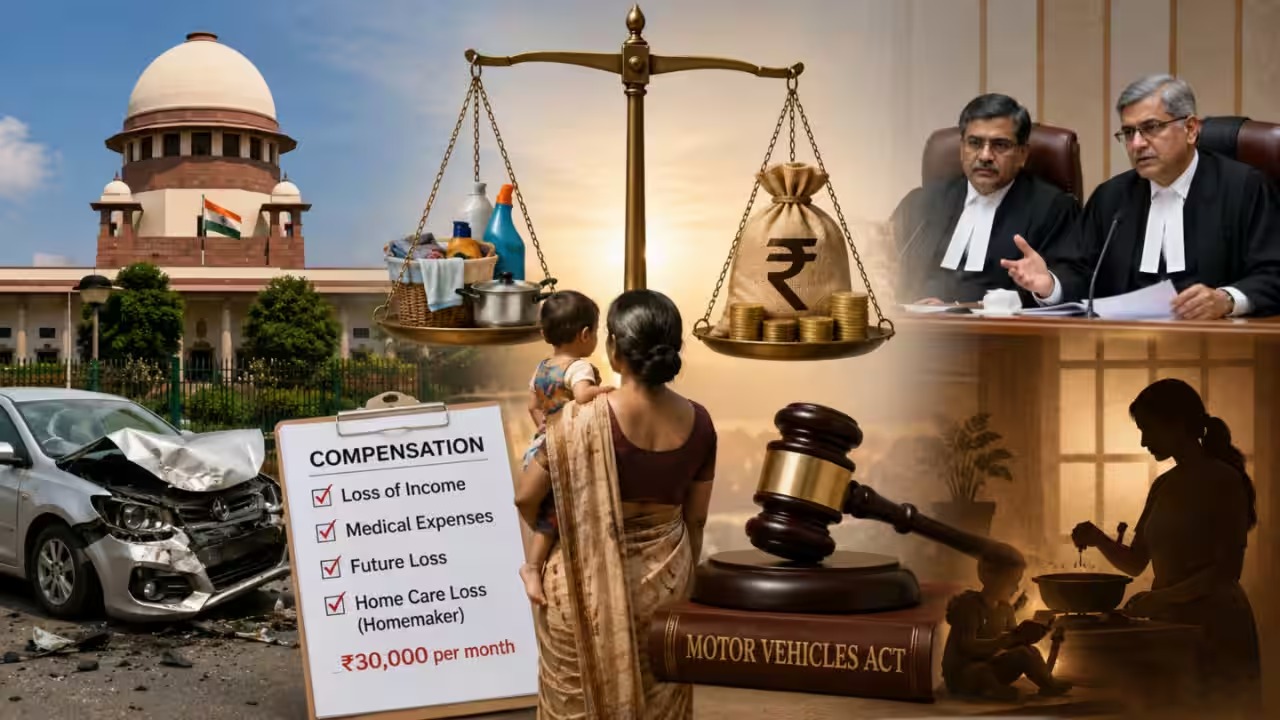
The Supreme Court has ruled that a homemaker’s unpaid labor must be valued at a minimum of ₹30,000 per month when determining motor accident compensation. Hailing housewives as "nation builders," the bench established this mandatory threshold to legally validate the immense economic and social worth of domestic caregiving.
NEW DELHI — In a historic judgment redefining the legal and economic evaluation of domestic labor, the Supreme Court of India ruled that the unpaid work performed by homemakers must be monetized at a minimum baseline of ₹30,000 per month. Handed down on June 11, 2026, the landmark decision designates the "loss of domestic care" as an independent, compensable head of damages in motor accident claims.
The division bench of the top court rejected decades of judicial practice that tied a housewife’s deemed income to the volatile wages of minimum daily wagers. By elevating this threshold, the ruling structurally alters how insurance companies, tribunals, and courts evaluate the economic foundation of Indian households. It delivers a firm message that running a home is an invaluable economic driver rather than non-productive domestic dependency.
Invisible Labor Quantified as Core Nation-Building Asset
The decision was delivered by a bench comprising Justice Sanjay Karol and Justice N. Kotiswar Singh while presiding over a long-standing appeal originating from a fatal road mishap in November 2001. Reviewing an earlier verdict by the Punjab and Haryana High Court, the apex court observed that traditional metrics like Gross Domestic Product (GDP) consistently omit household labor, despite the fact that a home's operational framework sustains the entire active workforce.
Writing for the bench, Justice Karol noted that it is deeply ironic to legally categorize a homemaker as a financial dependent when earning family members are entirely reliant on the homemaker's daily investments of time and care. The court noted that a homemaker acts as the unseen foundation enabling corporate professionals, daily workers, politicians, and artists to actively enter the outer economy and succeed.
Structural Adjustments to the Motor Accident Claims Matrix
The newly established operational directives completely restructure the legal parameters used by Motor Accident Claims Tribunals (MACT). Key revisions include:
1. The Multi-Tiered Compensation Architecture
The bench clarified that the "loss of domestic care" payout is a separate component. It exists over and above the established heads of damages defined under the historic National Insurance Co. Ltd. v. Pranay Sethi framework. Furthermore, if a deceased woman was a member of the formal workforce, the ₹30,000 monthly benchmark must be awarded in addition to her proven occupational salary.
2. Built-In Inflation Safeguards
To protect families against long-term macroeconomic adjustments, the court instituted an automated compounding mechanism. The baseline ₹30,000 notional monthly income will automatically scale upward by 10% every three years, ensuring that future compensation settlements keep pace with standard cost-of-living increases.
3. Broadened Gender Neutrality with Specific Boundaries
While the bench explicitly centered its calculations on the traditional, highly disproportionate domestic burdens borne by Indian women, it recognized shifting societal dynamics. The justices noted that under specific domestic circumstances, a man may also assume the exclusive role of a homemaker, rendering his unpaid care work equally eligible for identical legal evaluation.
Official Sources Section
The statutory changes, historical timelines, and newly formulated legal principles detailed in this news report are drawn from:
Judicial Warnings on Litigation Delays
A critical segment of the ruling addressed the severe, institutional delays plaguing insurance tribunals across the country.
"According to officials, the true purpose of providing just and fair compensation is completely eroded when families are forced to litigate for decades," the division bench observed in its formal judgment text. "Organizers and Chief Justices of all High Courts must ensure that long-pending motor accident compensation appeals are actively monitored and listed according to their age. Proceedings under Section 169 of the Motor Vehicles Act must be conducted via summary procedures in letter and spirit."
The court pointed out that the current case took 25 years to conclude after the victim's death, an systemic failure exacerbated by a local court records fire in 2011, which required years of file reconstruction.
Why It Matters: Immediate Legal Protections for Indian Families
For ordinary citizens and families dealing with sudden tragedy, this judgment ends the practice of insurance companies dismissing a housewife's life value as economically negligible. Previously, insurance adjusters frequently computed a deceased homemaker's income as zero or pinned it to nominal local daily wage rates, leading to meager claims settlements.
By enforcing a mandatory ₹30,000 monthly floor, a deceased homemaker's base annual notional income is formally fixed at ₹3.6 Lakhs before calculating future prospects and dependency multipliers. Consequently, final insurance payouts for grieving families will increase substantially—often by lakhs of rupees—offering realistic financial security to children who have lost maternal care.
Key Facts at a Glance
The Monetary Floor Set: The top court established a minimum notional income of ₹30,000 per month specifically to quantify the "loss of domestic care" in accident claims.
Inflation Protection Clause: The baseline valuation features a mandatory 10% compounding hike every three years to preserve purchasing power against inflation.
Empirical Foundation: The court utilized official Time Use Survey data showing that Indian women dedicate an average of over seven hours daily to unpaid domestic tasks, contributing roughly 15-17% to the country's economic ecosystem.
Strict Disposal Deadlines: High Courts are instructed to prioritize insurance cases pending for more than four years, emphasizing that accident claims should ideally be resolved within one year.
Frequently Asked Questions (FAQ)
Does this ruling mean housewives will now receive a monthly salary of ₹30,000 from the government?
No. This judgment does not establish a legal right to a monthly wage or salary for homemakers from their husbands or the state. It is a specific legal benchmark created for courts and insurance tribunals to calculate fair financial compensation for families in the event of a homemaker's untimely accidental death or permanent incapacitation.
How does this judgment impact a woman who balances a corporate job and household duties?
The Supreme Court clarified that dual-income or working mothers receive enhanced protection under this framework. If a woman is employed, the ₹30,000 "loss of domestic care" valuation will be added directly to her proven professional income, acknowledging that her domestic contributions run parallel to her economic career.
Will this new valuation apply to pending motor accident cases filed years ago?
Yes. Because the Supreme Court has laid down this principle as an interpretive clarification of "just compensation" under the Motor Vehicles Act, tribunals and High Courts across India are expected to apply this ₹30,000 minimum benchmark to all ongoing and active accident claims currently moving through the judicial system.
Sources: Supreme Court of India Official Portal, Ministry of Statistics and Programme Implementation