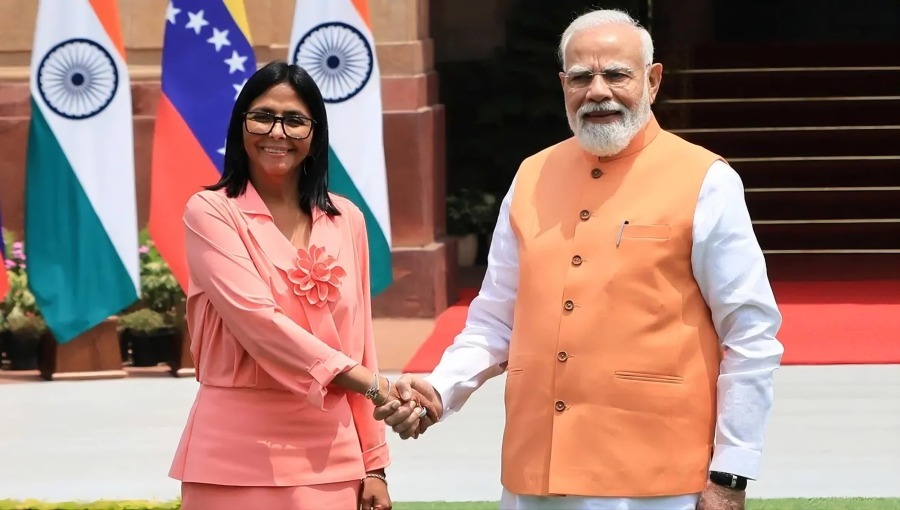
Acting Venezuelan President Delcy Rodríguez's June 2026 visit to India highlights a major shift in global energy trade. Driven by the closure of the Strait of Hormuz due to the Iran war, India has rapidly increased imports of discounted Venezuelan heavy crude to 427,000 bpd, strengthening its national energy security.
NEW DELHI, India — India's energy landscape is undergoing a structural realignment following a high-profile diplomatic visit from Venezuela's acting President, Delcy Rodríguez, to New Delhi from June 3 to June 7, 2026. The bilateral discussions, which included extensive face-to-face talks with Indian Prime Minister Narendra Modi, come as Venezuela rapidly establishes itself as India's third-largest source of crude oil imports. This sudden resumption of large-scale trade follows a long hiatus caused by unilateral international sanctions, signaling a significant shift in global energy logistics.
Faced with a complete closure of the Strait of Hormuz due to the ongoing Iran war, Indian refiners are aggressively diversifying away from volatile Middle Eastern supply routes. Meanwhile, structural changes inside Venezuela have enabled a massive, legally protected revival of its state-managed oil fields, aligning the two economies in a vital energy partnership.
1. The Strait of Hormuz Conflict Forces Supply Diversification
The primary driver behind India's renewed focus on South American energy is the severe disruption of traditional shipping lanes in West Asia. India currently imports roughly 90 percent of the crude oil it consumes. Historically, nearly half of those inbound shipments transited through the Strait of Hormuz—a narrow maritime chokepoint that has effectively closed due to the active war involving Iran.
To prevent nationwide fuel shortages and stabilize domestic energy costs, the Indian government has initiated an aggressive procurement drive across non-Middle Eastern fields, making Venezuela’s massive reserves a key pillar of its long-term energy security strategy.
2. Political Transformation and U.S.-Backed Legal Relief
The legal avenue for the resumption of Venezuelan oil exports to India opened following dramatic political changes in Caracas earlier this year. Following a U.S. military operation on January 3, former President Nicolás Maduro was removed from office, and Delcy Rodríguez assumed the acting presidency.
Under this transition, the Trump administration issued temporary sanctions relief, authorizing international and American corporations to legally resume operations within Venezuela's financial, mining, and petroleum sectors. Under the newly implemented legal regime, all global revenues generated by Venezuelan oil exports pass directly into audited U.S. Treasury accounts, with disbursements to Caracas subject to strict U.S. State Department approval.
3. Substantial Pricing Discounts and Complex Refining Capabilities
Beyond absolute supply security, the trade expansion is highly lucrative for sophisticated Indian refiners. Because Venezuelan heavy, sulfur-rich crude (primarily the Merey grade) is considered highly viscous and difficult to process, it trades at a significant commercial discount compared to lighter global benchmarks like Brent or WTI.
Indian conglomerates, most notably Reliance Industries Limited, possess specialized, high-complexity refining complexes at Jamnagar capable of processing these heavy grades into clean, high-value transport fuels. Reliance has historically held term agreements to import up to 400,000 barrels per day (bpd) from Petróleos de Venezuela SA (PDVSA), making it the primary commercial anchor for these incoming shipments.
4. Unlocking Trapped Capital and Expanding Upstream Assets
A key administrative focus of the current New Delhi summit is resolving more than 500 million dollars in stuck corporate dividends. Due to previous asset freezes, state-run ONGC Videsh Limited (OVL)—the overseas investment arm of the Oil and Natural Gas Corporation—had been unable to repatriate its financial returns from its 40 percent stake in the San Cristóbal field and its collaborative investments in the Carabobo-1 block.
Union Minister for Petroleum and Natural Gas, Hardeep Singh Puri, confirmed that a specialized Indian technical team will travel to Caracas to evaluate fresh production-sharing agreements, aiming to ramp up active extraction under the newly modified regulatory frameworks.
Escalating Cargo Volumes: India-Venezuela Trade Metrics
Audited data compiled by global shipping analytics firms highlights the rapid pace of Venezuela's reintegration into India's refining mix:
| Strategic Trade Parameter (May 2026) | Operational Volume / Financial Status |
| Total Venezuelan Crude Exports | 1.25 million barrels per day (bpd) |
| India's Import Volume from Venezuela | 427,000 barrels per day (bpd) |
| India's Global Import Ranking | 2nd largest buyer of Venezuelan crude |
| Stuck Indian Corporate Dividends | Over $500 million USD (Pending resolution) |
| Projected Inbound June 2026 Deliveries | 380,000 barrels per day (bpd) |
Data sources: Kpler Shipping Analytics and Ministry of External Affairs Compliance Briefings.
Official Sources Section
The diplomatic itinerary, bilateral statements, energy import statistics, and asset evaluations featured in this report are sourced directly from official media briefings provided by the Ministry of External Affairs (MEA), verified corporate statements from the Ministry of Petroleum and Natural Gas, and compiled tracking registers maintained by the Press Information Bureau (PIB).
Quote Section
"According to officials from India's foreign ministry, there exists a perfect structural complementarity between Venezuela's holding of 17 percent of global oil reserves and India's position as a stable, growing consumer of crude oil for decades to come."
Why It Matters
For global commodity traders, international energy analysts, and everyday consumers, the sudden revival of the India-Venezuela energy corridor has immediate economic impacts. By substituting blocked Middle Eastern oil with deeply discounted South American heavy crude, Indian refiners can suppress corporate input costs, protecting domestic drivers from hyper-inflationary retail fuel hikes at the pump. For Venezuela, anchoring its supply lines with one of the fastest-growing economies in Asia provides a predictable, legally compliant revenue flow necessary to stabilize its domestic economy after years of hyperinflation and complete financial isolation.
Key Facts at a Glance
Diplomatic Milestone: Acting Venezuelan President Delcy Rodríguez arrived in New Delhi for a formal working visit spanning June 3 to June 7, 2026.
Chokepoint Crisis: India is diversifying its crude oil sourcing after the Iran conflict effectively blocked the strategic Strait of Hormuz shipping corridor.
Volume Surge: Inbound shipments of Venezuelan heavy crude to India reached a record 427,000 bpd in May 2026, making India the world's second-largest buyer.
Corporate Pivot: Reliance Industries has emerged as the primary commercial consumer, leveraging its high-complexity Jamnagar refinery assets.
Frozen Assets: India and Venezuela are negotiating a resolution to clear over 500 million dollars in trapped dividends owed to state-run ONGC Videsh.
FAQ Section
Q1: Why did India stop importing oil from Venezuela in the first place?
Large-scale crude imports were largely suspended after the United States imposed sweeping economic sanctions on Venezuela's financial and energy sectors, which blocked the use of U.S. dollars for international transactions and settlement clearances.
Q2: How are oil payments settled under the current interim Venezuelan government?
Following the political transitions in Caracas in early 2026, all international financial payments for Venezuelan oil exports are routed directly into monitored accounts inside the U.S. Treasury, with eventual disbursements governed by the U.S. State Department.
Q3: Which Indian companies hold direct oil extraction assets in Venezuela?
State-run explorer ONGC Videsh Limited holds a 40 percent stake in the San Cristóbal oil field and participates in an international consortium developing a multi-million-dollar crude project in the Carabobo region of the Orinoco belt.
Source: Official bilateral briefing papers published by the Ministry of External Affairs (MEA); asset reports issued by ONGC Videsh Limited; and crude export tracking logs compiled by Reuters and Kpler data desks.