Latest macroeconomic data and historical timelines show that central government employees will receive scheduled Dearness Allowance (DA) increases before the 8th Pay Commission takes effect. With the 8th CPC report expected in mid-2027, the regular July index adjustments remain the primary tool for mitigating inflation in the interim.
Will DA Rise Before the 8th Pay Commission? Here Is What Latest Data Suggests
Central government employees look to upcoming inflation metrics for interim financial relief as the 8th Central Pay Commission accelerates stakeholder consultations.
NEW DELHI — Central government employees and pensioners are positioned to receive an interim increase in their Dearness Allowance (DA) well ahead of the implementation of the 8th Central Pay Commission (CPC). Microeconomic data models tracking retail inflation patterns indicate that the central government will maintain its twice-yearly institutional adjustment framework to protect consumer purchasing power, even as the newly formed pay panel speeds up its national consultative cycle.
The expected revision comes at a critical time for household budgets. With retail and food inflation experiencing upward pressure throughout the first half of 2026, the upcoming adjustment will provide immediate financial relief to more than 1.19 crore active public sector workers and retired beneficiaries across India.
AICPI-IW Projections Point Toward July Revision
The Securities and macroeconomic monitoring desks confirm that Dearness Allowance adjustments remain legally decoupled from the structural timeline of the 8th Pay Commission. Under the rules established by the preceding 7th CPC framework, the Ministry of Finance calculates changes to the allowance twice every year—effective January 1 and July 1—using the 12-month average of the All India Consumer Price Index for Industrial Workers (AICPI-IW).
The latest operational adjustment occurred in April 2026, when the Union Cabinet approved a 2% increase that brought the total DA component to 60% of basic pay. Data compiled for the next evaluation window indicates a strong probability of another upward shift.
According to statistical bulletins issued by the Labor Bureau:
The AICPI-IW reading for April 2026 advanced by 0.8 points, reaching an aggregate level of 149.9.
Domestic retail inflation indicators for May 2026 recorded a sequential increase, driven primarily by a 4.78% rise in the national food inflation index.
Wholesale price metrics climbed sharply to 9.68% in May, reflecting steep logistics and material expenses for essential commodities.
Market analysts and employee federation data desks calculate that if the upcoming AICPI-IW data models for May and June maintain their current path, the central government will likely announce a 2 to 3 percentage point hike. Following standard administrative timelines, the Union Cabinet is expected to formally clear the rollout between September and October 2026, with the financial benefits applied retroactively from July 1, 2026.
8th Pay Commission Timeline and Procedural Status
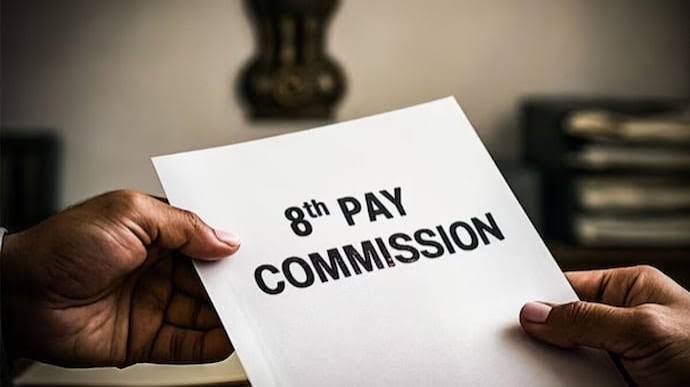
The persistence of periodic DA updates is essential for public sector personnel because the 8th Pay Commission operates on a separate, long-term implementation calendar. Formally constituted by the Government of India via Gazette notification on November 3, 2025, under the chairpersonship of retired Supreme Court Justice Ranjana Prakash Desai, the commission has an official 18-month window to submit its final structural blueprint.
The panel recently achieved a major milestone by closing the official window for memorandum submissions from employee unions on June 15, 2026. The commission is now conducting extensive state-level consultative rounds, having recently wrapped up technical discussions in Lucknow on June 22–23, with subsequent institutional meetings scheduled for Bhubaneswar and Kolkata in July 2026.
| Pay Commission Milestone | Operational Status / Expected Date |
| Formal Constitution | Completed (November 3, 2025) |
| Memorandum Submission Deadline | Completed (June 15, 2026) |
| Regional Stakeholder Consultations | Ongoing (Throughout July 2026) |
| Final Report Submission Target | Mid-to-Late 2027 |
| Anticipated Executive Implementation | Late 2027 / Early 2028 (with retroactive arrears) |
Official Sources Section
The inflation data points, economic indices, and formula breakdowns used in this report are sourced from official publications by the Ministry of Statistics and Programme Implementation (MoSPI) and the Labor Bureau under the Ministry of Labour & Employment. Institutional progress trackers and structural assembly data match the public announcements hosted on the 8th Central Pay Commission Portal.
Quote Section
National labor syndicates have repeatedly emphasized that interim cost-of-living adjustments must continue without interruption while the 8th CPC determines long-term salary structures and fitment multipliers.
According to officials representing major central employee associations:
"Dearness Allowance is a compensatory mechanism tied directly to inflation, not a structural salary hike. Until the 8th Pay Commission completes its regional evaluations and the Union Cabinet approves a new basic pay matrix, regular DA updates under the 7th CPC guidelines are the only way to safeguard real wages against rising fuel, transport, and food costs."
Why It Matters
The parallel progression of regular DA increases alongside the 8th Pay Commission's work has clear practical impacts on consumer spending. For tens of lakhs of government households and pensioners, an interim 2% to 3% increase in disposable income helps offset immediate inflationary pressures on daily travel, healthcare, and utilities. On a broader scale, institutional investors monitor these payouts closely; any significant increase in public sector liquidity tends to boost retail sales in consumer durables, real estate, and automotive markets, while temporarily expanding the government's fiscal wage bill.
Key Facts at a Glance
Independent Updates: Dearness Allowance (DA) will continue to rise through scheduled revisions before the 8th Pay Commission is fully implemented.
Current Benchmarks: The latest government revision fixed the active DA rate at 60% of basic pay.
Upcoming Decision Window: The next cost-of-living allowance adjustment is expected to be announced in September 2026, based on mid-year AICPI-IW metrics.
Long-Term Timeline: The 8th Pay Commission report is expected to reach the Union Cabinet by mid-2027, making interim DA increases the main mechanism for inflation relief over the next year.
FAQ Section
Q: Will the Dearness Allowance merge with basic pay before the 8th Pay Commission is implemented? A: No. The central government has clarified that there is currently no administrative proposal to merge DA into basic pay under the 7th CPC guidelines. The allowance will continue as a separate component until the next pay matrix is approved.
Q: How often is the Dearness Allowance reviewed by the government? A: The allowance is adjusted twice a year. The first phase covers January to June (typically announced in March/April), and the second phase covers July to December (typically announced in September/October).
Q: How many people benefit from these adjustments? A: Periodic DA and Dearness Relief (DR) updates directly affect roughly 55 lakh active central government employees and over 69 lakh retired pensioners, including personnel across the defense, railways, and civil service sectors.
Source: Ministry of Statistics and Programme Implementation Press Releases, 8th Central Pay Commission Official Progress Reports, Labor Bureau inflation index registers.