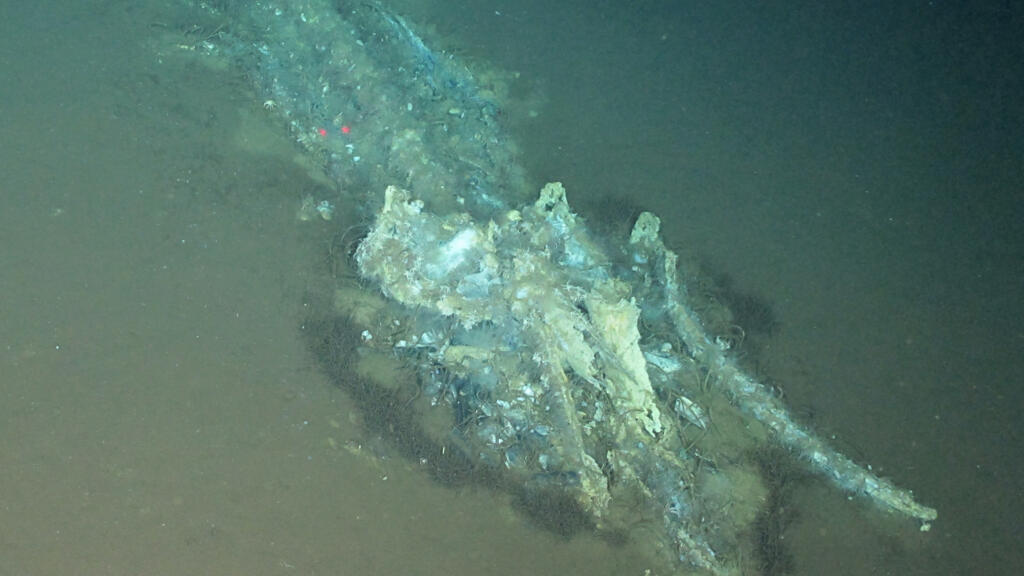
PERTH, Australia — An international team of oceanographers has discovered the world’s largest, deepest, and oldest known whale graveyard at the bottom of the southeastern Indian Ocean. Located within the Diamantina Fracture Zone—a rugged underwater trench system situated roughly 1,200 kilometers west of Australia—the massive "megasite" holds an unprecedented concentration of ancient fossils and modern whale carcasses.
PERTH, Australia — An international team of oceanographers has discovered the world’s largest, deepest, and oldest known whale graveyard at the bottom of the southeastern Indian Ocean. Located within the Diamantina Fracture Zone—a rugged underwater trench system situated roughly 1,200 kilometers west of Australia—the massive "megasite" holds an unprecedented concentration of ancient fossils and modern whale carcasses.
Published in the journal Nature, the discovery provides scientists with an intact window into millions of years of marine mammalian evolution. At the same time, it reveals complex deep-sea ecosystems thriving in absolute darkness on the floor of the ocean.
Deep-Sea Expedition Uncovers Extensive Underwater Necropolis
According to the study published by researchers from the Chinese Academy of Sciences, the University of Pisa, and institutions in New Zealand, the underwater necropolis spans a massive 1,200-kilometer corridor. Utilizing the deep-sea manned submersible Fendouzhe, the research team completed 32 programmatic dives into the crushing depths of the trench, documenting 476 distinct whale fossil sites alongside five modern "whale falls"—the biological term for sunken whale carcasses on the ocean floor.
The survey recorded remains at depths ranging between 4,200 meters and 7,002 meters below the surface. The maximum depth of over seven kilometers makes this community the deepest whale-fall colony ever recorded in marine history, exceeding previously documented sites by more than 2,500 meters.
Among the extensive collection of bones, researchers identified a five-meter-long skeleton of an Antarctic minke whale, alongside a fossilized skull belonging to an extinct species of beaked whale called Pterocetus benguelae dating back 5.3 million years. The team also successfully extracted a skull from an entirely new, previously undocumented extinct species, which they have officially named Pterocetus diamantinae.
Hidden Ecosystems Thriving on Ancient Remains
The discovery has fundamentally challenged existing biological models regarding energy distribution on the deep ocean floor. When a whale dies and sinks, its decaying mass creates a hyper-localized, self-sustaining habitat that provides nourishment to deep-sea creatures for decades.
Biologists working on the project reported that these extreme, high-pressure environments are teeming with biological activity. The submersibles captured high-resolution footage of brittle stars, bone-eating worms, sea anemones, amphipods, saltwater clams, and deep-sea sponges colonizing the skeletal remains.
Statisticians extrapolating the dive data estimate that the broader Diamantina Fracture Zone could contain between seven and eight carcasses and roughly 750 mineralized fossils per square kilometer. Scientists note that the vast volume of organic lipids and tissue sequestered in this specific corridor translates to roughly 6.7 million tonnes of stored carbon, creating an island-like oasis of life analogous to the hydrothermal vents found near active undersea tectonic ridges.
Impact on Marine Science and Global Conservation Fans
The discovery yields immediate structural value across multiple sectors of global marine research:
For Marine Biologists and Genealogists: The site offers an undisturbed chronological archive tracking how whales adapted to changing prehistoric ocean temperatures and migration pathways over geological time scales.
For Climate and Carbon Scientists: Documenting millions of tonnes of carbon sequestered at the bottom of the Indian Ocean provides critical baselines for calculating long-term global carbon cycle balances.
For Conservation Organizations and Nature Fans: The presence of rare, elusive species like the beaked whale allows conservation networks to better understand the critical foraging zones and open-ocean habitats of modern cetaceans.
Official Sources Section
The verified data, geographic coordinates, and taxonomic classifications detailed in this news report are drawn directly from the following official platforms:
The formal peer-reviewed research paper published in the international scientific journal Nature.
Operational data releases and expedition logs from the Institute of Deep-Sea Science and Engineering at the Chinese Academy of Sciences.
Taxonomic archives certified by the Earth Sciences department at the University of Pisa.
Quote Section
"Discovering a necropolis of this scale was completely unexpected. The size of distribution, the depth, and the age range were far beyond anything we had imagined. The vibrant ecosystems we saw offered a completely different perspective on this otherwise dark and cold ocean floor."
— Xiaotong Peng, Lead Study Author at the Chinese Academy of Sciences, via formal statement
"This discovery demonstrates that these extreme and unexplored environments are home to species and ecosystems still unknown to science, and that we are therefore still far from understanding the true biodiversity of our planet."
— Dr. Giovanni Bianucci, Study Co-Author, University of Pisa
Why It Matters
The discovery of the Diamantina Zone necropolis changes our understanding of deep-sea biology. Practically, it proves that the deep ocean trenches act as critical ecological sinks, anchoring unique food webs that can survive without sunlight. Identifying this multi-million-year-old migration and foraging hotspot provides international policy makers with the exact spatial data needed to establish protected marine sanctuaries in international waters, safeguarding vital areas from prospective deep-sea mining or destructive commercial fishing.
Key Facts at a Glance
Record-Breaking Scale: Scientists discovered a massive whale graveyard stretching 1,200 kilometers along the seafloor of the southeastern Indian Ocean.
Extreme Depths: The carcasses and fossils were mapped at depths of up to 7,002 meters, making this the deepest whale-fall colony known to science.
Ancient Lineage: Strontium isotope dating verified that several of the collected fossilized skulls are more than 5.3 million years old, originating from the Early Pliocene epoch.
New Species Identified: The expedition discovered an entirely new extinct species of beaked whale, officially named Pterocetus diamantinae.
Carbon Sequestration: Experts estimate the massive accumulation of bones represents millions of tonnes of sequestered carbon, supporting diverse, previously unknown invertebrate species.
FAQ Section
Where exactly was the world's largest whale graveyard found?
The whale graveyard was discovered in the southeastern Indian Ocean west of Australia, specifically along a 1,200-kilometer stretch of the deep underwater trenches known as the Diamantina Fracture Zone.
How old are the oldest bones found in the graveyard?
According to researchers who analyzed the mineralized remains using strontium isotopes, the oldest fossils date back approximately 5.3 million years to the Early Pliocene epoch.
What is a "whale fall" and why is it important to the ocean ecosystem?
A whale fall occurs when a dead whale sinks to the ocean floor. Because of its immense size and unique bone chemistry, the carcass provides an abundant source of nutrients that can sustain specialized deep-sea communities for several decades in areas lacking sunlight.
Which scientific body led the underwater expedition?
The deep-sea investigation was executed using the Fendouzhe manned submersible via a collaborative research team involving the Chinese Academy of Sciences, the University of Pisa, and marine institutes from New Zealand.
What types of whales were found at the Diamantina site?
The site contains a mix of species, including a five-meter-long skeleton of a modern Antarctic minke whale, along with numerous bones belonging to rare, deep-diving beaked whales and extinct prehistoric cetaceans.
Source: Nature Journal Archive, Chinese Academy of Sciences Official Press Office, University of Pisa Research Portal.