WOW STORY OF THE DAY: He Studied in England, Closed His First Label, and Returned During COVID to Build India's Most Inclusive Fashion Brand
Pearl Doshi - Gujarat Bureau
Aug 30, 2026 1,750
Views
Gaurav Jagtiani, Creative Director and Founder of Linetribe, a Delhi-based gender-fluid western wear label, built one of India's most distinctive and inclusive fashion brands after returning to design during COVID lockdown in 2020. A Lakme Fashion Week featured designer, Vivienne Westwood show attendee favourite, FDCI Boys Club menswear showcase participant, and Pitch to Get Rich JioHotstar Season 1 contestant, Linetribe is redefining inclusive Indian fashion one silhouette at a time.
Wigan, a Shuttered Label, Solitude, and a Line That Changed Everything
Gaurav Jagtiani studied at Wigan and Leigh College in England, developing the technical foundation in pattern cutting, draping, and tailoring that would later become Linetribe's most distinctive competitive advantage. He returned to India and launched his first label, Gaurav and Ritika, before shutting it down in 2014.
What followed was a deliberate and necessary detachment from running a design business. He consulted with Urvashi Kaur on Amazon, tried his hand at styling, explored e-commerce, worked in social media, and built a comprehensive understanding of how the Indian fashion industry operates beyond the atelier. That period gave him something most designers never develop: a full-stack perspective on the business of fashion, not just the art of it.
Then came 2020. COVID. Lockdown. Solitude.
"I had a lot of time to think, reflect, and solitude made me take the leap, with Line Tribe, my label," Gaurav says.
The name is precise and intentional. "Line is a significant motif," he explains. "It is a word, you can write it or draw it. Sketching is fundamental, especially a line when you begin. It is a primary building block." Linetribe was built around that simplicity: the line as the beginning of everything.
Gender Fluid Design, Silhouette Centricity, Ikat Streetwear, and a Philosophy That Questions Everything
The boldest design decision Linetribe made was to build a label where gender was a question rather than an answer. Linetribe is deliberately and definitively gender fluid, creating contemporary western wear that moves freely across gender norms without apology, without caveat, and without the self-consciousness that often accompanies such positioning in Indian fashion.
The brand uses a self-developed mix of draping and pattern making focused on exceptional tailoring. Working with a highly trained atelier, Linetribe takes a silhouette-centric path while creating collections, constantly exploring construction and deconstruction and using a spectrum of textiles in the most effective manner both technically and ethically. The design vocabulary blends streetwear with Ikats, mixing India's most celebrated handwoven textile tradition with the irreverence of contemporary street culture, a combination described as capturing "the flavour of the decade, androgyny."
As a queer founder, Gaurav has built inclusion into both the brand's design philosophy and into the studio itself.
"At our workplace we ensure secure, non-hierarchical functioning. Our studio is transparent and each member of the team has access to help and assistance whenever they need it. As a queer person myself, I'm very aware of how these unspoken codes work and through the medium of creative entrepreneurship I'm trying to craft an effective, efficient and safe space for my team," he says.
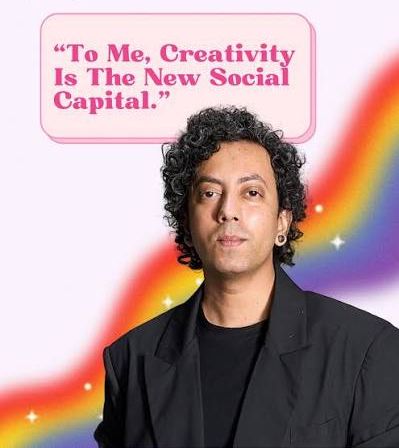
His philosophy extends beyond the studio into a broader vision for how creativity can reshape society. "Over time I have come to believe that coexistence and mindful business are inherent for the future," he says. "To me, creativity is the new social capital and as we move away from older systems that were based on watertight divisions, this new way of thinking and functioning ensure real progress."
The Recognition — Vivienne Westwood, Lakme Fashion Week, FDCI Boys Club, and Pitch to Get Rich
Linetribe has earned recognition at every level of the Indian fashion establishment in a remarkably short time since its 2020 launch.
When Vivienne Westwood brought its capsule collection featuring hand-woven Chanderi silk and khadi cotton to Mumbai, the guests who attended chose homegrown labels that echoed the same values. Stylist Divyak D'Souza chose Linetribe: "When I heard that the Vivienne Westwood team was working with Indian textiles, I thought I would also like to work with a bright young name in Indian fashion who works with textiles in a contemporary way." He described the suit as "punk, the right balance of masculine and feminine."
At Lakme Fashion Week 2025, Linetribe presented as part of The Boy's Club showcase organised by FDCI, where Gaurav presented the Monolith collection, a futuristic menswear range featuring oversized jackets, tie-dye techniques, and metallic accents. "I wanted to balance functionality with ornamentation while keeping the essence of Linetribe intact," he said. Lakme Fashion Week described the label as "gender fluid, contemporary, and creative" with "bright colours, oversized silhouettes, and impeccable tailoring."
On Pitch to Get Rich Season 1 on JioHotstar, Linetribe was featured as one of the 14 visionary fashion founders selected to compete for funding and mentorship from India's most celebrated names in entertainment and business, including Akshay Kumar, Karan Johar, Manish Malhotra, and Malaika Arora, alongside leading industrialists from the ₹40 crore investment pool. The platform has since grown significantly, with Pitch to Get Rich Season 2 announcing a ₹100 crore investment pool, a 150% increase from Season 1, confirming the scale of the stage that Linetribe stepped onto.
1.Education & First Venture (Pre-2014):
Studied pattern cutting, draping, and tailoring at Wigan and Leigh College in England; co-founded and closed his initial label, Gaurav and Ritika, in 2014.
2.Industry Consulting & Detachment (2014–2019):
Gained cross-functional fashion experience via consulting with Urvashi Kaur on Amazon, styling, e-commerce, and social media management.
3.Linetribe Launch in Solitude (2020):
Returned to design during the 2020 lockdown, founding the gender-fluid, silhouette-centric western wear label Linetribe in Delhi.
4.High-Profile Platforms & Industry Recognition (2020–2025):
Styled for the Vivienne Westwood Mumbai event, showcased the 'Monolith' collection at Lakme Fashion Week 2025, and competed on JioHotstar's Pitch to Get Rich Season 1.
Scale and Real-World Impact
Enterprise Parameter
Key Metrics & Operational Details
Founder & Role
Gaurav Jagtiani (Creative Director and Founder)
Headquarters & Year
Delhi, India | Founded in 2020
Educational Foundation
Wigan and Leigh College (England)
Previous Label
Gaurav and Ritika (Closed in 2014)
Prior Industry Experience
Consulting (Urvashi Kaur on Amazon), Styling, E-commerce, Social Media
Brand Identity & Aesthetic
Gender-fluid contemporary western wear, silhouette-centric design, Ikat-infused streetwear
Lakme Fashion Week 2025 (FDCI's The Boy's Club - Monolith Collection)
Special Events & Features
Vivienne Westwood Mumbai event (Styled by Divyak D'Souza)
Media & Venture Competitions
Pitch to Get Rich Season 1 on JioHotstar (Selected among 14 founders for ₹40 Cr pool)
The Most Enduring Fashion Brands Are the Ones Built by Founders Who Design From Their Deepest Truth
The sharpest lesson from Gaurav Jagtiani's journey is this: the most defensible and most distinctive fashion brands are built by founders who design from a place of genuine personal conviction rather than market trend analysis.
Gaurav shut down his first label. He walked away from design for years. He built expertise in every dimension of the fashion business from the outside. And when solitude gave him back his voice, he built a brand that questioned gender, culture, and community through every silhouette, every seam, and every line.
"Creativity is the new social capital," he says. "Coexistence and mindful business are inherent for the future."
He started with a line. He built a tribe. And India's fashion industry is genuinely more inclusive for it.