Ahead of the December 2026 expiration of the 30-year Ganga Water Treaty with Bangladesh, West Bengal has urged India's Central Government to protect state interests. Submitting technical reports to the Union Ministry of Jal Shakti, state officials emphasized securing adequate downstream water flows to sustain ports, industry,and municipal drinking supplies.
KOLKATA — The West Bengal government has formally requested the Union Government to protect the state's critical water, industrial, and maritime interests ahead of the scheduled renewal of the 30-year Ganga Water Sharing Treaty with Bangladesh.
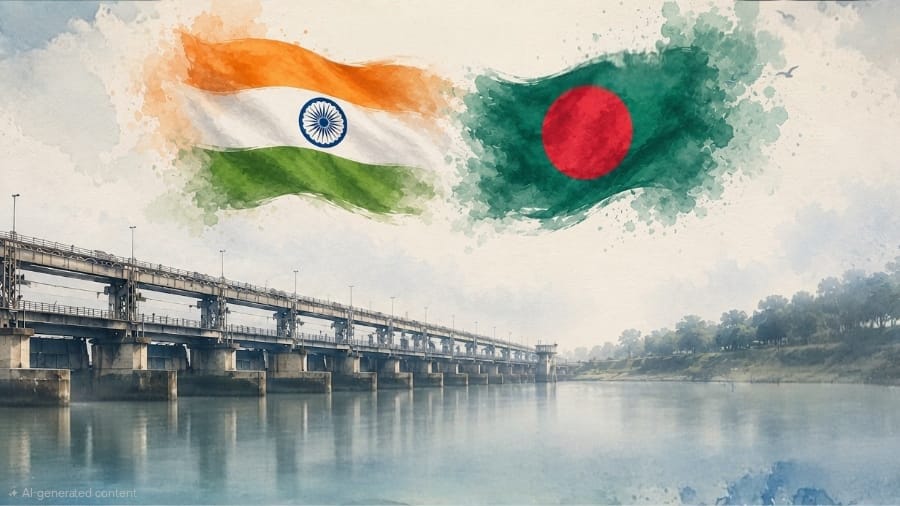
The bilateral pact, originally signed in December 1996 to govern dry-season water allocation at the Farakka Barrage, is set to expire in December 2026. State officials presented detailed hydrological and economic assessments during a recent meeting of an internal committee organized by the Union Ministry of Jal Shakti. The state government emphasized that any revised agreement must secure adequate downstream flow to sustain irrigation, urban drinking water infrastructure, and commercial navigation along the Bhagirathi-Hooghly river system.
Hydrological Concerns and Port Operations
A primary focus of West Bengal's submission involves severe siltation along the lower stretches of the Ganga River network. State bureaucrats warned that reduced dry-season discharge exacerbates heavy sediment accumulation, increasing the frequency of regional flooding and hindering vessel movements toward Kolkata's Syama Prasad Mookerjee Port.
The 1996 treaty establishes a ten-day rotational schedule between January 1 and May 31 each year to distribute water at Farakka, located in West Bengal's Murshidabad district. However, environmental shifting and upstream diversions over the past three decades have reduced baseline river volume.
"Our primary concern is to ensure that the state's legitimate requirements are adequately protected in any renewed agreement," a senior West Bengal state bureaucrat stated during the ministry review. "Adequate downstream flow during the dry season is particularly vital for the Bhagirathi-Hooghly system to control siltation and sustain municipal water supply systems".
Official Sources Section
According to official releases from the Union Ministry of Jal Shakti and statements from the West Bengal Irrigation and Waterways Department, formal consultative channels remain open between central technical panels and state nominees. State authorities confirmed submitting a comprehensive demand report projecting West Bengal's multi-sectoral water requirements for the next 30 years.
Quote Section
According to senior state officials, the official technical submission underscores that emerging environmental threats require modern evaluation.
Organizers and ministry representatives stated that joint technical committee meetings between Indian and Bangladeshi counterparts will continue to evaluate historical hydrological data alongside evolving downstream demands prior to finalizing a diplomatic framework.
Why It Matters
The outcome of the Ganga Water Treaty renegotiation directly influences eastern India's maritime trade, urban drinking water access, and agricultural stability. Reduced water flow into the Hooghly River increases salinity levels in coastal municipal supplies and requires costly maintenance dredging to keep shipping channels open to Kolkata and Haldia ports. For regional industries and farming communities across southern West Bengal, securing guaranteed water allocations remains essential for ongoing operations.
Key Facts at a Glance
Treaty Expiry: The 30-year bilateral Ganga Water Sharing Treaty between India and Bangladesh expires in December 2026.
Core Mechanism: Governs lean-season water distribution (January–May) from the Farakka Barrage in Murshidabad district.
State Demands: West Bengal seeks protected discharge volumes to clear riverbed silt, preserve shipping channels, and curb groundwater depletion.
Key Risk: Low freshwater flows increase riverbed siltation and elevate coastal water salinity levels.
Frequently Asked Questions
What is the 1996 Ganga Water Sharing Treaty?
The 1996 treaty is a 30-year bilateral agreement between India and Bangladesh that defines how water from the Ganga River is shared at the Farakka Barrage during the dry season from January 1 to May 31.
Why is West Bengal asking for specific assurances?
The state government seeks to protect Kolkata Port navigation, satisfy growing industrial and drinking water demands, and mitigate excessive riverbed siltation and coastal soil salinity.
When does the current water treaty expire?
The treaty concludes its 30-year term on December 12, 2026, requiring both nations to agree on a revised framework or extend existing provisions.
Source: Official statements from the Ministry of Jal Shakti, public filings from the Government of West Bengal, and operational updates from Syama Prasad Mookerjee Port Trust.