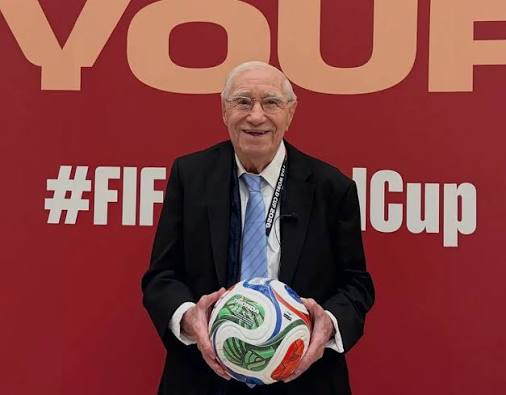
91-year-old Argentine journalist Enrique Macaya Márquez has commenced coverage of his 18th consecutive FIFA World Cup. A veteran of the sport since 1958, Márquez remains a pivotal voice in international sports media, bridging the gap between football's history and its modern, data-driven evolution during the 2026 tournament.
BUENOS AIRES — Enrique Macaya Márquez, the veteran Argentine sports journalist, has officially commenced his coverage of the 2026 FIFA World Cup, marking his 18th consecutive tournament as a broadcaster. At 91 years old, his participation sets an unprecedented record in sports media, spanning a career that began during the 1958 World Cup in Sweden.
The longevity of his career serves as a bridge between different eras of the sport. From the analog broadcasts of the mid-20th century to the high-definition, data-driven coverage of the modern digital age, Márquez remains a primary source of analysis for audiences across South America. His presence at the 2026 tournament, co-hosted by the United States, Mexico, and Canada, highlights the enduring nature of sports journalism and its role in chronicling the evolution of global football.
A Career Defined by Consistency
Márquez’s journalistic journey is intrinsically linked to the history of the FIFA World Cup. Having covered every tournament since 1958, he has provided expert commentary on the rise of legends like Pelé, Diego Maradona, and Lionel Messi. His professional consistency has earned him accolades from the International Sports Press Association (AIPS), which has previously recognized his contributions to international sports media.
According to official accreditation records, his ability to adapt to changing broadcast technologies—moving from radio and print to television and now multi-platform digital streaming—has allowed him to maintain a significant audience share. His analysis is noted for a focus on tactical evolution, emphasizing how the sport’s mechanics have shifted over seven decades.
The Evolution of Football Analysis
The role of a sports journalist at the FIFA World Cup has transformed significantly since Márquez began his career. Where once analysts relied on physical scouting and intuition, today's reporting involves deep integration with advanced sports analytics, GPS tracking data, and video assistant referee (VAR) technology.
Despite these changes, Márquez maintains a focus on the human and strategic elements of the game. Industry peers have lauded his work for preserving the context of past tournaments while providing contemporary insights into current match-day strategies. For many followers of the sport, his coverage represents a living archive of football’s global growth and its transition into the world’s most televised sporting event.
Impact on Sports Media and Fans
The continued participation of a 91-year-old journalist has resonated with both younger audiences and industry veterans. It underscores the value of experience in a field often characterized by rapid turnover and youth-centric trends. For sports organizations and media outlets, Márquez’s career serves as a case study in audience engagement and the importance of authoritative, historical narratives in sports broadcasting.
The media landscape surrounding the FIFA World Cup has also benefited from the increased interest in long-form, analytical content. As global viewership numbers reach into the billions, journalists with deep historical context, like Márquez, play a vital role in framing the significance of individual matches and tournament outcomes for a new generation of fans.
Official Sources
Quote Section
"According to officials" from the broadcasting teams covering the event, Márquez’s preparation for the 2026 tournament has been as rigorous as in previous years. Organizers stated that his presence on the press roster provides a sense of continuity that is highly valued by global media partners, ensuring that the tournament’s history is accurately preserved for future viewers.
Why It Matters
Márquez’s participation is a testament to the longevity of sports culture and the importance of institutional memory in media. His record-breaking 18th appearance at the FIFA World Cup ensures that the 2026 tournament is framed through the lens of history, providing a depth of analysis that reflects the development of football as both a sport and a global social phenomenon.
Key Facts at a Glance
Tournament Record: Covering his 18th consecutive FIFA World Cup.
Journalistic Span: Career started at the 1958 tournament in Sweden.
Professional Legacy: Recognized by AIPS for his contributions to sports broadcasting.
Global Reach: His analysis is broadcast across various platforms, reaching millions of Spanish-speaking football fans globally.
FAQ
How many World Cups has Márquez covered?
Enrique Macaya Márquez is currently covering his 18th consecutive FIFA World Cup.
When did his career start?
His career in international sports journalism began at the 1958 FIFA World Cup in Sweden.
Why is his coverage significant?
His long-standing career provides a unique historical perspective on the tactical and cultural evolution of football over the past seven decades.
Source: FIFA, AIPS, FAP