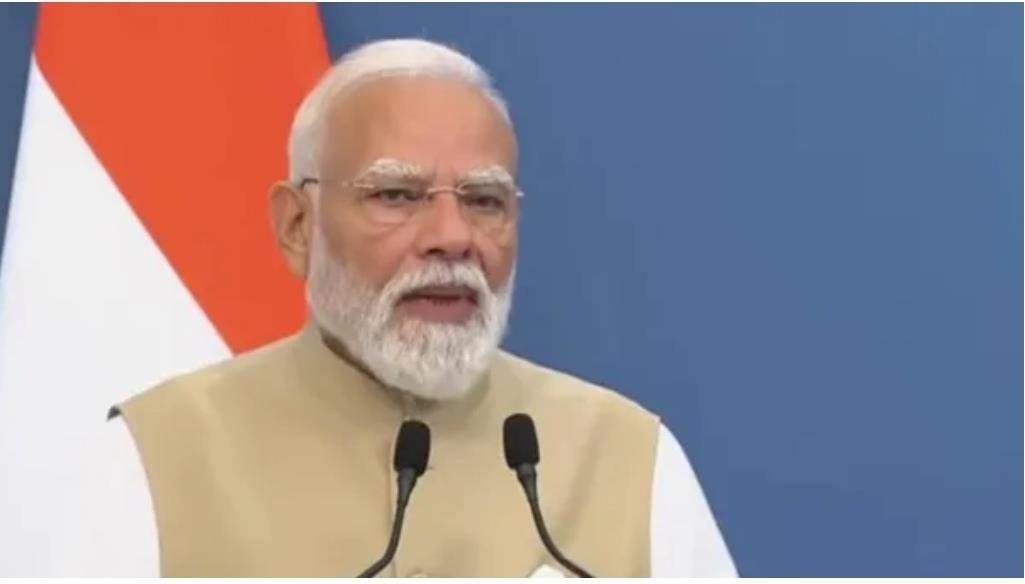
Prime Minister Narendra Modi stated that the abrogation of Article 370 has fulfilled the dream of Bharatiya Jana Sangh founder Dr. Syama Prasad Mookerjee for full national integration. Marking Mookerjee's 125th Jayanti, the PM also praised the West Bengal government for actively honoring the leader's historical legacy.
NEW DELHI, India — Prime Minister Narendra Modi announced Monday, July 6, 2026, that the abrogation of Article 370 has successfully fulfilled the foundational dream of Bharatiya Jana Sangh founder Dr. Syama Prasad Mookerjee. The development marks the complete integration of Jammu and Kashmir under a single national framework.
Addressing a commemorative gathering via a video message on Mookerjee’s 125th birth anniversary, the Prime Minister described the late leader as a distinguished nation-builder, scholar, and champion of absolute national unity. Speaking from New Delhi, Modi drew a direct line from Mookerjee's mid-century political struggles to contemporary policy achievements, emphasizing that the complete enforcement of the Indian Constitution across all territories represents the realization of a long-standing national resolution.
Concurrently, the Prime Minister lauded the newly formed Bharatiya Janata Party (BJP) government in West Bengal, led by Chief Minister Suvendu Adhikari, for prioritizing heritage preservation and organizing grand commemorative events to honor the state's historic leaders.
Dismantling the Dual System to Achieve Supreme Unity
The Prime Minister emphasized that Mookerjee’s lifelong campaign was aimed at eliminating parallel administrative mechanisms that compromised the sovereignty of the republic. During the early post-independence years, the temporary provisions of Article 370 permitted Jammu and Kashmir to maintain a distinct state flag, a separate constitution, and unique executive titles.
According to parliamentary address records published by the Prime Minister's Office (PMO), Mookerjee fiercely challenged this internal partition by introducing a powerful legislative rallying cry to the masses. He established the definitive guiding principle that one sovereign nation cannot tolerate the coexistence of two separate constitutions, two heads of state, and two national symbols.
Modi stated that the legislative actions taken by Parliament in August 2019 permanently brought down that political wall, ensuring that every citizen across Jammu and Kashmir now enjoys equal rights under a single, unified national consciousness.
Historical Defense of Bengal and Institutional Legacy
The address highlighted Mookerjee’s critical intervention during the partition crisis of 1947. The Prime Minister recounted how complex political conspiracies threatened to absorb the entirety of the Bengal province into Pakistan. Through systematic public mobilization and relentless political negotiations, Mookerjee successfully secured the partition of the province itself, ensuring that West Bengal remained an integral territory of the Indian Union.
Beyond territorial integration, the Prime Minister detailed Mookerjee’s contributions to economic self-reliance as independent India's first Industry Minister. He credited the leader with laying the operational foundations for institutions that anchored India's heavy engineering sectors for decades, including the Chittaranjan Locomotive Works, the Sindri Fertilizer Plant, and the Damodar Valley Corporation.
Lauding West Bengal’s Nation First Governance Shift
A major focus of the Prime Minister's address was the changing political landscape in Kolkata. Modi explicitly praised the state administration for breaking away from past political frameworks that downplayed regional icons, noting that under a governance model built on the principle of "Nation First," national heroes are finally receiving proper institutional honor.
The Prime Minister specifically highlighted the grand celebration of Paschim Banga Divas (West Bengal Foundation Day) on June 20 as an example of this cultural revival. Simultaneously, attending a parallel commemorative event at Kolkata's Milan Mela Prangan, Union Home Minister Amit Shah laid the foundation stone for a landmark 125-foot statue of Mookerjee at his birthplace. Shah confirmed that the state has formally declared July 6 a public holiday and has initiated structural panels to prepare for the rollout of a Uniform Civil Code (UCC) within the state.
Official Sources Section
The text of the address, historical citations, infrastructure summaries, and administrative timelines correspond directly with official press sheets authorized by the Press Information Bureau (PIB), along with official transcripts archived by the Ministry of Culture under the national two-year commemoration guidelines.
Quote Section
"Today, our government takes pride in the fact that by bringing down that wall, we have fulfilled Dr. Mookerjee's dream," stated Prime Minister Narendra Modi in his formal video message. "His idea of 'Ek Bharat, Shreshtha Bharat' is now the motto for the country, ensuring that the Constitution of India is implemented with full pride and glory throughout the entire land."
Why It Matters
For citizens, travelers, and corporate businesses, the total legal integration of Jammu and Kashmir simplifies regulatory processes, opens real estate investment opportunities, and normalizes tourist transit across the region. For the broader public, the alignment between historical national goals and modern executive governance provides stability to the legal framework. It ensures that critical state policies, from the National Education Policy's focus on local languages to industrial self-reliance initiatives, remain anchored in a shared constitutional identity.
Key Facts at a Glance
Dream Fulfilled: The abrogation of Article 370 successfully realized Mookerjee's vision of full national integration.
Bengal Honor: PM Modi lauded the West Bengal government for organizing grand heritage celebrations, including Paschim Banga Divas.
Statue Foundation: Union Home Minister Amit Shah laid the foundation stone for a 125-foot statue of Mookerjee in Kolkata.
Two-Year Commemoration: The central government is managing a nationwide two-year cycle to celebrate the leader's 125th birth anniversary until July 2027.
Linguistic Alignment: The PM noted that the National Education Policy's emphasis on local languages fulfills Mookerjee's educational philosophy.
Frequently Asked Questions
Why did Dr. Syama Prasad Mookerjee oppose Article 370?
Mookerjee strongly opposed Article 370 because it created a separate constitutional identity for Jammu and Kashmir, which he argued damaged national unity by allowing a single state to have its own flag and distinct laws.
What role did Mookerjee play during the 1947 Partition of India?
When political moves threatened to include the entire province of Bengal into Pakistan, Mookerjee mobilized public opinion to partition the province, successfully keeping West Bengal within India.
How long will the national celebrations marking his 125th Jayanti continue?
The Government of India is leading a comprehensive, two-year national commemoration that officially began on July 6, 2025, and will conclude on July 6, 2027.
Source: Official speech indexes issued by the Prime Minister's Office (PMO) India, national heritage circulars from the Ministry of Culture, and legislative archives at the Press Information Bureau.