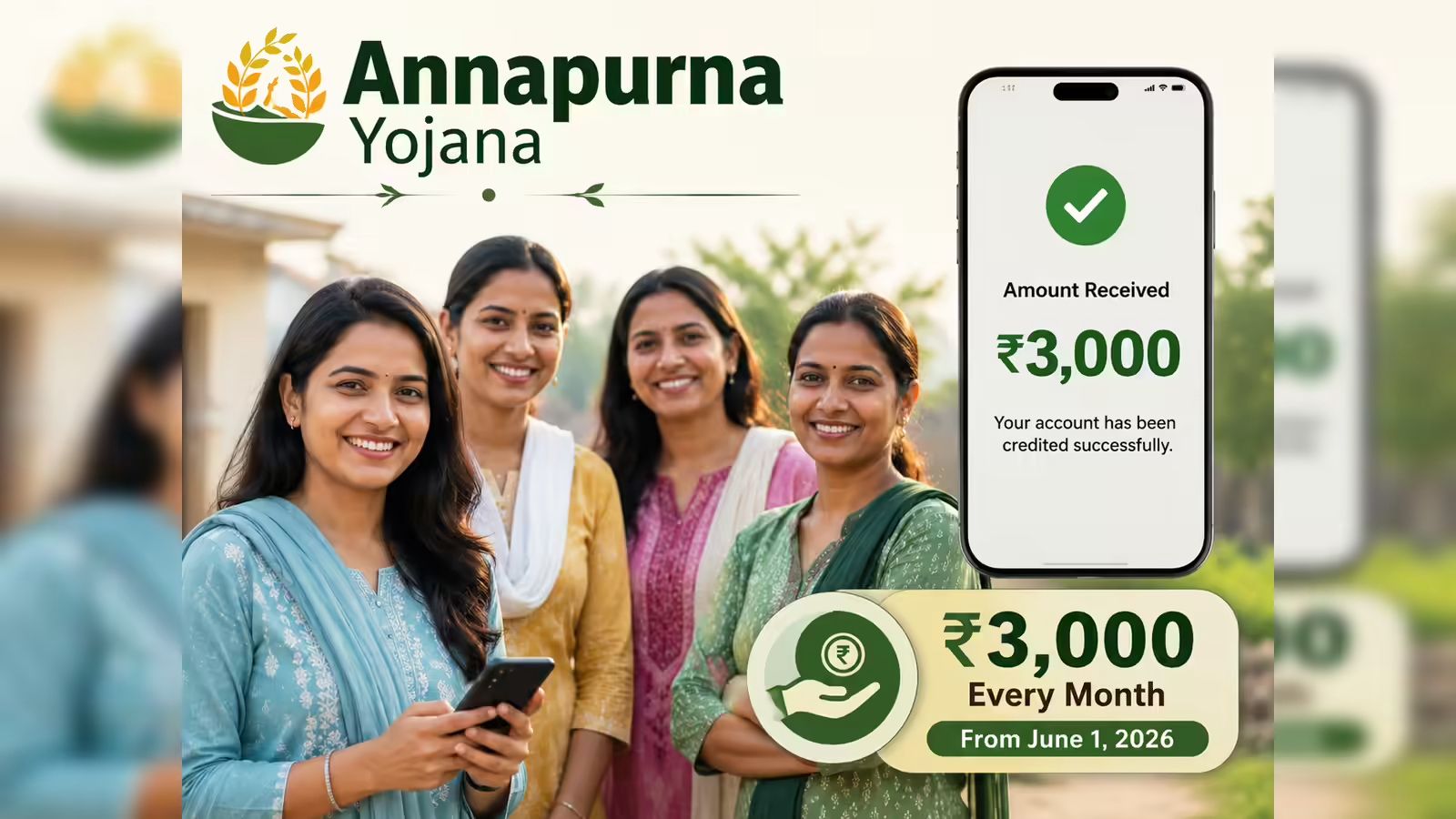
The Government of West Bengal launched the "Annapurna Yojana" on June 3, 2026, transferring ₹3,000 monthly to over 28 lakh women in its first phase. Replacing the old Lakshmir Bhandar scheme, the initiative unifies cash assistance, lowers the eligibility age to 21, and includes free travel on state buses.
KOLKATA — In a major realignment of its state-level social safety net, the Government of West Bengal has officially rolled out its highly anticipated women's welfare program, the "Annapurna Yojana." Formally launched at the Nabanna secretariat on Wednesday, June 3, 2026, by newly sworn-in Chief Minister Suvendu Adhikari, the Direct Benefit Transfer (DBT) initiative immediately credited a flat ₹3,000 to the bank accounts of 28,25,769 verified female residents during its first operational phase. Administered by the state's Women and Child Development Department, this sweeping structural intervention completely replaces the previous administration's "Lakshmir Bhandar" scheme, uniformizing and nearly doubling the volume of direct cash assistance to fortify the liquid purchasing power of rural and urban families across West Bengal.
Restructuring Cash Welfare and Standardizing Payouts
According to official executive orders ratified by the Cabinet and archived on the single-window West Bengal Social Security Portal, the new policy completely removes the previous multi-tiered, category-based payment structure. Under the defunct Lakshmir Bhandar platform, the state distributed fractured monthly sums of ₹1,200 to General category applicants and ₹1,500 to Scheduled Caste (SC) and Scheduled Tribe (ST) households.
The baseline rules for the Annapurna Yojana permanently replace that framework by establishing a universal, flat payout of ₹3,000 per month for every qualified female applicant, regardless of caste or social community lines. Furthermore, the administration has paired this financial payout with a universal mobility benefit: starting June 1, all registered beneficiaries are legally entitled to free travel on all state-run public transport buses operating across West Bengal.
Streamlined Migration Pathways and Age-Limit Relaxations
To ensure continuity of basic household funding, administrative directives confirm that the vast majority of existing Lakshmir Bhandar users are being automatically migrated into the active database of the Annapurna Yojana without needing to complete fresh physical paperwork. However, to prevent leakages, state data teams are vetting records against the State Identification Register (SIR-2026) to filter out deceased, shifted, or duplicate voter entries.
For new registrations, the Department of Personnel has initiated a massive 90-day enrolment drive spanning from late May through August 25, 2026. Strikingly, the state has lowered the minimum qualification age threshold from 25 down to 21 years, enabling a much larger demographic of young university students and early-career women to access the direct safety net.
Multi-Layered Screening Guidelines to Prevent Double Dipping
While the expansion targets an eventual baseline of nearly two crore citizens, the Women and Child Development Department has codified strict exclusion parameters to protect the state exchequer from extreme fiscal stress. Women who currently pay income tax, receive a regular pension from central or state programs, or hold a permanent government job within statutory bodies, municipalities, or government-aided educational institutions are legally prohibited from applying.
Verification operations are decentralized across distinct administrative units to guarantee transparent target delivery. Block Development Officers (BDOs) manage rural verification tracks, Sub-Divisional Officers (SDOs) oversee urban blocks, and specialized desk officers evaluate files within the Kolkata Municipal Corporation (KMC) perimeter, with District Magistrates serving as the ultimate sanctioning authorities before monthly electronic funds are authorized.
"According to officials present at Nabanna, the launch of the Annapurna Yojana fulfills a vital core electoral promise to put liquid assets directly into the hands of the household managers who drive our rural economy. By modernizing the Direct Benefit Transfer tracking software and linking payments strictly to active Aadhaar clearance networks, we have completely eliminated administrative middleman intervention while delivering double the previous level of financial security."
Official Sources Section
The social security parameters, financial allocation structures, regulatory age boundaries, and verification pipelines detailed in this economic report are compiled directly from the policy dockets issued by the West Bengal Cabinet, gazetted rollout notifications posted via the West Bengal State Portal, and launch transcripts archived at the Nabanna administrative headquarters.
Why It Matters
The rollout of the Annapurna Yojana has deep practical implications for the household economies of millions of low- and middle-income families across West Bengal. Raising the baseline monthly allowance to a flat ₹3,000 provides women with a reliable source of liquid cash to pay for immediate necessities like nutritional food, school textbooks, utility bills, and private medical checkups, reducing reliance on local moneylenders. For small-scale local retailers, the monthly injection of thousands of crores in rural purchasing power creates a predictable economic multiplier effect, stimulating market demand for daily consumer items. Additionally, by lowering the minimum entry age to 21 and removing caste-based funding divisions, the program creates an equal playing field for younger women, encouraging them to open personal bank accounts and participate actively in the modern financial system.
Key Facts at a Glance
Direct Cash Inflow: Eligible female residents across West Bengal will receive a flat ₹3,000 every month via Direct Benefit Transfer (DBT).
Massive First Phase: The initial launch at Nabanna immediately disbursed funds to exactly 28,25,769 verified, Aadhaar-linked bank accounts.
Universal Payout Rate: The new policy eliminates the previous tiered payment system based on caste, standardizing the benefit for all eligible applicants.
Expanded Age Access: The minimum entry requirement has been lowered from 25 to 21 years, allowing young adults to register during the current 90-day enrolment drive.
Transit Mobility Boost: Registered scheme beneficiaries are entitled to free travel on all state-operated public transport buses.
FAQ Section
Do existing Lakshmir Bhandar beneficiaries need to fill out a new form for the Annapurna Yojana?
No. Existing, active beneficiaries of the previous scheme are automatically migrated into the new system by state data teams, provided their bank accounts remain active and linked to their Aadhaar card.
Who is excluded from applying for the new ₹3,000 monthly benefit?
Women who pay income tax, receive a formal government pension, or are employed in permanent positions within state or central government agencies, panchayats, municipal bodies, or government-aided schools are not eligible.
How can a new applicant register for the program, and what documents are needed?
New applicants can register online via the official portal or submit physical applications at local block offices and upcoming Janakalyan Shibir camps. Required documents include an Aadhaar card, Voter ID, proof of West Bengal residence, and an active bank passbook showing clear IFSC details.
What is the specific timeline for the monthly cash transfers?
According to the state's updated financial disbursement calendar, the ₹3,000 monthly allowance will be deposited into verified bank accounts during the first seven days of each calendar month.
Source: Policy framework files managed by the West Bengal Women and Child Development Department, operational data tracking reports from the Nabanna Secretariat, and local coverage from the Anandabazar Patrika and Times of India financial desks