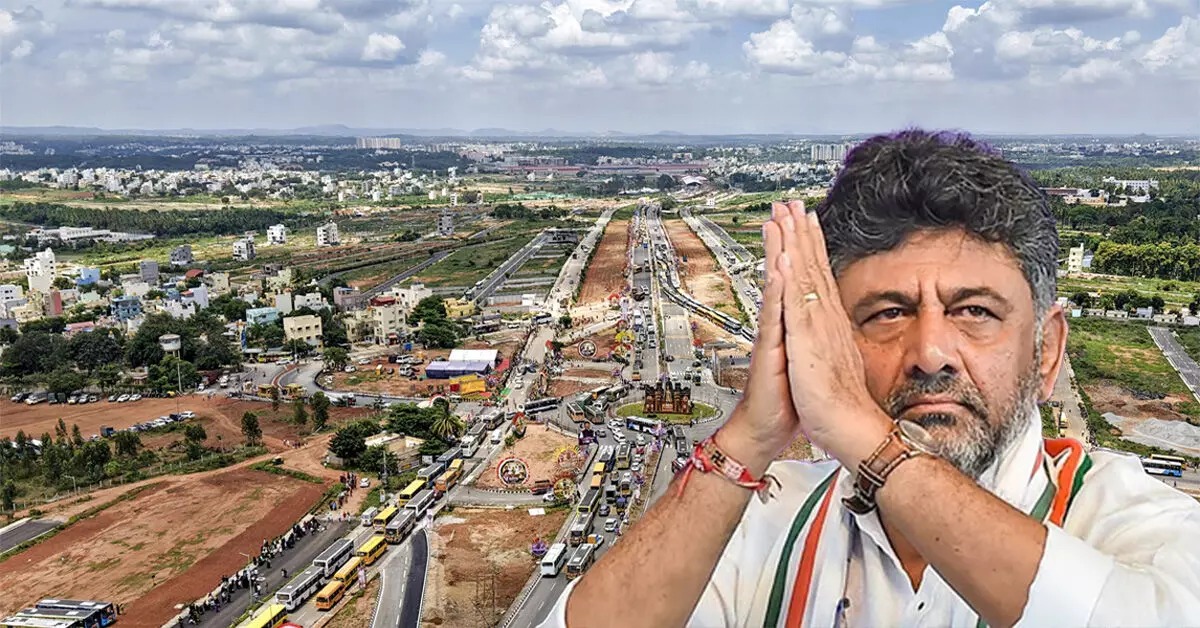
Karnataka Deputy Chief Minister D.K. Shivakumar has inaugurated the 10.7-km S.M. Krishna Road in Bengaluru. The 10-lane signal-free corridor, built for ₹631 crore, connects Kadabagere Cross to Challaghatta. The toll-free arterial route is expected to reduce travel time between Magadi Road and Mysuru Road significantly, marking a major step in urban mobility.
The 10-lane arterial corridor aims to slash travel time between Magadi Road and Mysuru Road to just 20 minutes.
BENGALURU — Karnataka Deputy Chief Minister D.K. Shivakumar officially inaugurated a 10.7-kilometer, 10-lane signal-free corridor on Saturday, June 27, 2026. The new infrastructure, named S.M. Krishna Road after the former Karnataka Chief Minister, is designed to significantly alleviate traffic congestion in western Bengaluru by providing a toll-free alternative to existing routes.
The inauguration ceremony coincided with the 517th birth anniversary celebrations of Nadaprabhu Kempegowda, the founder of Bengaluru. The new corridor connects Kadabagere Cross to Challaghatta Metro Station, serving as a vital link for commuters in the rapidly expanding western and southern parts of the city.
Strategic Connectivity and Infrastructure
Built at an investment of ₹631 crore by the Bangalore Development Authority (BDA), the S.M. Krishna Road is 100 meters wide and features a sophisticated design intended to minimize traffic bottlenecks. The project includes three underpasses, 11 bridges, and a 270-meter tunnel.
According to officials, the corridor is engineered for long-term growth, incorporating a three-meter central median specifically designed to accommodate future Namma Metro connectivity. The route passes through the Nadaprabhu Kempegowda Layout and is expected to benefit residents of Kambipura, Kommaghatta, Kenchanapura, and several neighboring villages, while also providing a streamlined path for long-distance commuters arriving from Mysuru, Mandya, Hassan, and Ramanagara.
Future Expansion and "Wall of Gratitude"
During the inauguration, Deputy CM Shivakumar outlined an ambitious long-term mobility blueprint, noting that the current 10.7-km stretch is only the beginning. "This road will not stop at 11 km; it will later be expanded to 123 km," he stated, referring to the broader Bengaluru Business Corridor project currently in development.
In a unique policy move, the Karnataka government plans to establish a "Wall of Gratitude" along the corridor to permanently honor the landowners who voluntarily provided their land for the project. Shivakumar emphasized that this model of voluntary land acquisition, which offers options for commercial land, residential land, or Transferable Development Rights (TDR), will be implemented across all future infrastructure developments in the state.
Why It Matters
For Bengaluru’s millions of daily commuters, the S.M. Krishna Road represents a much-needed relief valve. By providing a high-capacity alternative to existing arterial roads, the government expects the corridor to reduce commute times between Magadi Road and Mysuru Road from approximately 60 minutes to just 20 minutes. This project is a central component of Karnataka's strategy to address the city’s rapid urban expansion and the increasing demand for seamless connectivity across its suburban peripheries.
Key Facts at a Glance
Project Scope: A 10.7-km long, 100-meter-wide, 10-lane signal-free corridor.
Cost & Time: Constructed at an investment of ₹631 crore; reduces peak travel time by 40 minutes.
Key Features: Includes three underpasses, 11 bridges, a 270-meter tunnel, and a dedicated cycling track.
Future Vision: The corridor is planned to be part of a 123-km Bengaluru Business Corridor expansion.
Naming: Officially named S.M. Krishna Road in honor of the former Chief Minister’s contributions to the city's modernization.
Frequently Asked Questions
Where does the new S.M. Krishna Road start and end?
The 10.7-km corridor connects Kadabagere Cross to the Challaghatta Metro Station in Bengaluru.
Is there a toll fee to use this new corridor?
No, the corridor is completely toll-free, as confirmed by the Karnataka government during the inauguration.
How does this road benefit commuters from other districts?
It provides an efficient alternative for travelers coming from Mysuru, Mandya, Hassan, and Magadi, bypassing the city’s more congested traditional entry points.
What is the "Wall of Gratitude" mentioned by the Deputy CM?
It is a government initiative to permanently record and honor the names of landowners who voluntarily provided their property to facilitate public infrastructure projects.
Are there other major infrastructure projects planned for Bengaluru?
Yes, the government is currently advancing the 123-km Bengaluru Business Corridor and a new 2.2-km tunnel project near Hebbal to further reduce citywide traffic congestion.
Source: Deccan Herald, Financial Express, WebIndia123