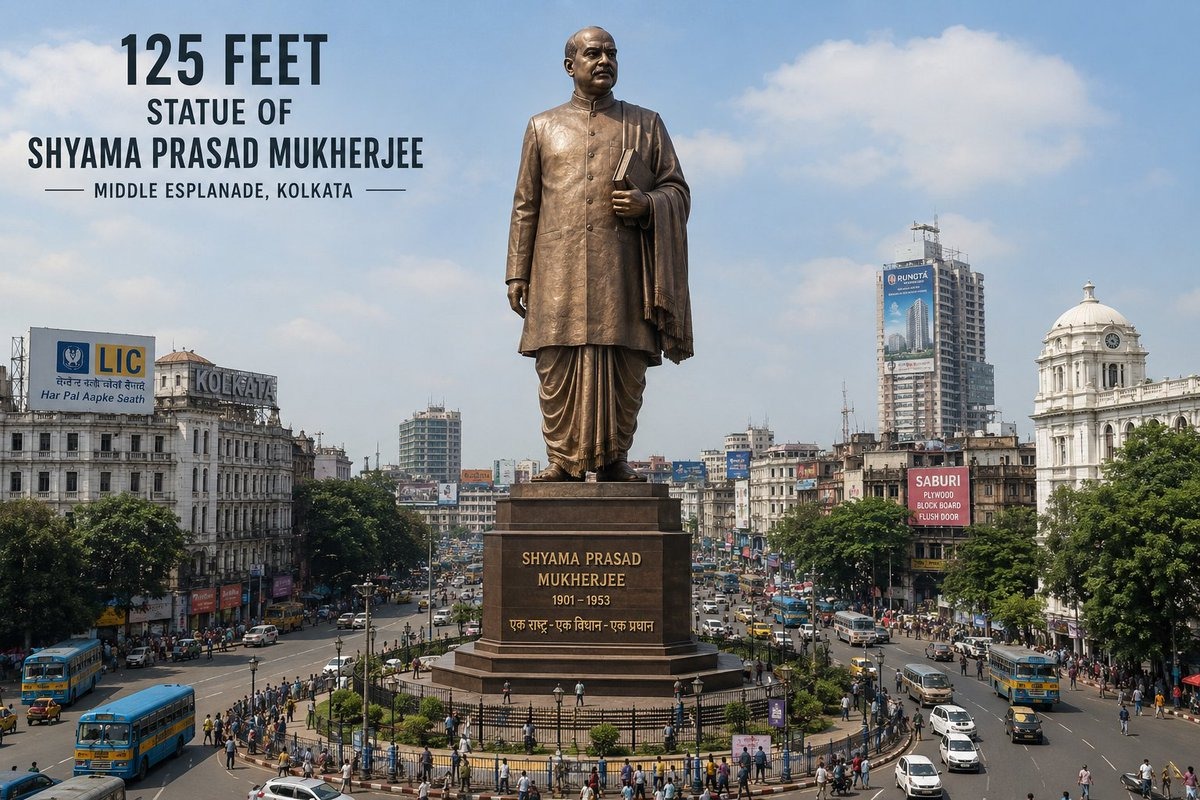
West Bengal Chief Minister Suvendu Adhikari has announced the installation of a 125-foot standing statue of Dr. Syama Prasad Mookerjee in Kolkata to mark his 125th birth anniversary. Additionally, the state government will purchase Mookerjee's ancestral home in Hooghly's Jirat to develop a heritage memorial and library.
TARAKESWAR, INDIA — West Bengal Chief Minister Suvendu Adhikari announced on Saturday, June 20, 2026, that his government will construct a 125-foot-tall standing statue of Dr. Syama Prasad Mookerjee in Kolkata. Speaking at an official event in Hooghly's Tarakeswar district to mark the state's first officially observed Paschimbanga Divas (West Bengal Day), the Chief Minister confirmed that the state cabinet has formally approved the cultural infrastructure project.
As part of the same commemorative framework, the state government will acquire Mookerjee’s ancestral home in the village of Jirat to build a public memorial and repository library. This major announcement carries profound administrative weight today, as it solidifies a permanent policy shift toward honoring the state's nationalist heritage ahead of Mookerjee's 125th birth anniversary celebrations.
Twin Projects to Reshape Kolkata Skyline and Hooghly Heritage
The two-pronged heritage initiative is designed to preserve the political legacy of the Bharatiya Jana Sangh founder. While the physical scale and technical height of the standing statue have been finalized at 125 feet, surveys are underway to determine its exact location within Kolkata. Administrative sources from the state Public Works Department and the Department of Information and Cultural Affairs indicated that the neighborhood of Bhabanipur in South Kolkata is currently the primary contender for the installation due to its direct historical links with the Mookerjee family. When completed, the monument will stand as the tallest statue of Mookerjee in the world.
Simultaneously, the state government will finalize land acquisition procedures for Mookerjee's ancestral homestead in Jirat, Hooghly. Mookerjee's grandfather, Ganga Prasad Mukhopadhyay, was born in the village before settling in Kolkata, where Syama Prasad was subsequently born in 1901. The upcoming Jirat memorial complex will feature a comprehensive library dedicated to preserving regional history, original manuscripts, and socio-political literature from the mid-20th century.
Historical Revisionism and Syllabus Reforms
The official announcement was intentionally timed to coincide with West Bengal Day, which the newly formed state government celebrated officially for the first time. Addressing a gathering that included Prime Minister Narendra Modi, Chief Minister Adhikari highlighted the historical events of 1947. He noted that under Mookerjee's active leadership, a historic Maha Sammelan was convened at Tarakeswar in 1947, which heavily influenced the vote of 58 legislators to successfully ensure that West Bengal remained a part of the Indian Union during Partition.
The policy shift signals a broader cultural agenda by the new state cabinet. Alongside the physical installations, the government plans to introduce the specific historical details of Paschimbanga Divas and Dr. Mookerjee's role during Partition into the official primary and secondary state school syllabi. This structural overhaul aims to update the state's educational landscape, balancing decades of historical documentation published by prior administrations.
Impact on Tourism, Urban Infrastructure, and Public Service
The rollout of these multi-crore cultural landmarks directly impacts local economies, citizens, and regional urban planning. The construction of a 125-foot statue in Kolkata will demand specialist engineering assessments to ensure structural stability against regional wind resistance and seismic safety standards. Once unveiled, the site is expected to act as a primary domestic tourism driver, attracting scholars, history enthusiasts, and domestic travelers into the state capital.
In Hooghly's Jirat sector, the conversion of the ancestral property into a state-run memorial is anticipated to upgrade local hospitality facilities, generating downstream economic opportunities for local transport networks and businesses. Furthermore, to balance these long-term heritage investments with immediate public requirements, the Chief Minister announced that municipal and block offices will conduct sequential public welfare camps to ensure citizens maintain uninterrupted access to grass-roots government schemes.
Official Sources Section
The specifications regarding the statue's dimensions, land acquisition for the ancestral property, and institutional budget approvals are verified by gazetted files from the Government of West Bengal and official press statements from the Chief Minister's Office. Historical legislative voting figures from 1947 align with data preserved by the West Bengal Legislative Assembly.
Quote Section
Addressing the public gathering at Tarakeswar regarding the preservation of the state's foundational history, Chief Minister Suvendu Adhikari stated:
"Your government, the nationalist government, has decided to buy Syama Prasad Mookerjee's ancestral home in Jirat and develop it into a memorial. We will build a library there. Furthermore, your government will install a 125-foot-tall standing statue of Syama Prasad Mookerjee in Calcutta, ensuring that his legacy remains eternal."
Why It Matters
For citizens and cultural investors, the construction of these large-scale monuments signals a major realignment of West Bengal's identity and state patronage. Practically, the projects will modernize the tourism infrastructure connecting Kolkata to peripheral historical hubs like Hooghly, providing new funding routes for local preservation groups while changing how the state's formative years are taught to future generations.
Key Facts at a Glance
The Monument: A 125-foot standing statue of Dr. Syama Prasad Mookerjee will be erected in Kolkata, making it the tallest statue of the leader globally.
The Ancestral Site: The state government will acquire Mookerjee’s ancestral home in Jirat, Hooghly, transforming it into a public memorial and library.
Timeline Anchor: The twin cultural infrastructure projects are being executed to mark the icon's upcoming 125th birth anniversary.
Syllabus Expansion: The state education department will introduce the detailed history of the creation of West Bengal into school text books.
Strategic Contender: Bhabanipur, the locality housing Mookerjee’s Kolkata family home, has emerged as the most likely site for the statue.
FAQ Section
Q: Why is a 125-foot statue of Syama Prasad Mookerjee being built now?
A: The statue is being commissioned by the state government to mark the 125th birth anniversary of the leader, acknowledging his historical role during the 1947 Partition.
Q: Where exactly will the statue and the memorial be located?
A: The 125-foot statue will be installed in Kolkata, with Bhabanipur being considered a top location choice. The memorial and library will be built at his ancestral home in Jirat, Hooghly.
Q: What is the significance of the Jirat village to the Mookerjee family?
A: Jirat is the ancestral village of the family where Syama Prasad Mookerjee's grandfather, Ganga Prasad Mukhopadhyay, was born before moving to Kolkata.
Q: When will the foundation stone for the Kolkata statue be officially laid?
A: According to administrative planning updates released by state ministers, the grand foundation stone laying ceremony is scheduled to take place on July 5.
Source: Government of West Bengal Official Portal, Chief Minister’s Office (CMO) West Bengal Media Release, Press Trust of India (PTI) Archives.