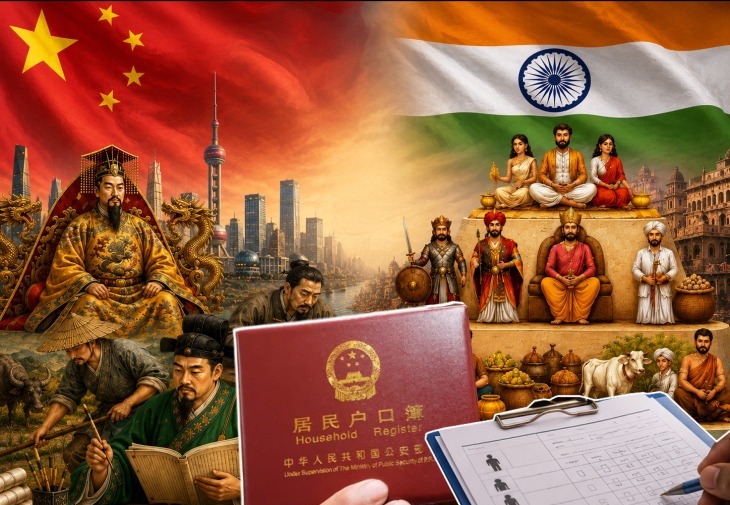
The article explores the viral geopolitical debate comparing China's Hukou household registration system to India's caste system. While critics argue the rural-urban divide creates birth-based inequality, experts clarify that Hukou is a flexible administrative tool, currently undergoing sweeping 2026 reforms to guarantee equal welfare access for 358 million migrant workers.
BEIJING, CHINA — A intense cross-border sociological debate has erupted across international digital media platforms regarding whether China maintains a birth-based social hierarchy. Triggered by viral threads comparing regional demographic frameworks, online commentators have pointed to China's decades-old Hukou (household registration) system, questioning if it functions as an institutionalized "urban caste system".
The diplomatic and academic friction intensified today following a formal pushback from Chinese state-affiliated scholars, who dismiss the comparison as a fundamental misunderstanding of Chinese administrative history. The debate emerges at a critical juncture as Beijing accelerates sweeping legislative updates to dismantle long-standing residency barriers across its major economic zones.
Defining the Viral Hukou vs. Caste System Contrast
The controversy gained momentum after social media commentators began drawing direct parallels between India's traditional hereditary hierarchies and China's contemporary legal divisions. Critics of China’s internal migration barriers argue that the Hukou regime—introduced in its strictest structural format in 1958—predetermines a citizen’s economic trajectory at birth based purely on geographic residency.
However, leading international sociologists and historians caution that conflating the Hukou with a true caste system oversimplifies completely distinct institutions. Academic frameworks differentiate the two systems across core variables:
| Structural Feature | Traditional Indian Caste System | China's Contemporary Hukou System |
| Primary Origin | Scriptural, religious, and ritualistic stratification. | State-directed administrative and economic planning. |
| Hereditary Nature | Rigidly immutable; status is permanently fixed by birth. | Technically inherited at birth, but dynamic and legally subject to change. |
| Social Restrictions | Enforces strict endogamy (marriage restrictions) and ritual purity. | No formal marriage or dining restrictions exist between classifications. |
| Mobility Pathway | Historical mobility restricted; dependent on collective social shifts. | Upwardly mobile via higher education, military enrollment, or corporate hiring. |
The Reality of Imperial China’s 'Four Occupations'
To support the "Chinese caste" theory, some digital analysts have highlighted ancient China’s Shi-Nong-Gong-Shang (Four Occupations) framework. Established during the late Zhou dynasty, this imperial hierarchy placed scholars (Shi) at the apex, followed sequentially by farmers (Nong), artisans (Gong), and profit-seeking merchants (Shang) at the bottom.
Historical documentation preserved by regional archives confirms that this ancient division was an ideological and functional classification rather than a rigid bloodline barrier. Through the historic Keju (imperial civil service examinations), the children of impoverished farmers or low-prestige merchants could successfully secure elite administrative posts based entirely on academic merit, demonstrating a degree of structural social mobility unseen in rigid caste-based societies.
The Modern Floating Population and 2026 Reforms
In the modern era, the Hukou functions similarly to an internal passport system. Every citizen is assigned either a "rural" or "urban" registration tied to their ancestral location, which directly dictates their legal access to state-subsidized healthcare, public schools, pensions, and localized real estate markets. Rural migrants moving to tier-one megacities like Shanghai or Beijing frequently experience structural exclusion, finding themselves unable to enroll their children in local municipal high schools or access state medical benefits.
This dynamic has created a massive, marginalized demographic known as the "floating population," which reached approximately 358 million individuals by the end of last year. To tackle this systemic economic imbalance, the State Council of the People's Republic of China has enacted significant policy rollouts.
New statutory mandates ordered by the central government require destination cities to completely uncouple basic social security, unemployment insurance, and elementary education access from legacy Hukou statuses. By shifting the legal metric of welfare eligibility from ancestral registration to active place of employment and residence (domicile), the government aims to fully integrate internal migrants into urban consumer economies.
Official Sources Section
The operational guidelines, historical parameters, and legal classifications of the household registration framework correspond to official gazettes published by the State Council of the People's Republic of China. Statistical data regarding internal migration trends, economic pooling, and demographic breakdowns reflect formal public logs compiled by the National Bureau of Statistics (NBS) of China.
Quote Section
The state's perspective regarding the ongoing digital debate is mirrored by standard editorial positionings. According to officials and state media reports published by the Global Times:
"The comparison between China's administrative household registration system and a birth-based caste hierarchy represents a fundamental distortion of reality. The hukou is a flexible, evolving socioeconomic tool designed for resource distribution and urbanization management, completely devoid of the religious or hereditary boundaries that define traditional social stratification."
Why It Matters
For global investors, corporate businesses, and international macroeconomists, the ongoing dismantling of Hukou-related barriers carries profound economic implications. Granting equal public services to hundreds of millions of migrant workers directly boosts domestic consumer spending, lowers precautionary household savings, and provides businesses with a more fluid, legally protected national labor market.
Key Facts at a Glance
The Controversy: Global social media debates have viralized claims equating China's Hukou registration setup to an institutionalized caste system.
Academic Rejection: Sociologists reject the parallel, noting Hukou lacks the religious backing, rigid endogamy, and absolute hereditary immutability of caste.
The Scale: China’s unregisterd "floating population" of internal migrant workers encompasses an estimated 358 million citizens.
Policy Overhaul: Sweeping 2026 reforms mandate that local municipalities extend social security, public health, and basic schooling based on actual residence rather than registration status.
Ancient Precedent: Imperial China’s historical Shi-Nong-Gong-Shang occupational system allowed for upward social mobility via competitive state exams.
FAQ Section
Q: What exactly is China's Hukou system?
A: Introduced in the 1950s, the Hukou is a mandatory household registration system that classifies Chinese citizens as either rural or urban residents, tying their access to public services and welfare benefits to their official birthplace.
Q: Can a Chinese citizen change their Hukou status?
A: Yes. Unlike rigid caste structures, Hukou status can be legally altered through higher education graduation, corporate sponsorship in major cities, property investment, or military service.
Q: What do current 2026 reforms change about the system?
A: Recent central government guidelines are systematically removing Hukou barriers, requiring cities to provide equal access to schools, healthcare, and rental housing based on where a person lives and works rather than where they were born.
Source: State Council of the People's Republic of China Official Portal, National Bureau of Statistics (NBS) Migration Reports, Tsinghua University Sociology Archives.