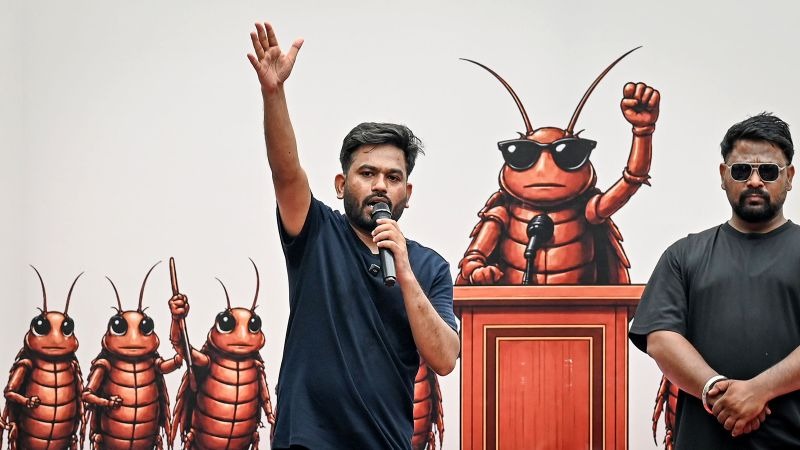
India's youth-led Cockroach Movement clarified that founder Abhijeet Dipke is not in state detention, reversing earlier claims. Meanwhile, the Indian government has formally requested protesters to end their mass sit-in at Jantar Mantar and assist local authorities in restoring public normalcy following intense clashes near parliament.
NEW DELHI — India’s youth-led satirical political front, widely known as the Cockroach Movement, confirmed on Monday that its founder, Abhijeet Dipke, is not in police custody. The clarification via the organization's official communications channel on X followed an earlier statement alleging he had been "picked up" by law enforcement during mass demonstrations in the capital. Concurrently, senior Indian union ministers have formally requested all Cockroach Movement protesters to immediately dismantle their ongoing sit-in at Jantar Mantar and assist the federal administration in restoring civil normalcy. The developments mark a critical inflection point for the massive social-media-born campaign, which has quickly evolved into the largest domestic challenge facing the government during the opening session of parliament.
Retraction of Detention Claims and Security Realities
Chaos erupted across central New Delhi early Monday morning as thousands of young demonstrators attempted to breach security perimeters to march toward parliament. Amidst the gathering, the Cockroach Movement's digital dispatch teams issued an alert claiming that founder Abhijeet Dipke had been detained by the Delhi Police. However, subsequent official statements retracted the claim, confirming Dipke was safe and not under state detention.
The initial panic coincided with high-stakes discussions between the group’s senior leadership and the federal administration. While thousands of student activists clashed with paramilitary forces along security blockades, two prominent representatives from the Cockroach Movement were granted an official audience with Union Health Minister J.P. Nadda.
The 10-minute closed-door meeting represented the first direct diplomatic outreach by the central government since the movement transitioned from viral digital satire to coordinated street blockades across multiple cities, including Pune, Bengaluru, and Lucknow.
Administrative Demands for Normalcy
Following the ministerial consultation, government officials issued an appeal directed at the thousands of student agitators currently occupying public spaces. Pointing to the massive logistical gridlock affecting the capital's central business districts, the administration urged the youth front to clear the Jantar Mantar protest grounds.
Law enforcement officials stated that the sheer volume of demonstrators had completely exhausted the physical capacity of the designated protest zone, presenting severe public safety risks.
The government has formally requested the organization's steering committees to cooperate with local municipal authorities to restore regular traffic flow and civic functionality, promising that the grievances filed during the ministerial talks would undergo internal evaluation.
Roots of the Gen-Z Mobilization
The Cockroach Movement originally emerged as a satirical internet parody on May 16, 2026, launched by digital communications strategist Abhijeet Dipke. The campaign was sparked by a controversial remark made during a Supreme Court hearing by the Chief Justice of India, who allegedly described certain unemployed youth activists as "parasites" and "cockroaches". Dipke reclaimed the intended insult, forming the "Cockroach Janta Party" as a mock political alternative to express systemic youth frustration over high graduate unemployment and corruption.
Within weeks, the movement gained massive momentum online, amassing over 22 million followers on social platforms and vastly outpacing the digital footprint of major established political entities.
The online phenomenon transformed into physical civilian resistance following a series of high-profile national examination scandals, specifically paper leaks tied to the National Eligibility cum Entrance Test (NEET) for medical colleges. The ongoing street agitation intensified over the weekend after Delhi Police forcibly moved renowned hunger-striking climate activist Sonam Wangchuk from Jantar Mantar to a local medical facility due to deteriorating health metrics.
Official Sources Section
Factual reporting regarding the status of organizational leadership, police operations, and ministerial communications is verified by regulatory filings, digital security notifications, and official administrative bulletins.
Primary updates were gathered from verified statements published on X by CJP Chief Spokesperson Saurav Das alongside statutory public security alerts issued by the Delhi Police Ground Command. Parliamentary updates and government directives conform to tracking notices provided by the Press Information Bureau (PIB) of India.
Quote Section
"According to officials familiar with the security deployment, the administration remains committed to preserving public order during the ongoing monsoon session of parliament. Law enforcement personnel exercised maximum restraint while managing the high volume of marchers, and structural safety channels remain open for peaceful systemic dialogue."
Why It Matters
The evolution of the Cockroach Movement carries profound structural implications for India's economic, political, and educational architectures. For student communities and families nationwide, the protests highlight a deep-seated crisis of confidence in the integrity of national examination frameworks, which serve as the primary gateway to socioeconomic mobility.
For institutional investors, market analysts, and local business owners, the persistent blockades and mass gatherings in key economic hubs introduce logistical friction and heightened security overhead.
Politically, the movement underscores a widening generational disconnect within the world’s largest democracy, signaling that the expanding under-30 demographic is increasingly prepared to leverage decentralized digital organizing to demand strict state accountability and educational infrastructure reform.
Key Facts at a Glance
Detention Clarification: The Cockroach Movement confirmed founder Abhijeet Dipke was not detained, correcting earlier reports of police custody.
Ministerial Talks: CJP leaders conducted a brief 10-minute meeting with Union Health Minister J.P. Nadda to deliver formal policy demands.
Government Request: Federal ministers have requested all demonstrators to immediately dismantle the Jantar Mantar sit-in to restore urban normalcy.
Core Grievances: Protesters are demanding extensive examination system overhauls following high-profile medical entrance exam paper leaks.
FAQ Section
What is the Cockroach Movement?
It is a youth-led social and political campaign in India that began as an internet parody following critical comments made by the country's top judiciary regarding unemployed youth. It has since grown into a mass advocacy front focusing on educational reform.
Was founder Abhijeet Dipke arrested by law enforcement?
No. While initial social media reports from inside the protest group stated that Dipke had been picked up by police, subsequent official updates clarified that he is not in state detention.
What are the primary demands of the student protesters?
The demonstrators are demanding comprehensive accountability for recent national entrance exam paper leaks, structural transparency in the state testing apparatus, and the resignation of top education officials.
Source: Delhi Police Official Communications, Press Information Bureau - Government of India, National Stock Exchange of India Corporate Archive.