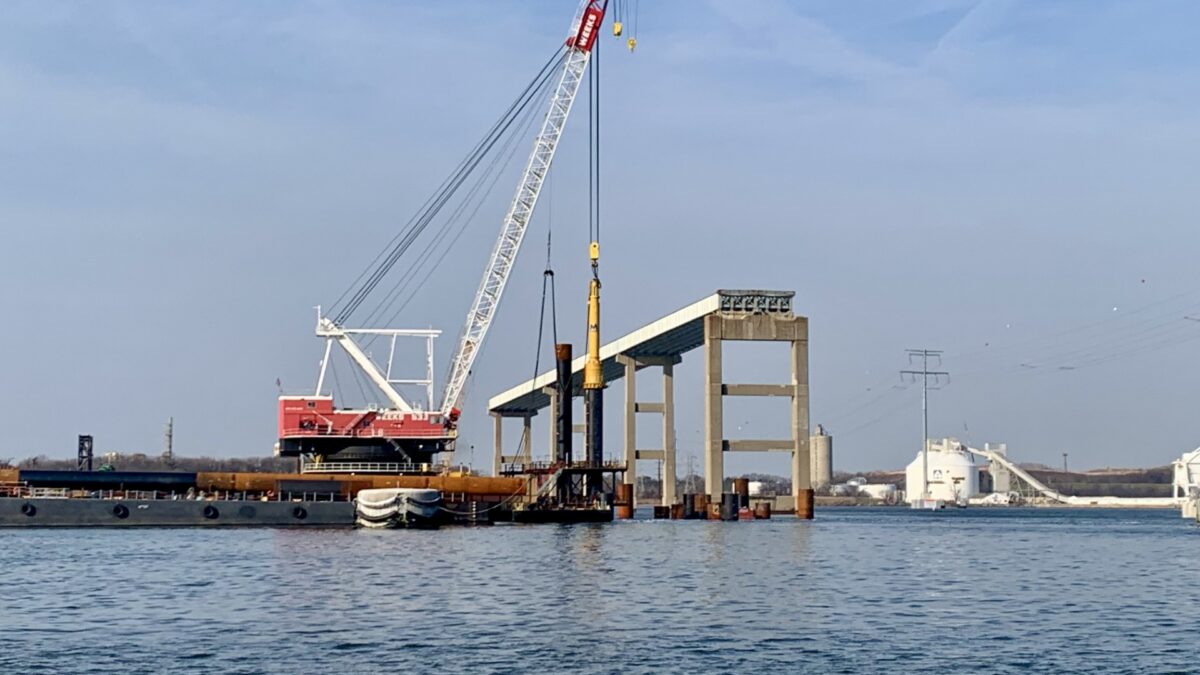
The chief engineer of the M/V Dali, Karthikeyan Deenadayalan, entered a 36-month deferred prosecution agreement with U.S. authorities. Deenadayalan admitted to a criminal violation of the Ports and Waterways Safety Act for failing to report an unsafe, non-redundant fuel pump configuration before the fatal 2024 Baltimore bridge collapse.
Dali Chief Engineer Enters Deferred Prosecution Over Key Bridge Crash
Federal agreement pauses criminal charge against ship's engineer in exchange for 36 months of probation and cooperative conditions.
BALTIMORE — The chief engineer of the cargo ship Dali, which struck and destroyed Baltimore's Francis Scott Key Bridge in March 2024, entered into a formal deferred prosecution agreement with federal prosecutors on Thursday, June 18, 2026. Appearing before a federal judge in the U.S. District Court for the District of Maryland, 46-year-old Indian national Karthikeyan Deenadayalan waived his right to a grand jury indictment and admitted to a criminal violation of the Ports and Waterways Safety Act. The agreement delays his prosecution for up to 36 months under strict conditions of supervised release, representing a significant legal development in the ongoing criminal fallout from the maritime disaster that killed six construction workers and halted operations at a major American port.
Technical Violations and Admitted Facts
According to the unsealed statement of facts attached to the agreement, Deenadayalan admitted that he knowingly failed to report a hazardous condition to the U.S. Coast Guard. Specifically, the chief engineer acknowledged that he was fully aware that the 984-foot vessel was operating with an unsafe fuel system setup that lacked critical mechanical redundancy.
The documents reveal that the vessel relied on a non-redundant flushing pump to supply fuel to two of the ship's generators. Deenadayalan admitted that the system's lack of a backup compromised the ship's safe navigation and hindered its ability to recover from a sudden loss of electrical power. The National Transportation Safety Board (NTSB) previously determined that a single loose wire caused a breaker to open, sparking a sequence of blackouts, propulsion failures, and steering loss that ultimately sent the massive container ship crashing into the bridge infrastructure.
Additionally, the statement of facts details that Deenadayalan had identified the severe state of disrepair in generators 3 and 4 shortly after boarding the ship in January 2024. He corresponded about the mechanical failures with shoreside technical superintendent Radhakrishnan Karthik Nair, who was criminally indicted by a federal grand jury last month. The Justice Department reported that Nair had instructed Deenadayalan to draft a "convincing" email to the vessel's charterer to conceal the unsafe reliance on the flushing pump and avoid further scrutiny regarding fuel consumption.
Terms of Supervised Release and Cooperation
Under the terms authorized by Senior U.S. District Judge James K. Bredar, Deenadayalan will face 36 months of probation and regular check-ins with the court's probation office. If he successfully complies with all stipulations, the federal government will permanently dismiss the criminal information charge against him. However, failure to comply could revive the prosecution, exposing him to a maximum sentence of six years in federal prison if convicted.
The public conditions of Deenadayalan's supervised release include:
Surrendering his passport and restricted possession of firearms.
Remaining within the United States, with a strict ban on international travel unless granted explicit court permission.
Maintaining zero contact with any individuals associated with the parallel criminal case against the vessel's operators.
Legal experts speculate that the sealed portions of the agreement likely hinge on Deenadayalan providing material testimony in the upcoming trial against his employers.
Broad Impact on Shipping and Corporate Liability
The deferred prosecution agreement carries immense weight for international maritime businesses, supply chain logistics, and infrastructure investors. The Dali disaster caused an estimated $5 billion in infrastructure and environmental damage. The criminal charging of an on-board officer establishes a clear precedent regarding the individual accountability of crew members to report mechanical safety hazards directly to federal authorities, rather than bowing to corporate pressure.
While the criminal cases move forward, the massive civil litigation landscape is shifting. Earlier this year, Maryland finalized a landmark $2.25 billion settlement with the ship's Singapore-based owner, Grace Ocean Private Limited, and its operator, Synergy Marine Pte Ltd. Flurries of additional civil settlements resolved the claims of the families of the six deceased road workers, leading a federal judge to pause the broader civil trials. Nonetheless, several economic loss claims from local businesses, longshoremen, and the City of Baltimore remain outstanding.
Official Statements
The agreement was announced jointly by federal and local law enforcement leaders.
"Today, the United States and Motor Vessel Dali Chief Engineer entered into a Deferred Prosecution Agreement in which he admitted to conduct that constitutes a criminal violation of the Ports and Waterways Safety Act," stated Kelly O. Hayes, U.S. Attorney for the District of Maryland, in an official United States Department of Justice release.
In response to the expanding criminal actions, the vessel’s operators, Synergy Marine Pte Ltd and Synergy Maritime Pte Ltd, released a corporate statement maintaining that they would strenuously defend themselves against the federal indictments. The corporate entities expressed concern over the federal government keeping crew members within the United States for over two years despite assertions that the crew's emergency actions during the blackout were timely.
Key Facts at a Glance
Defendant: Karthikeyan Deenadayalan, 46, Chief Engineer of the M/V Dali.
Charge: One count of violating the Ports and Waterways Safety Act for failing to notify the U.S. Coast Guard of a hazardous condition.
Agreement Duration: 36 months of supervised probation; charges will be dropped upon full compliance.
Core Admission: Knowing operation of an unsafe, non-redundant fuel flushing pump system and active concealment of the hazard from charterers.
Related Criminal Case: A federal trial against operator Synergy Marine and technical superintendent Radhakrishnan Karthik Nair is currently scheduled for October 2027.
FAQ Section
Q: What is a deferred prosecution agreement? A: It is a voluntary agreement where prosecutors file criminal charges but agree to postpone prosecution. If the defendant meets specific conditions over a set period—such as probation, remaining in the country, or testifying—the charges are ultimately dropped entirely.
Q: Why was the chief engineer charged if the blackout was caused by a loose wire? A: While a loose wire initiated the blackout, federal authorities note that the vessel's reliance on an improper, non-redundant fuel flushing pump system directly prevented the crew from regaining propulsion and steering power in time to avoid hitting the bridge. The engineer failed his legal duty to report this unsafe system to the Coast Guard.
Q: Will the chief engineer go to prison? A: Not if he fulfills the conditions of his 36-month probation. If he violates the terms, federal prosecutors can pursue the charge, which carries a maximum penalty of six years in prison.
Q: What is the current status of the bridge rebuilding and civil lawsuits? A: The state of Maryland reached a $2.25 billion settlement with the ship's owner and operator, and the civil trial has been paused following settlements with the victims' families. The criminal trial against the operator and technical supervisor is set for October 2027, while regional recovery and rebuilding efforts continue.
Source: * United States Department of Justice - District of Maryland Press Release