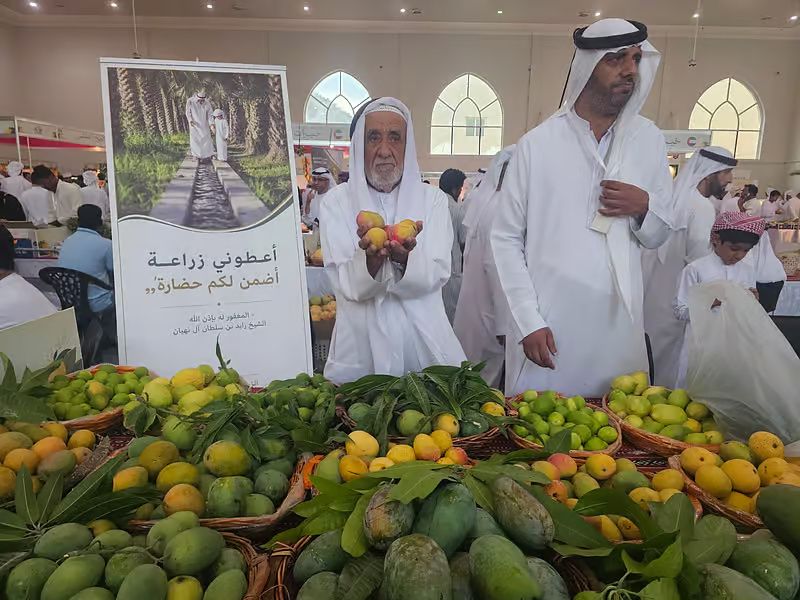
For over 50 years, Emirati farmer Ahmed Mohammed Gharib has transformed barren desert land in Fujairah into a thriving mango orchard. By experimenting with seeds from India and Pakistan, he has successfully cultivated thousands of kilograms of diverse mango varieties, becoming a pioneer of sustainable agriculture in the UAE.
FUJAIRAH — For over five decades, Ahmed Mohammed Gharib, an 82-year-old Emirati farmer, has defied the harsh desert climate to cultivate what many considered an impossible crop: the mango. What began as a personal passion sparked by the taste of the fruit during travels to India and Pakistan has evolved into a multi-generational agricultural success story that now sees thousands of kilograms of produce harvested annually in the UAE.
Gharib’s journey began when he returned from his travels with seeds and saplings, determined to recreate the lush orchards he had experienced abroad. Today, his farms in Sharm and Al Bidya stand as a testament to his persistence, showcasing a diverse array of mango varieties including Arabi Hamadh, Hindi Hamadh, Lumi, Fifai, and Arabi Moza. His work is currently being celebrated at the Khorfakkan Mango Festival, held from June 26 to June 28, 2026.
Adapting to the Arid Environment
The transition from tropical South Asia to the sandy, arid soil of the Emirates required extensive experimentation. Gharib spent years mastering cross-breeding techniques and adjusting irrigation and fertilization cycles to suit the region’s high temperatures and humidity.
According to agricultural experts, the coastal areas of Fujairah have become a primary hub for this cultivation. The humidity and soil composition in Fujairah are uniquely suited for mango trees, which require deep soil for their extensive root systems. While the UAE remains a challenging environment for agriculture, Gharib’s success highlights how targeted horticultural practices—and a deep understanding of soil moisture—can turn desert landscapes into productive orchards.
A Legacy of Knowledge
Gharib’s contribution extends beyond the harvest. He remains a vocal advocate for local farming, participating in numerous exhibitions and festivals to pass his expertise to the next generation of Emirati farmers. For him, these events serve a purpose greater than commerce; they are a platform to demonstrate the capabilities of local agriculture to residents, tourists, and the hospitality sector.
"These festivals are not just about selling mangoes," Gharib told local media. "They are an opportunity to show people what Emirati farms can produce." His efforts reflect a broader national push for food security and agricultural diversification in the UAE, a vision championed by the late Sheikh Zayed bin Sultan Al Nahyan.
Why It Matters
This legacy is significant as the UAE continues to invest in sustainable farming and food sovereignty. By proving that high-quality, exotic fruit can be grown domestically, farmers like Gharib are helping to reduce reliance on food imports while preserving the traditional connection between the Emirati people and the land. For the local economy, this shift supports organic produce markets and strengthens the farm-to-table movement in the region.
Key Facts at a Glance
A 50-Year Journey: Ahmed Mohammed Gharib began his farming efforts five decades ago after bringing seeds back from India and Pakistan.
Annual Yield: Depending on weather conditions, his farms produce between 5,000 and 12,000 kilograms of mangoes each year.
Diverse Varieties: His orchards feature unique cultivars such as Arabi Hamadh, Hindi Hamadh, and Arabi Moza.
Regional Significance: Fujairah holds about half of the UAE's estimated 140,000 mango trees due to its favorable coastal climate.
FAQ
How did the farmer manage to grow mangoes in the desert?
Through decades of experimentation with cross-breeding, careful selection of salt-tolerant and heat-resistant varieties, and precise management of irrigation and fertilization.
What is the importance of the Khorfakkan Mango Festival?
It provides a platform for local farmers to sell directly to consumers, share agricultural techniques, and build trust regarding the organic quality of locally grown produce.
Why are mangoes successfully growing in Fujairah?
Fujairah's coastal humidity and specific sandy soil structure provide the necessary environment for mango tree root systems to thrive, unlike the denser clay soils found elsewhere.
Source: Khaleej Times, The National News, MyBayut Agriculture Guide