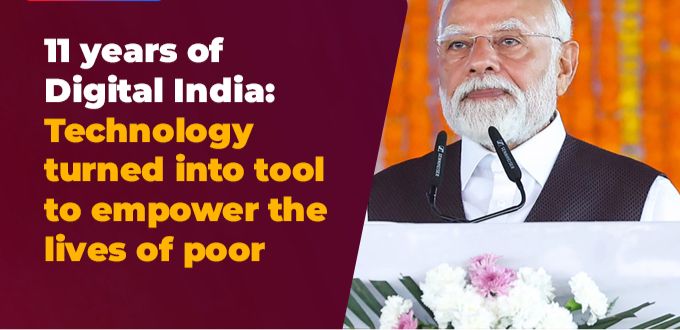
As the Digital India initiative marks 11 years, the government is prioritizing AI and semiconductors to drive the next phase of tech-led growth. With ₹1.64 lakh crore invested in chip projects and a massive 45,000-GPU compute facility, India is transitioning from a digital consumer to a global technology leader.
NEW DELHI — As the landmark "Digital India" initiative approaches its 11th anniversary on July 1, 2026, the Indian government has outlined a strategic pivot toward advanced technology sectors. After a decade dedicated to expanding digital infrastructure, financial inclusion, and citizen service delivery, the program is now entering a phase focused on anchoring the nation’s future in Artificial Intelligence (AI) and semiconductor manufacturing.
The Ministry of Electronics and Information Technology (MeitY) confirmed on Saturday that this "next phase" of growth is designed to cement India's status as a global technology powerhouse. By leveraging the foundational digital layers built since 2015, the government intends to drive India toward the "Viksit Bharat 2047" vision through state-backed investments and mission-mode execution.
Scaling the Semiconductor Ecosystem
India’s journey in semiconductor manufacturing has moved decisively from policy conceptualization to active production. Under the India Semiconductor Mission (ISM), the government has approved 12 major projects with an investment pipeline of approximately ₹1.64 lakh crore. This industrial landscape now includes one semiconductor fabrication unit, two compound semiconductor facilities, and nine assembly and packaging units.
"India's semiconductor ecosystem has moved decisively from policy to production," a Ministry release stated. Building on this momentum, the recently announced "India Semiconductor Mission 2.0" aims to deepen national capabilities in critical areas, including semiconductor equipment, indigenous intellectual property (IP), and resilient supply chain management. This transition has helped electronics manufacturing grow into a ₹13 lakh crore industry, with electronics now ranking as India’s third-largest export category.
AI Infrastructure and Computational Backbone
To support the demands of modern innovation, the IndiaAI Mission—backed by an outlay of over ₹10,372 crore—is establishing the nation's computational backbone. A shared compute facility featuring over 45,000 GPUs is already in operation, providing the necessary infrastructure for national-scale AI research and deployment.
The AI ecosystem is further bolstered by the "AI Kosh" platform, which currently hosts more than 12,500 datasets, 307 AI models, and 20 toolkits, making resources accessible to startups, researchers, and academic institutions. To ensure this progress is inclusive, the government has established 27 Data and AI Labs in Tier II and Tier III cities, supporting a mission that prioritizes "safe, inclusive and trustworthy" AI, as outlined in the governance guidelines released in November 2025.
Why It Matters
For citizens, the evolution of Digital India signals a shift from basic connectivity to advanced participation in the global digital economy. For businesses and investors, the massive scaling of GPU compute facilities and semiconductor fab projects offers a stable environment for deep-tech investment. As India aims to become a globally competitive hub, these investments are expected to catalyze innovation, create high-skilled employment, and ensure long-term technological sovereignty.
Key Facts at a Glance
Anniversary Milestone: Digital India completes 11 years on July 1, 2026.
Semiconductor Investment: 12 approved projects worth ₹1.64 lakh crore, comprising one fab, two compound fabs, and nine packaging units.
AI Compute: A shared facility with 45,000+ GPUs supports indigenous AI development.
Startup Growth: India’s startup ecosystem recorded its strongest year in FY26, with over 55,200 new startups recognized.
Digital Reach: Broadband subscriptions have reached 106.58 crore, with 5G services covering 99.9% of districts.
FAQ
What is the focus of Digital India’s next phase?
The program is shifting its primary focus toward frontier technologies, specifically Artificial Intelligence and semiconductor manufacturing, to build upon the foundational digital infrastructure established over the last decade.
How is the government supporting AI research?
Through the IndiaAI Mission, the government has provided 45,000+ GPUs for shared computing, established the AI Kosh data repository, and launched 27 labs in smaller cities to democratize AI access.
What is the status of semiconductor manufacturing in India?
The industry has moved from policy to production, with 12 manufacturing projects already approved, creating a robust supply chain for chips, displays, and packaging.
Source: Press Information Bureau (PIB), Ministry of Electronics and Information Technology (MeitY), ANI News