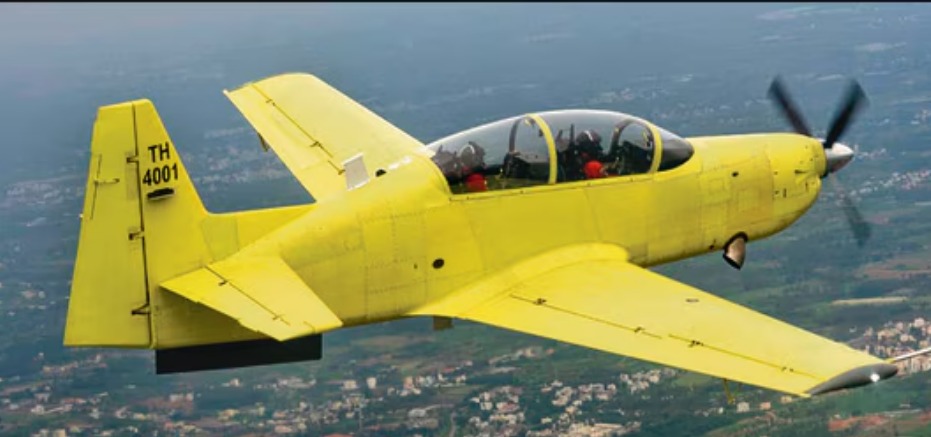
India’s troubled basic trainer aircraft programme has just got the push it badly needed, with US firm Honeywell finally delivering key engines for the HTT 40 to Hindustan Aeronautics Limited in Bengaluru. Three TPE331 12B turboprop engines have reached HAL, allowing the state owned plane maker to unlock series production that had been stuck largely for want of powerplants.
The HTT 40, meant to train rookie Indian Air Force pilots at the very first stage, has been running late despite a ₹6,838 crore order for 70 aircraft placed three years ago. HAL was supposed to hand over 12 trainers in FY26 but has not delivered a single one so far, leaving the IAF dependent on older assets and imported platforms longer than planned.
Engines Start To Flow
Under a 100 million dollar contract signed almost four years ago, Honeywell is to supply and manufacture 88 TPE331 12B engines and kits for the HTT 40 fleet. The US company will deliver 16 fully built engines, while HAL will assemble the remaining units through technology transfer, with further deliveries now expected at roughly two engines a month as supply chain bottlenecks ease.
What This Means For The HTT 40 Line
Two series production HTT 40s are already flying with used Category B engines that earlier powered prototypes. With fresh engines arriving and a dedicated HTT 40 manufacturing facility in place, HAL is aiming to fast track aircraft rollouts and catch up on the IAF training schedule. The platform, currently about 56 percent indigenous by content, is expected to cross 60 percent localisation as more components and subsystems are sourced or built in India.
Implications For Pilot Training And Indigenisation
For the air force, stable engine supplies are central to easing a long standing bottleneck in basic flying training and reducing dependence on foreign trainers over time. Strategically, the progress also ties into a wider push to deepen aerospace manufacturing and capability at home, even if India still relies on imported powerplants for now while its own aero engine programmes move slowly.
Key Highlights
- Honeywell delivers first batch of three TPE331 12B turboprop engines for HAL’s HTT 40 basic trainer after delays linked to supply chains
- IAF’s order for 70 HTT 40s worth ₹6,838 crore has seen no deliveries yet, despite a plan to supply 12 aircraft in FY26
- US firm to supply 16 engines, with the remaining 72 to be built by HAL under technology transfer; further units expected at about two per month
- HTT 40 currently has 56 percent indigenous content, targeted to rise above 60 percent as more systems are localised
Sources: Hindustan Times reporting on HTT 40 engine deliveries and contract details, plus background on the Honeywell agreement and HAL trainer programme