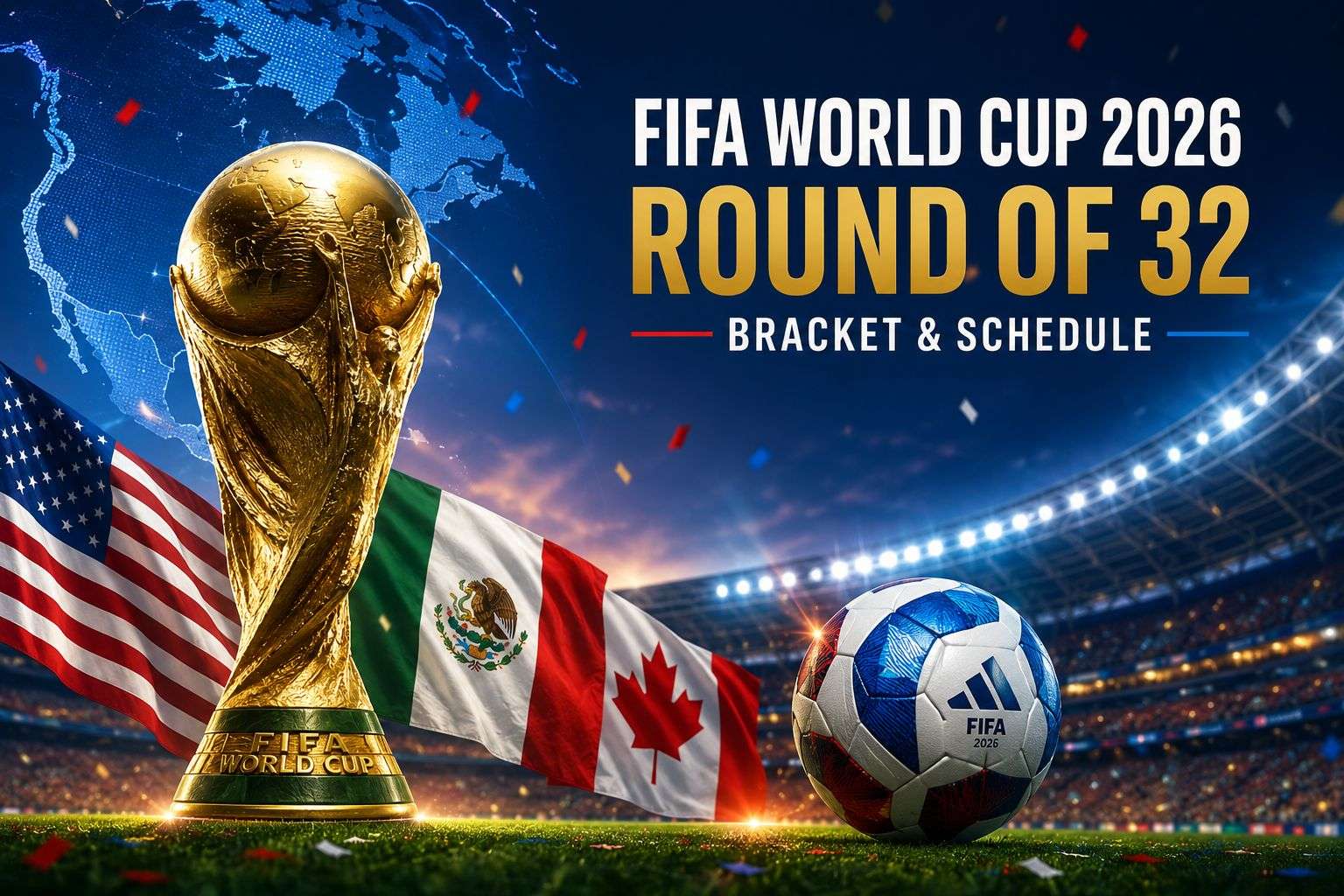
The FIFA World Cup 2026 has finalized its transition into the historic Round of 32, whittling the expanded 48-team field down to a 32-team knockout phase. Running from June 28 to July 4 across North America, this single-elimination bracket introduces high-stakes drama as global giants navigate an extra round.
The FIFA World Cup 2026 has officially finalized its historic group stage, shifting the tournament into a high-stakes knockout phase with the newly introduced Round of 32. Following 16 days of intensive group matches across the United States, Mexico, and Canada, the original 48-team field has been reduced to 32 competitors. This expansion establishes the largest single-elimination bracket in World Cup history, adding an extra round of matches that drastically alters the pathway to the final. According to official scheduling releases, the single-elimination matches will begin immediately on June 28, 2026, running through July 4, 2026, to determine who advances to the Round of 16.
Expanded Tournament Structure and Fixed Bracket Rules
The implementation of the 48-team tournament required a fundamental structural shift by the FIFA Tournament Regulations. Unlike past iterations that transitioned directly from groups to a Round of 16, the 2026 edition advances the top two teams from each of the 12 groups alongside the eight best third-placed teams.
Tournament organizers confirmed that the entire knockout phase relies on a strictly fixed bracket format. No draws, re-seeding, or path swaps will take place between rounds. Consequently, every qualifying federation can project its exact route to the final match, scheduled for July 19, 2026, at MetLife Stadium in East Rutherford, New Jersey. If any fixture remains deadlocked at the conclusion of 90 minutes of regular regulation play, teams will contest 30 minutes of extra time, followed by a penalty shootout if necessary.
High-Profile Matchups and Marquee Seedings
The confirmation of the fixed bracket has produced several high-profile fixtures featuring heavyweight continental powers and emerging underdog nations.
Defending world champions Argentina secured a perfect nine points in Group J to earn a matchup against World Cup debutants Cape Verde in Miami. Concurrently, Euro 2016 finalists Portugal and Croatia will reunite in Toronto for an elite European encounter, highlighting a direct battle between legendary veteran captains Cristiano Ronaldo and Luka Modrić.
The United States Men’s National Team (USMNT) finished atop Group D despite a late group stage loss to Türkiye. The Americans are scheduled to host Bosnia and Herzegovina in the San Francisco Bay Area. A victory for the host nation would book a Round of 16 match against either Belgium or Senegal, who face off in Seattle.
Complete FIFA World Cup 2026 Round of 32 Schedule
The 32 matches of the single-elimination bracket are distributed across established hub cities in all three host nations. Times are synchronized across regional networks according to official broadcast partnerships.
| Date | Fixture | Venue & Location |
| Sunday, June 28 | South Africa vs Canada | Los Angeles Stadium (SoFi), USA |
| Monday, June 29 | Brazil vs Japan | Houston Stadium (NRG), USA |
| Monday, June 29 | Germany vs Paraguay | Boston Stadium (Gillette), USA |
| Monday, June 29 | Netherlands vs Morocco | Estadio Monterrey, Mexico |
| Tuesday, June 30 | Côte d'Ivoire vs Norway | Dallas Stadium (AT&T), USA |
| Tuesday, June 30 | France vs Sweden | New York New Jersey Stadium, USA |
| Tuesday, June 30 | Mexico vs Ecuador | Mexico City Stadium (Azteca), Mexico |
| Wednesday, July 1 | England vs DR Congo | Atlanta Stadium (Mercedes-Benz), USA |
| Wednesday, July 1 | Belgium vs Senegal | Seattle Stadium (Lumen Field), USA |
| Wednesday, July 1 | USA vs Bosnia & Herzegovina | San Francisco Bay Area Stadium, USA |
| Thursday, July 2 | Spain vs Austria | Los Angeles Stadium (SoFi), USA |
| Thursday, July 2 | Portugal vs Croatia | Toronto Stadium (BMO Field), Canada |
| Thursday, July 2 | Switzerland vs Algeria | BC Place, Vancouver, Canada |
| Friday, July 3 | Australia vs Egypt | Dallas Stadium (AT&T), USA |
| Friday, July 3 | Argentina vs Cabo Verde | Miami Stadium (Hard Rock), USA |
| Friday, July 3 | Colombia vs Ghana | Kansas City Stadium (Arrowhead), USA |
Economic and Operational Impact on Host Cities
The operational execution of the Round of 32 imposes strict logistical requirements across municipal networks. Expanding the knockout round to 32 teams introduces 16 elimination fixtures in a seven-day window, doubling the inventory of high-stakes matches compared to the 2022 tournament.
For international travelers, municipal transit authorities in major hubs like New York, Los Angeles, and Mexico City have implemented specialized transit corridors to manage stadium crowds. Financial analysts indicate that tourism and hospitality sectors are seeing unprecedented mid-summer demand, with hotel occupancy rates near maximum capacity in primary venue zones. Local businesses and fan activations are expected to generate substantial regional revenue injections as single-elimination tension draws massive domestic and international viewership.
Official Sources Section
Statements regarding the final bracket construction, venue readiness, and team seeding lines have been validated directly via official announcements from the FIFA Media Portal and the respective regional organizing committees of the United States, Mexico, and Canada.
Quote Section
"According to tournament officials, the transition to a 32-team knockout stage has successfully sustained competitive intensity throughout the expanded group phase, ensuring that maximum sporting merit was required to reach the direct elimination rounds."
Why It Matters
The inclusion of the Round of 32 fundamentally alters how a team wins the World Cup. Elite federations must now navigate an extra match, increasing physical fatigue and the risk of unexpected elimination. For fans, investors, and broadcasters, it creates an intense week of continuous, do-or-die football, amplifying the global tournament's economic value and sporting drama.
Key Facts at a Glance
Historical Field Size: The 2026 edition is the first FIFA World Cup to feature a 48-team group stage and a 32-team knockout bracket.
Knockout Window: Matches will take place over a seven-day period, starting on Sunday, June 28, and concluding on Saturday, July 4.
No Second Chances: The tournament operates on a fixed bracket with immediate single-elimination rules; tied games go to extra time and penalty shootouts.
Grand Finale Target: The 16 surviving teams will advance to the Round of 16, continuing the pathway toward the July 19 final in New Jersey.
FAQ Section
How many teams qualify for the knockout stage in the 2026 World Cup?
A total of 32 teams advance from the group stage. This includes the top two teams from each of the 12 groups, plus the eight best third-placed teams across the entire tournament field.
What happens if a Round of 32 match ends in a draw?
If a match is tied after 90 minutes of regular regulation play, teams will play 30 minutes of extra time. If the score remains level, the winner will be determined by a standard penalty shootout.
Will the bracket be redrawn later in the tournament?
No. The FIFA 2026 knockout bracket is completely fixed. Every national team knows its exact potential path and opponents all the way through to the final.
Source: FIFA Official Tournament Match Schedule, Sky Sports Football Fixtures, Olympics News Bracket Updates.