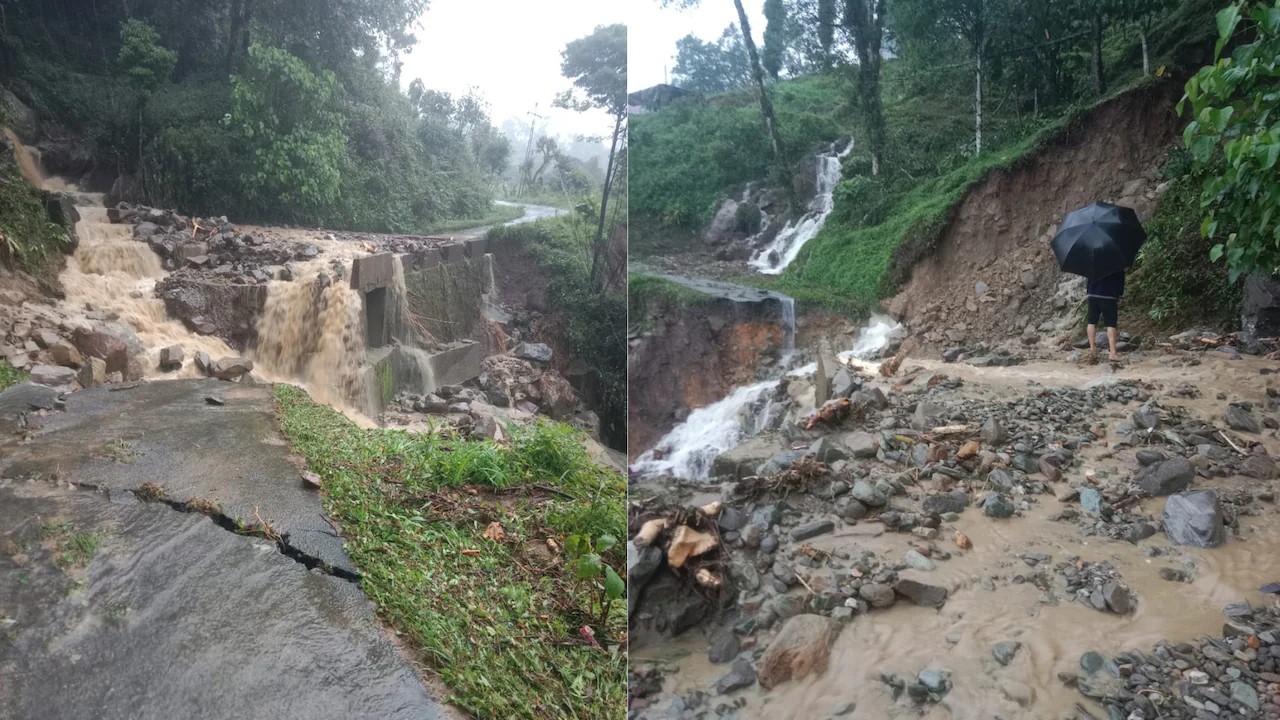
Incessant heavy rainfall in Sikkim has washed away a strategic Bailey bridge over the Phee Khola, completely severing the Phidang–Sankalang road link. The infrastructure collapse has isolated remote villages in North Sikkim's Dzongu region, while triggering wider landslides and flash floods across the vulnerable Himalayan state.
GANGTOK, INDIA — A vital transport corridor in North Sikkim has been entirely severed after a key Bailey bridge was washed away overnight, following relentless monsoon rainfall that has triggered widespread flash floods and landslides across the eastern Himalayan state. Local administrative authorities confirmed on June 28, 2026, that the infrastructure collapse occurred late Saturday night when water levels in the Phee Khola mountain stream rose exponentially. The surging torrent completely overwhelmed the bridge’s concrete foundation at Phidang, abruptly suspending all vehicular movement on the principal Phidang–Sankalang road artery. The disaster has isolated multiple remote indigenous communities, escalating logistical challenges for emergency response teams.
Infrastructure Collapse Isolates Remote Dzongu Villages
The structural destruction of the Phidang Bailey bridge marks the most critical logistical failure in the ongoing sub-Himalayan monsoon season. Positioned within the Mangan district, the bridge serves as a singular transport pipeline for the ecologically sensitive Dzongu region.
According to reports filed by emergency response units on Sunday morning, the structural integrity of the bridge gave way under the massive hydraulic pressure of the swollen Phee Khola. Local panchayat (village council) representatives and the Sub-Divisional Magistrate (SDM) of Mangan arrived at the disaster zone early Sunday to execute a thorough site inspection.
The immediate fallout of the structural breach includes:
Complete Transport Paralysis: Total cessation of light and heavy vehicular transport on the Phidang–Sankalang stretch.
Community Isolation: Temporary containment of several remote villages, primarily populated by the indigenous Lepcha community, cutting off their access to primary markets and administrative centers.
Essential Supply Threats: Imminent disruption to the transport of daily food rations, pharmaceutical supplies, and acute medical emergency services.
State authorities verified that while the physical bridge was completely swept away by the current, no human casualties or physical injuries were recorded during the incident.
Landslides Batter South Sikkim and National Highway 10
The climatic disruption is not contained to the northern district. India's official weather agency, the India Meteorological Department (IMD), issued an emergency bulletin on June 28 indicating that heavy to extremely heavy rainfall has lashed isolated pockets of Sikkim over the preceding 24 hours. Light to moderate precipitation continues to saturate the steep topography across the remainder of the state.
In South Sikkim, local administrators reported extensive topographical damage in the Upper Kaw Khola area of Lingee, where cascading mudslides have damaged secondary rural roads and agricultural terraces. Simultaneously, Sikkim’s primary economic artery, National Highway 10 (NH-10), which links the landlocked state to Siliguri in West Bengal, faces recurring closures. Heavy earthmovers and emergency personnel are currently deployed near Singtam to clear extensive rockfall debris that continues to threaten commercial shipping lanes and tourism transit.
Official Sources Section
According to data released by the Mangan District Administration, disaster management protocols have been fully activated. Strategic technical logs regarding the infrastructure status and regional weather warnings are actively maintained via updates from the Sikkim State Disaster Management Authority (SSDMA) and official district monitoring dispatches.
Quote Section
"A detailed inspection is underway to determine the extent of the damage to the foundation. The Phee Khola stream experienced a flash flood that placed immense pressure on the Bailey bridge, severing the Phidang to Sankalang route. Engineering assets are evaluating temporary footbridges to re-establish a basic supply pipeline."
— Statement from a Mangan Sub-Divisional official coordinating rescue operations at the site.
Why It Matters
Sikkim's steep terrain makes its roads incredibly fragile during the monsoon. The destruction of the Phidang bridge hampers the movement of essential goods and prevents medical access for remote communities. Furthermore, recurring blockages on NH-10 create severe supply bottlenecks, inflating the cost of daily goods and hindering recovery efforts for the region’s vital tourism and hydropower sectors.
Key Facts at a Glance
Critical Breach: A strategic Bailey bridge over the Phee Khola at Phidang was completely washed away by rising floodwaters on Saturday night.
Total Disruption: The collapse has entirely severed the Phidang–Sankalang road link, isolating indigenous communities within North Sikkim’s Dzongu area.
Widespread Damage: Active landslides have also caused extensive damage in the Upper Kaw Khola region of Lingee in South Sikkim.
Zero Casualties: Local officials confirmed that no injuries or fatalities have been reported in connection with the bridge collapse.
Emergency Response: Teams from the local administration and engineering wings are on-site evaluating the installation of emergency pedestrian zip lines.
FAQ Section
Where exactly did the bridge collapse occur in Sikkim?
The incident occurred at Phidang in the Dzongu region of Mangan district, located in North Sikkim. The bridge spanned the Phee Khola mountain stream.
Are there any casualties reported from the flash floods?
No. According to direct confirmations from district officials and panchayat representatives, no injuries or fatalities have occurred due to the bridge failure.
What is the current status of National Highway 10?
NH-10 is experiencing intermittent blockages due to landslide debris, particularly near Singtam. Emergency earthmoving equipment is actively clearing the road to keep the state's main supply line open.
Source: Press Trust of India (PTI) Syndicated Feed, The Telegraph India Northeast Bureau, NorthEast India 24 Regional Dispatch.