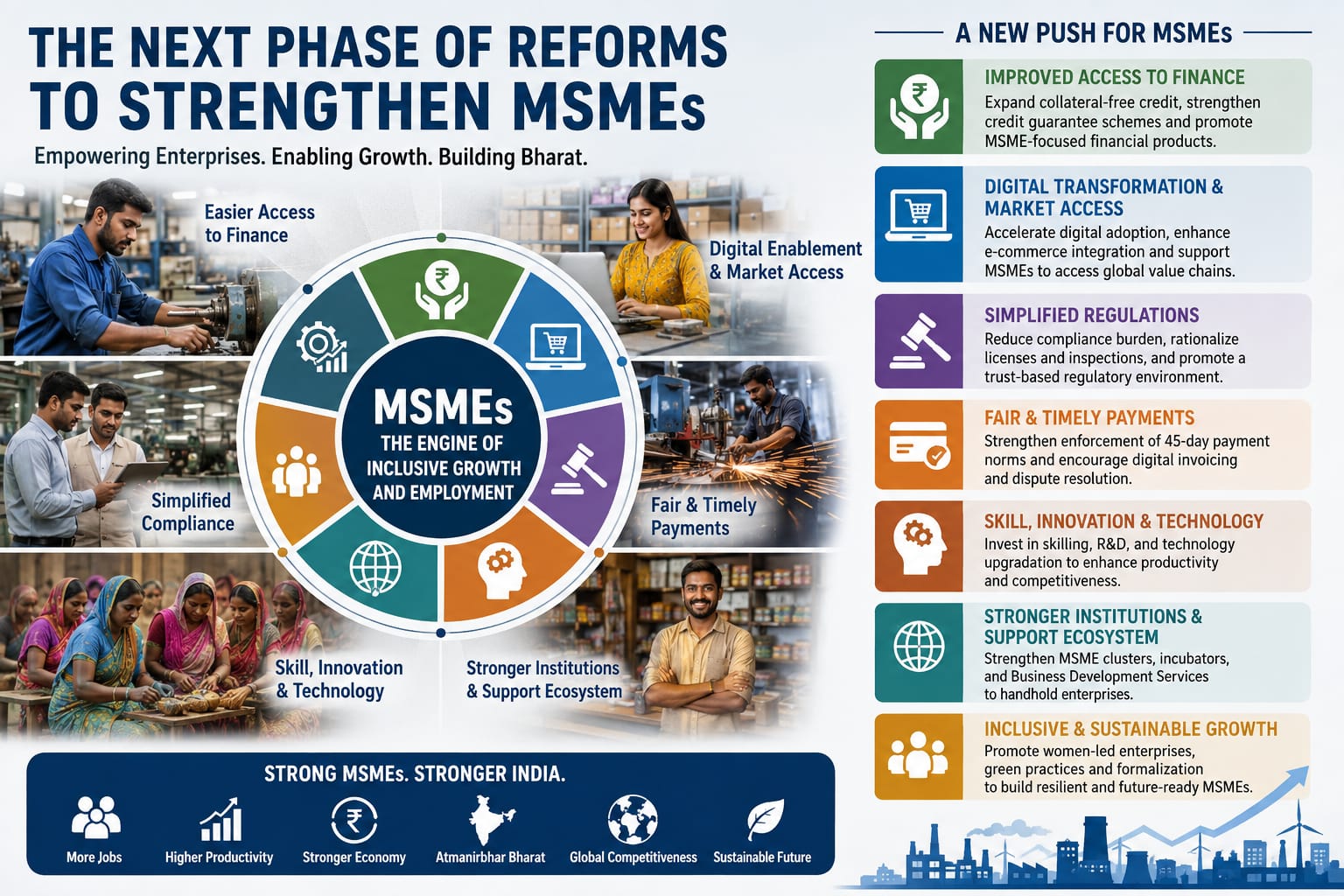
The passage of the MSME Development (Amendment) Bill, 2026, marks a major step in bolstering India's small business ecosystem. Spearheaded by the MSME Ministry, the reforms introduce Online Dispute Resolution, enforce faster TReDS invoice settlements, expand credit guarantee cover, and provide equity funding to scale domestic enterprises into global hubs.
NEW DELHI — The Parliament of India has officially passed the Micro, Small and Medium Enterprises Development (Amendment) Bill, 2026, marking a pivotal transition into the next phase of structural economic reforms for the domestic MSME sector.
Speaking on August 21, 2026, Shobha Karandlaje, Union Minister of State for Micro, Small and Medium Enterprises, detailed the legislative changes aimed at enhancing ease of doing business, resolving delayed payments, and accelerating credit accessibility for over nine crore registered enterprises. With MSMEs currently contributing 31 percent to India's GDP and 50 percent to total exports, the amended framework provides administrative relief and statutory backing to help small enterprises scale into global manufacturing hubs.
Dispute Resolution and Administrative Framework Reforms
A core pillar of the MSME Development (Amendment) Bill, 2026, is the integration of statutory Online Dispute Resolution (ODR) mechanisms. The system is designed to drastically compress the time and capital required for small businesses to resolve commercial conflicts and recover delayed receivables.
To address chronic liquidity constraints caused by delayed payments, the government has strengthened the mandate around the Trade Receivables Discounting System (TReDS) platform. As of March 2026, the RBI-regulated platform has facilitated over ₹8.71 lakh crore in cumulative invoice discounting. Central Public Sector Enterprises (CPSEs) and large corporate buyers are required to settle MSME invoices via TReDS, improving cash flow predictability.
Expansion of Institutional Finance and Equity Support
The legislative updates build on a substantial expansion in institutional credit delivery:
Outstanding Bank Credit: Institutional credit to the MSME sector expanded from ₹10 lakh crore in 2014–15 to more than ₹38.35 lakh crore in 2026.
Credit Guarantees: Total guarantees extended through the Credit Guarantee Fund Trust for Micro and Small Enterprises (CGTMSE) surged to ₹10.43 lakh crore over the last four fiscal years.
Growth Capital Fund: A dedicated ₹10,000 crore SME Growth Fund provides equity-based financing, enabling growing firms to invest in technology, R&D, and plant expansion without adding short-term debt pressures.
Support for Women Entrepreneurs: Over 3.38 crore registered MSMEs (39%) are now women-owned. Under the updated framework, women entrepreneurs qualify for up to 90 percent credit guarantee coverage and a 10 percent concession on annual guarantee fees.
Official Sources Section
According to official releases from the Ministry of Micro, Small and Medium Enterprises and notifications published by the Parliament of India, the MSME Development (Amendment) Bill, 2026, provides statutory upgrades to administrative frameworks and formalization incentives across national registries.
Quote Section
"The Micro, Small and Medium Enterprises Development Amendment Bill, 2026, is a very significant reform and an important step in strengthening the MSME ecosystem," stated Shobha Karandlaje, Minister of State for MSME. "Its objective is to improve the administrative framework, promote ease of doing business, and pave the way for small enterprises to emerge as champions of growth."
Why It Matters
For Small Business Owners: Provides online dispute resolution tools to settle commercial disputes faster and lower legal expenses.
For Corporate Buyers: Mandates streamlined invoice settlement through TReDS platforms to eliminate supply chain frictions.
For Female Entrepreneurs: Offers higher credit guarantee limits and lowered fee structures to boost access to capital.
Key Facts at a Glance
Registered Enterprises: Over 9 crore MSMEs registered on the Udyam portal, employing 40 crore people.
Economic Footprint: Account for 31% of India's GDP and 50% of total export volume.
Credit Scale: Outstanding MSME bank credit reached ₹38.35 lakh crore in 2026.
Invoice Cash Flow: TReDS platform facilitated ₹8.71 lakh crore in payments as of March 2026.
Frequently Asked Questions (FAQ)
What is the primary focus of the MSME Development (Amendment) Bill, 2026?
The Bill focuses on administrative simplification, strengthening Online Dispute Resolution (ODR), expanding access to collateral-free institutional credit, and enforcing timely payment settlements.
How does TReDS help small businesses manage working capital?
TReDS allows MSMEs to discount their unpaid trade invoices through multiple competitive financiers online, converting delayed receivables into immediate working capital without long-term debt.
What financial incentives are available for women-owned MSMEs?
Women entrepreneurs receive enhanced credit guarantee coverage up to 90 percent alongside a 10 percent concession on annual guarantee fees under government-backed lending schemes.
Source: Ministry of Micro, Small and Medium Enterprises | Udyam Registration Portal | Parliament of India