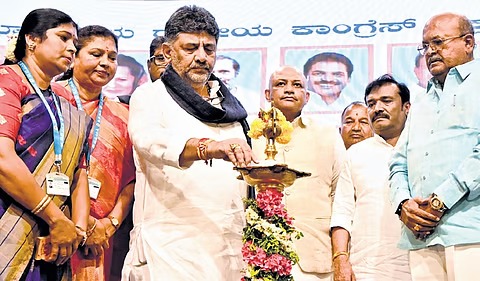
This regional policy report details Karnataka Deputy Chief Minister D.K. Shivakumar's announcement regarding the upcoming deployment of five-member guarantee committees across 7,000 gram panchayats and 4,000 municipal wards. The documentation examines how these localized panels will audit beneficiary files to maximize financial transparency and control leakages.
BENGALURU — The Karnataka state government will soon establish decentralized guarantee committees at every gram panchayat and municipal ward level to supervise the distribution of its flagship welfare programs. Deputy Chief Minister D.K. Shivakumar announced the administrative layout on June 21, 2026, during a high-profile state assembly in Bengaluru.
The intervention comes as the ruling administration carries out a comprehensive structural review of its high-budget social safety nets. The primary objective of the newly proposed local bodies is to scrutinize beneficiary documentation, verify eligibility data on the ground, and directly plug ongoing financial leakages across the state exchequer.
Decentralized Auditing Structure and Composition
The grass-roots monitoring framework will scale up the state's capacity to audit public funds. Under the directive outlined by the Deputy Chief Minister, a dedicated five-member guarantee committee will be permanently deployed inside each micro-jurisdiction.
The administrative rollout is extensive, with the state government mandating the formation of these local panels across 7,000 distinct gram panchayats and 4,000 municipal wards throughout Karnataka.
The state planning desks clarified that the panels will be explicitly structured to guarantee broad demographic representation. "I have discussed the formation of these guarantee committees with party seniors," Shivakumar stated during his address, confirming that all societal sections will be accommodated to ensure local transparency.
Plugging Fiscal Leakages Amid Political Friction
The expansion into ward and panchayat levels occurs amidst an intense wider debate regarding the operational cost of managing these public assistance programs. The state government has historically faced heavy criticism from opposition parties including the BJP and JD(S) concerning the financial layout of its multi-tier Guarantee Implementation Committees.
Prior legislative sessions witnessed deep friction over the state exchequer funding monthly honorariums for committee leaders. While opposition leaders have labeled these oversight structures as fiscally inefficient, the administration maintains that local auditing teams are necessary to prevent systemic welfare fraud.
By transitioning the verification burden directly to decentralized five-member teams at the village level, the state intends to refine its beneficiary registries. The panels will handle real-time documentation checks, ensuring that financial support goes exclusively to qualifying households.
Impact on Citizens, Consumers, and Local Communities
For the average rural resident, private household consumer, and grass-roots worker, the deployment of neighborhood guarantee committees will alter how local welfare systems are managed. On one hand, having a dedicated five-member board right in the village provides citizens with a direct, local point of contact to resolve registration delays or fix documentation glitches without needing to travel to taluk headquarters.
Conversely, the strict document verification process means that families holding incorrect or duplicate ration cards may face immediate suspension of benefits. For small regional businesses and agrarian laborers, the success of these committees in plugging fiscal leaks is critical to maintaining a stable state budget, directly ensuring that funds for essential rural infrastructure remain uninterrupted.
Official Sources Section
The administrative statistics, committee volumes, and panel breakdown metrics cited in this regional report correspond directly to the official public briefings provided by Deputy Chief Minister D.K. Shivakumar during the state organization assembly in Bengaluru. Historical expenditure parameters and legislative session responses align with official assembly transcripts archived by the Karnataka Legislative Assembly Secretarial Desk.
Quote Section
Addressing how the new village-level panels will balance political inclusion with administrative accountability, the government leadership outlined its approach:
"According to officials, thousands of dedicated grass-roots workers have been successfully accommodated within these expanding guarantee committees, enabling the state to build an inclusive tracking layer even though providing individual statutory executive positions to every active representative remains impossible."
Why It Matters
For economic analysts and local citizens alike, the creation of micro-level guarantee committees demonstrates a critical shift toward stricter welfare oversight. When a state commits billions of rupees to massive public support programs, establishing clean, ground-level verification networks becomes essential to preventing fiscal strain. Ensuring that welfare capital reaches legitimate beneficiaries shields state finances and protects the economic stability of vulnerable rural households.
Key Facts at a Glance
The Core Initiative: Karnataka will deploy specialized five-member guarantee committees to supervise grass-roots welfare distribution.
Macro Rollout Scope: The administrative network will cover 7,000 rural gram panchayats and 4,000 urban municipal wards.
Primary Objective: Local panels are strictly mandated to audit beneficiary files and eliminate financial leakages.
Diverse Composition: The panel structures are being designed to provide balanced representation across all local communities.
FAQ Section
What specific duties will the new village guarantee committees perform?
The five-member panels will be responsible for examining beneficiary documents on the ground, confirming household eligibility, and identifying duplicate or fraudulent profiles to ensure welfare resources are distributed accurately.
Why is the government setting up these committees now?
The expansion follows a comprehensive financial review by the state government, which is looking to tighten its welfare budget and eliminate waste by utilizing ground-level inspectors to verify registries.
Will ordinary citizens have access to these committee members?
Yes. Because these panels operate directly at the gram panchayat and municipal ward levels, they are designed to serve as a nearby, accessible contact point for residents navigating the welfare system.
Source: Official press statements from Deputy Chief Minister D.K. Shivakumar, and statutory tracking registers from the Government of Karnataka Official Portal.