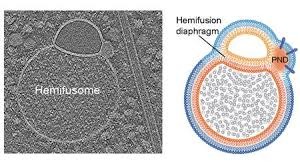
In a landmark breakthrough, researchers from the University of Virginia School of Medicine and the National Institutes of Health have identified a previously unknown organelle inside human cells—named the hemifusome. This discovery, published in Nature Communications in June 2025, is alread...
In a landmark breakthrough, researchers from the University of Virginia School of Medicine and the National Institutes of Health have identified a previously unknown organelle inside human cells—named the hemifusome. This discovery, published in Nature Communications in June 2025, is already being hailed as one of the most significant cellular biology findings of the decade. The hemifusome appears to play a central role in how cells sort, recycle, and dispose of internal cargo, offering new insights into genetic diseases and cellular health.
The discovery was made possible through cryo-electron tomography (cryo-ET), a cutting-edge imaging technique that allows scientists to visualize cells in near-native states at nanometer resolution. The implications of this new organelle extend across immunology, neurobiology, and genetic medicine, potentially reshaping our understanding of intracellular logistics.
Key Highlights From the Discovery
- The hemifusome is a membrane-bound organelle involved in cellular recycling and cargo sorting
- It operates independently of known protein-based systems like ESCRT, relying instead on lipid remodeling
- The structure was observed across multiple mammalian species including humans, monkeys, rats, and mice
- Hemifusomes are linked to multivesicular body (MVB) formation, a process critical to immune response and neuroprotection
- The organelle may be implicated in disorders such as Hermansky-Pudlak syndrome, Alzheimer’s disease, and certain cancers
What Is a Hemifusome?
The hemifusome is a vesicle-like structure that exists in a partially fused membrane state. It serves as a dynamic interface where cellular vesicles—tiny blister-like sacs—connect and transfer cargo. Scientists describe it as a loading dock for intracellular delivery trucks, facilitating the movement and sorting of proteins, lipids, and other molecules.
Unlike traditional recycling pathways that rely on protein scaffolding, hemifusomes appear to use lipid-rich remodeling mechanisms. These structures are often found near proteolipid nanodroplets (PNDs), suggesting a unique biochemical environment that supports their function.
Breakthrough Imaging With Cryo-ET
Cryo-electron tomography was instrumental in visualizing the hemifusome. This technique flash-freezes cells in milliseconds, preserving their internal architecture without ice crystal damage. Researchers then fire electron beams through the sample to generate high-resolution, three-dimensional reconstructions.
This method revealed that nearly 1 in 10 vesicles near the cell membrane were hemifusomes—underscoring their biological significance. The organelle’s appearance and disappearance based on cellular needs further highlight its dynamic role in maintaining cell health.
Implications for Human Health
The hemifusome’s role in vesicle formation and cargo sorting has profound implications for understanding diseases where these processes malfunction. For example:
1. Hermansky-Pudlak syndrome: A rare genetic disorder affecting pigmentation, vision, and blood clotting. Improper cargo handling is a known contributor.
2. Alzheimer’s disease: Disrupted recycling pathways are linked to protein accumulation and neurodegeneration.
3. Cancer: Abnormal vesicle trafficking can influence tumor growth and immune evasion.
4. Viral infections: Viruses often hijack vesicle systems to replicate and spread; understanding hemifusomes may offer new antiviral strategies.
A New Chapter in Cell Biology
The discovery of the hemifusome opens a new frontier in cellular biology. It challenges existing models of vesicle formation and introduces a lipid-based pathway that could coexist or compete with protein-driven systems. Researchers believe this could lead to novel therapeutic approaches targeting intracellular transport and recycling.
Future research will focus on mapping the molecular components of hemifusomes, understanding their regulation, and exploring their presence in various cell types and disease states. The potential to manipulate hemifusome activity could revolutionize treatments for genetic disorders, neurodegenerative diseases, and immune dysfunction.
Sources: SciTechDaily, ScienceAlert, University of Virginia Health System