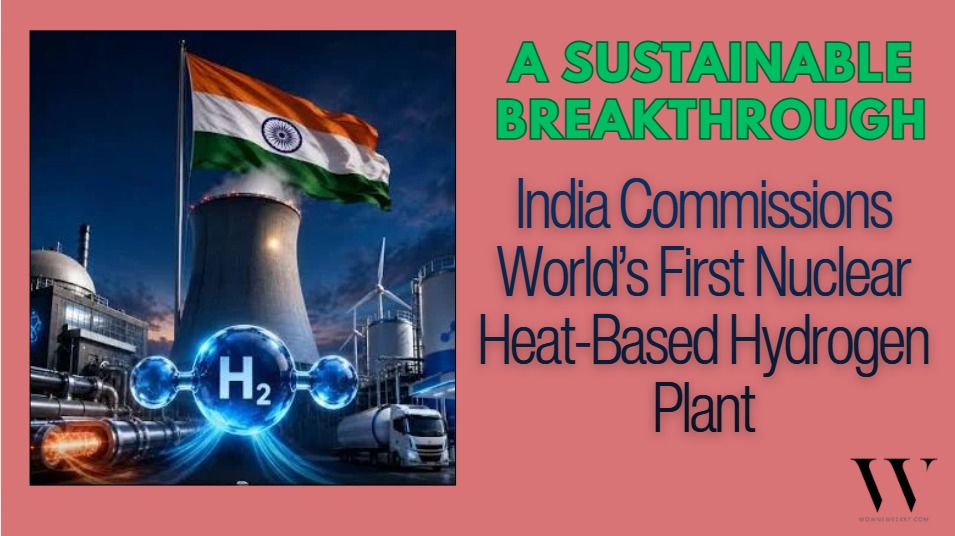
India has commissioned the world's first nuclear heat-based hydrogen production facility at Kalpakkam. By utilizing the Copper–Chlorine thermochemical cycle powered by the Fast Breeder Test Reactor, the plant demonstrates a highly efficient, continuous, and carbon-free method for producing hydrogen, marking a major advancement in global clean energy technology.
The Department of Atomic Energy has commissioned a pioneering facility at Kalpakkam that utilizes nuclear process heat to produce carbon-free hydrogen.
KALPAKKAM — India has achieved a significant technological milestone in its clean energy roadmap with the inauguration of the world’s first hydrogen production facility driven by nuclear process heat. The plant, located at the Indira Gandhi Centre for Atomic Research (IGCAR) in Kalpakkam, Tamil Nadu, was officially commissioned on June 26, 2026.
Unlike conventional methods that rely heavily on electricity for water electrolysis, this facility employs the indigenously developed Copper–Chlorine (Cu–Cl) thermochemical cycle. By tapping directly into the high-temperature heat generated by the Fast Breeder Test Reactor (FBTR), the system offers a more energy-efficient and continuous pathway for large-scale hydrogen production.
Pioneering a New Energy Pathway
The facility serves as a critical technology demonstrator, designed to validate the integration of nuclear systems with hydrogen generation. According to the Department of Atomic Energy (DAE), the process is uniquely suited for India’s long-term energy security goals.
The Cu–Cl thermochemical cycle operates at temperatures between 430°C and 550°C—a range that nuclear reactors can comfortably supply. This provides a distinct advantage over other thermochemical cycles that require much higher temperatures (often exceeding 800°C), making the Indian approach both safer and more thermodynamically efficient.
"The integration of nuclear energy with emerging clean energy technologies such as hydrogen production represents a strategic pathway towards a sustainable energy future," said Ajit Kumar Mohanty, Secretary of the DAE and Chairman of the Atomic Energy Commission. "Nuclear power is ideally suited to support large-scale hydrogen production while contributing to India’s decarbonization goals."
Technical Innovation and Collaboration
The project is the result of years of collaborative research between the Bhabha Atomic Research Centre (BARC) and IGCAR. By leveraging decades of operational experience from the FBTR, which has been a cornerstone of India’s fast breeder reactor program since 1971, engineers have successfully proven that nuclear plants can serve dual roles: generating carbon-free electricity and providing industrial process heat for fuel synthesis.
This innovation represents a shift in how nuclear energy is viewed in the context of the green transition. By utilizing "process heat" rather than converting heat into electricity first—an inherently lossy process—the facility maximizes the thermodynamic potential of the nuclear core.
Official Sources
The commissioning was confirmed in an official release by the Department of Atomic Energy (DAE) on June 26, 2026. The technical validation of the Cu–Cl cycle was led by researchers from BARC and IGCAR, who emphasize that the site is intended to provide operational data to optimize the process for potential future commercial deployment.
Why It Matters
For heavy industries such as steel manufacturing, fertilizer production, and oil refining, the ability to generate hydrogen without reliance on the electrical grid is transformative. Because nuclear reactors operate continuously, this facility offers a "round-the-clock" hydrogen supply, overcoming the intermittency challenges associated with solar or wind-based electrolysis.
This development positions India as a global leader in "pink hydrogen"—hydrogen produced via nuclear energy—and reinforces the country’s three-stage nuclear power programme as a versatile tool for national sustainability.
Key Facts at a Glance
World First: India is the first nation to commission a hydrogen production facility utilizing nuclear process heat via the Copper–Chlorine thermochemical cycle.
Operational Source: The heat is derived from the Fast Breeder Test Reactor (FBTR) at IGCAR, Kalpakkam.
Technological Shift: The process bypasses electricity-heavy water electrolysis, using direct nuclear thermal energy to split water chemically.
Efficiency: The Cu–Cl cycle is highly efficient, operating at a manageable temperature range of 430–550°C.
Sustainability Goal: This project supports India's commitment to achieving long-term energy security and a low-carbon economy.
Frequently Asked Questions
How does this facility produce hydrogen?
It uses a Copper–Chlorine (Cu–Cl) thermochemical cycle. In this process, nuclear heat is used to drive a series of chemical reactions that split water into hydrogen and oxygen, rather than using electricity to perform electrolysis.
Why use nuclear heat instead of electricity?
Directly using heat is more energy-efficient and avoids the thermodynamic losses associated with converting heat into electricity first. Additionally, nuclear reactors provide a constant, weather-independent power source.
Is this plant meant for commercial fuel production?
Currently, the facility is a technology demonstrator. Its primary purpose is to validate the technology and provide operational data to scale up the process for future commercial and industrial use.
What is the role of the Fast Breeder Test Reactor (FBTR)?
The FBTR acts as the heat source for the facility, showcasing the versatility of fast reactor technology in supporting industrial applications beyond power generation.
Source: Department of Atomic Energy (DAE), Indira Gandhi Centre for Atomic Research (IGCAR), Bhabha Atomic Research Centre (BARC)