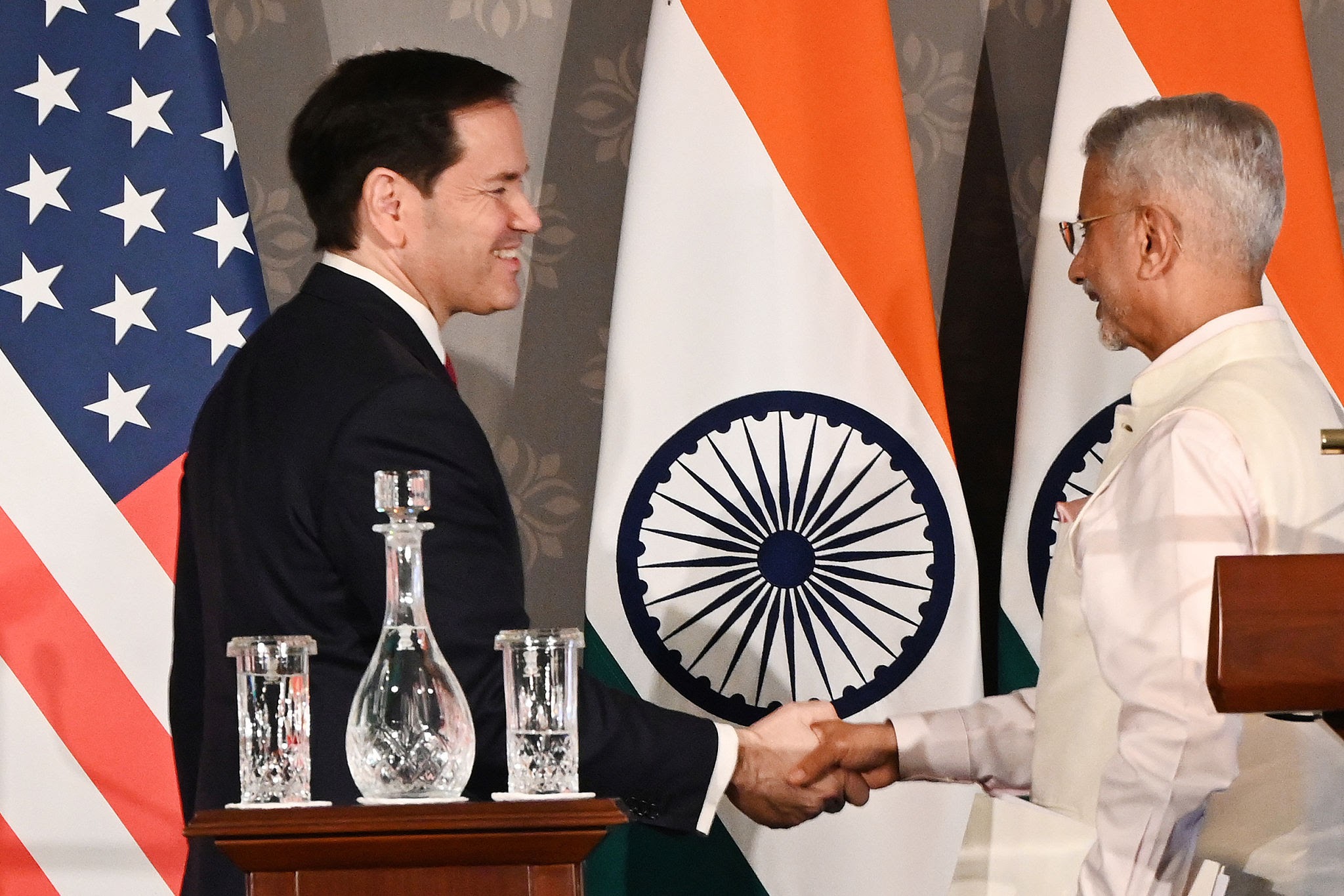
India has issued a strong diplomatic protest to the US following naval strikes in the Gulf that killed three Indian mariners on the commercial tanker MT Settebello. External Affairs Minister S. Jaishankar informed US Secretary of State Marco Rubio that lethal action against merchant shipping is unjustified, prompting intense bilateral discussions.
NEW DELHI — India has lodged a strong diplomatic protest with the United States following a series of US Navy attacks on commercial vessels in the Gulf region that resulted in the deaths of three Indian mariners. India’s External Affairs Minister, Dr. S. Jaishankar, spoke directly with US Secretary of State Marco Rubio on Friday evening to convey New Delhi's intense objections, declaring that lethal actions against commercial shipping are entirely unjustified. The diplomatic confrontation marks a significant point of friction between the two strategic partners over maritime security operations in the Middle East.
High-Level Diplomatic Confrontation Over Gulf Strikes
The telephone call between Dr. Jaishankar and Secretary Rubio follows a US military strike on the commercial oil tanker MT Settebello in the Gulf of Oman earlier this week. US forces targeted the Palau-flagged vessel under allegations that it had breached a naval blockade imposed on Iranian ports.
The strike resulted in the deaths of three Indian crew members, who were initially reported missing before their bodies were recovered and identified by maritime authorities. Of the 24 Indian nationals aboard the MT Settebello, 21 were rescued safely.
During the discussion, Dr. Jaishankar emphasized that commercial shipping and civilian crews must not be subjected to military violence. In an official statement shared on the social media platform X, Jaishankar wrote:
"Spoke to US Secretary of State Marco Rubio this evening. I reiterated India's strong protest at the attacks by the US Navy in the Gulf that killed three Indian mariners. Such lethal actions against commercial shipping are not justified."
Escalating Tensions and Diplomatic Summons in New Delhi
The direct call between the foreign ministers caps a week of escalating diplomatic maneuvers in New Delhi. On Friday, the Ministry of External Affairs (MEA) summoned the US Charge d'Affaires in New Delhi, Jason Meeks, to formally register its condemnation of the continuing operations off the Omani coast.
This marked the second time the top US diplomat in India was called in by the MEA within a single week. The move was prompted by an additional incident involving another commercial ship carrying 20 Indian crew members that came under fire in the same strategic waterway. According to reports from the US Central Command, naval forces have intercepted or disabled multiple vessels in recent days—including the Guinea-Bissau-flagged M/T Jalveer and the Palau-flagged M/T Marivex alongside the MT Settebello—as part of enforcement actions against the transport of Iranian oil near the Strait of Hormuz.
Impact on Global Seafarers and Maritime Trade
The escalation has raised severe concerns within the global shipping industry and the international maritime community. India supplies a substantial percentage of the global seafaring workforce, meaning that heightened military enforcement actions in commercial transit lanes directly threaten the safety of thousands of Indian citizens working on foreign-flagged merchant ships.
Industry analysts warn that the implementation of kinetic military strikes to enforce trade blockades significantly raises risk premiums for commercial vessels. For businesses, international travelers, and investors, this could translate to:
Spiking Insurance Rates: Marine insurance companies are expected to increase war-risk premiums for ships transiting the Gulf of Oman and the Strait of Hormuz.
Supply Chain Disruptions: Altered shipping routes to bypass high-risk zones could delay commodity deliveries, particularly crude oil and liquefied natural gas (LNG).
Labor Vulnerabilities: Maritime unions may demand stricter safety guarantees or hazard pay for crews operating in blockaded areas.
Official Sources Section
The developments have been verified through multiple concurrent official statements from the respective administrations:
The formal confirmation of diplomatic positions was detailed via public releases from India's Ministry of External Affairs.
Details regarding the rescue operations and final status of the mariners were verified by Union Shipping Minister Sarbananda Sonowal.
Operational context regarding the enforcement of blockades was provided via declarations from the US Central Command.
Quote Section
Expressing deep condolences and outlining the administration's immediate priorities, Union Shipping Minister Sarbananda Sonowal stated:
"It is deeply unfortunate to learn of the tragic incident aboard the Palau-flagged MT Settebello. Sadly, three Indian seafarers initially reported missing are now confirmed dead after bodies have been located and identified. The government stands firmly with the bereaved during this difficult hour and is fully committed to supporting the next of kin."
Minister Sonowal further confirmed that he has instructed maritime authorities to ensure the immediate repatriation of the surviving rescued crew members and the swift return of the bodies of the deceased to India.
Why It Matters
The maritime incident challenges the strategic alignment traditionally maintained between New Delhi and Washington. While both nations share a stated objective of ensuring a free, open, and unimpeded flow of commerce in international waterways, the use of lethal force against commercial vessels carrying civilian crews has disrupted this consensus. For global supply chains, any sustained instability in the Strait of Hormuz—through which one-fifth of the world's petroleum passes—can trigger immediate volatility in energy markets, impacting inflation and consumer fuel prices worldwide.
Key Facts at a Glance
Casualties: Three Indian mariners were killed following a US Navy attack on the Palau-flagged oil tanker MT Settebello.
Diplomatic Action: India's External Affairs Minister S. Jaishankar lodged a strong protest with US Secretary of State Marco Rubio, calling the actions "not justified."
Enforcement Actions: US Central Command confirmed operations against multiple vessels, alleging violations of an active naval blockade on Iranian oil shipments.
Diplomatic Summons: The MEA summoned US Charge d'Affaires Jason Meeks twice in one week to register diplomatic objections.
Repatriation: India has initiated steps for the swift return of 21 rescued Indian crew members and the mortal remains of the deceased.
FAQ Section
Q1: Which ships were involved in the recent US Navy incidents?
According to reports from military and diplomatic channels, the primary vessels involved include the Palau-flagged MT Settebello, the Guinea-Bissau-flagged M/T Jalveer, and the M/T Marivex.
Q2: Why did the US Navy target these commercial tankers?
The US Central Command indicated that the actions were part of military enforcement operations aimed at disabling vessels suspected of transporting Iranian oil in violation of localized naval blockades.
Q3: What is the official stance of the Indian government on the blockades?
While India supports maritime safety, the Ministry of External Affairs maintains that lethal military attacks on commercial shipping vessels that endanger civilian mariners are unacceptable and unjustified.
Q4: How many Indian citizens were on board the MT Settebello?
There were 24 Indian nationals on board the vessel. Twenty-one were successfully rescued by regional forces, while three lost their lives.
Source: Ministry of External Affairs, India | Statements from Union Minister for Ports, Shipping and Waterways, Sarbananda Sonowal | Official Correspondence updates via US Department of State.