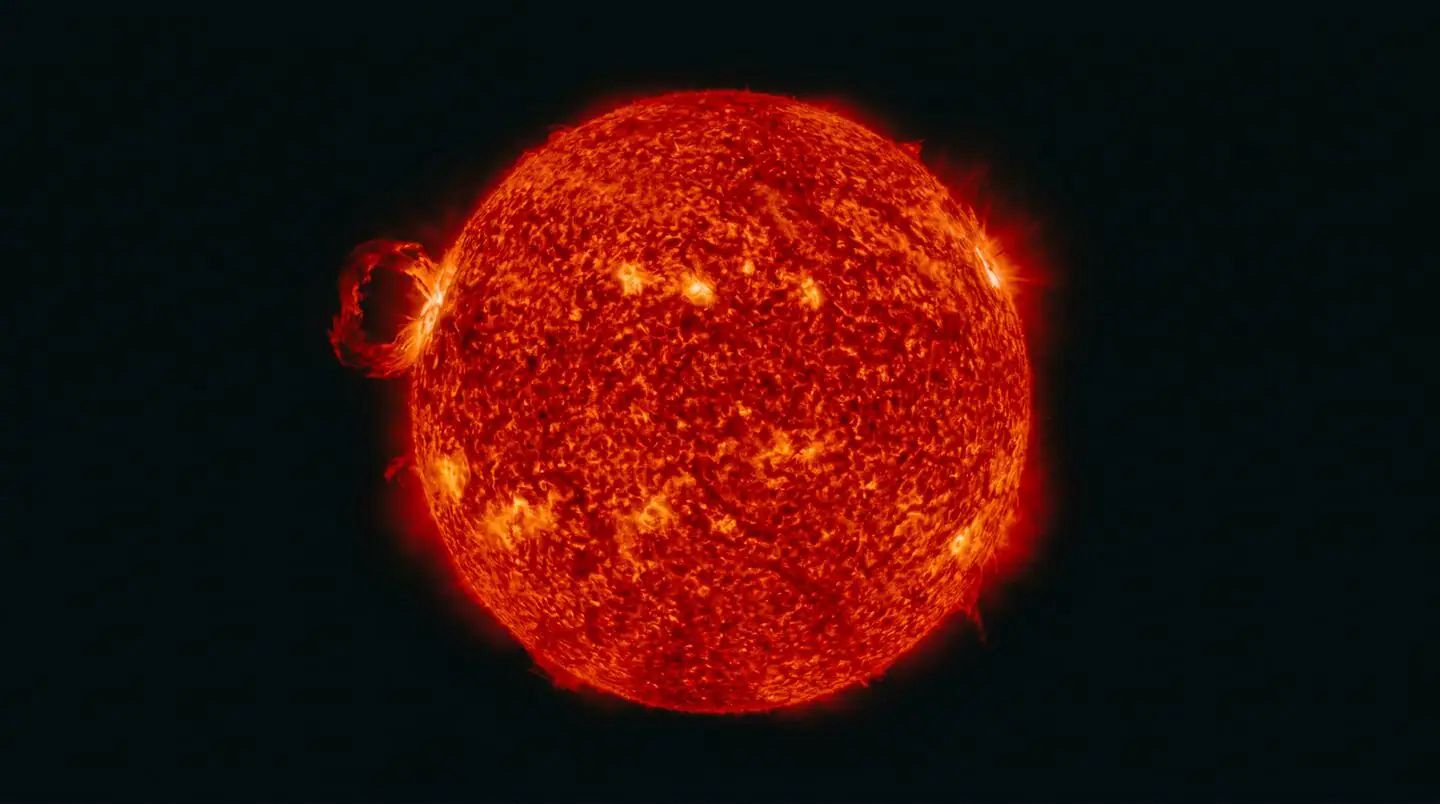
Indian astrophysicists at the Gauribidanur Observatory have created a ground-based technique to measure the Sun's weak coronal magnetic fields by tracking radio wave polarization. Published in The Astrophysical Journal, this indigenously developed system provides a cost-effective early warning method to predict violent solar storms and safeguard global satellite networks.
GAURIBIDANUR — In a major development for global space weather forecasting, Indian astrophysicists have successfully demonstrated an original method to measure the Sun's weak magnetic fields in its outer atmosphere. Announcing the breakthrough on Thursday, June 4, 2026, a research team from the Indian Institute of Astrophysics (IIA) confirmed they have successfully captured minute magnetic variations in the solar corona from a distance of 150 million kilometers. The measurements were achieved using a highly sensitive, indigenously fabricated radio telescope system at the Gauribidanur Observatory, located approximately 100 kilometers north of Bengaluru. This computational and structural milestone provides global space agencies with an early warning capability to predict violent solar outbursts, protecting billions of dollars in orbiting communication satellites and terrestrial power grids.
Capturing Polarization Twists inside the Solar Corona
According to peer-reviewed data accepted for publication in The Astrophysical Journal, the breakthrough addresses a long-standing challenge in solar physics: measuring magnetic fields during the Sun’s "quiet" or undisturbed phases. While intense magnetic fields near sunspots are easily tracked, the background coronal magnetic fields are exceptionally weak, typically registering at less than one-thousandth of a Tesla.
The research team, led by senior IIA professor Dr. R. Ramesh and PhD researcher Shaik Sayuf, bypassed traditional optical limitations by measuring the polarization of solar radio waves. As these electromagnetic waves travel through the plasma of the solar corona, the underlying magnetic field forces a subtle change, acting as a physical twist. By measuring this incredibly small fractional twist—which ranges between 0.01 and 0.02 in degree—the researchers successfully mapped the exact field intensity profile of the outer star.
Eliminating Global Reliance on Multi-Billion Dollar Satellite Assets
The structural execution of the project is notable due to its minimal financial footprint. Unlike major international space-based sensors, the radio telescope array was fabricated entirely in-house at the Gauribidanur facility, utilizing locally sourced manufacturing components and raw materials.
Administrative reports from the Department of Science and Technology (DST) emphasize that this validation transforms the historical observatory into an elite testbed for radio astronomy. Scientists from the National Centre for Radio Astrophysics (NCRA) noted that the IIA team cleverly structured their experiment around existing hardware limitations, achieving a level of precision that was previously considered nearly impossible for ground-based systems operating outside the optical spectrum.
Mitigating Coronal Mass Ejections to Safeguard Terrestrial Assets
The practical focus of the ongoing observation program is the early identification of Coronal Mass Ejections (CMEs)—the most powerful plasma explosions in the solar system. Without an active magnetic field baseline, tracking the structural formation of these eruptions remains highly speculative.
The newly deployed polarimetric model allows astronomers to monitor how energy and magnetic twist build up inside the corona. When the rate of absolute net current helicity increases rapidly, it signals an impending containment failure, allowing scientists to calculate exactly when a solar blast will break through the Sun’s background global "magnetic cage" and erupt outward into interplanetary space.
"We have successfully demonstrated a technique to measure such weak magnetic fields. We will now monitor the Sun's magnetic fields to spot any early sign of a coronal mass ejection. It is interesting that similar small field strengths, similar to those created with bar magnets in school laboratory experiments, can give rise to strong eruptions which create disturbances in the near-Earth environment and affect the functioning of satellites."
Official Sources Section
The experimental parameters, telescope design logs, observational data tiers, and physics derivations referenced in this astronomical report are drawn directly from the official research dossiers validated by the Indian Institute of Astrophysics, institutional announcements archived by the Department of Science and Technology, and official press bulletins from the Press Information Bureau (PIB).
Why It Matters
This astrophysical milestone shifts space weather tracking from a reactive state to a predictive science. For global telecommunication companies, airline navigation teams, and electrical grid operators, an early warning system for CMEs provides a critical window to protect high-altitude hardware. When a massive solar storm hits Earth's magnetosphere, it induces powerful electric currents that can permanently damage geostationary satellites and blow out regional power transformers. By proving that low-cost, ground-based radio telescopes can accurately monitor these weak, early stage magnetic build-ups, India's scientific community has delivered a scalable framework to protect global tech assets, significantly lowering the cost of space weather infrastructure.
Key Facts at a Glance
Breakthrough Discovery: Indian scientists have developed a ground-based method to measure the Sun's elusive, weak coronal magnetic fields.
Extreme Precision: The telescope successfully isolated fractional radio wave twists representing polarization levels of just 0.01 to 0.02.
Low Field Strength: The measured fields are less than one-thousandth of a Tesla, roughly equal to a standard school laboratory bar magnet.
Predictive Horizon: Tracking these weak background fields allows astronomers to detect early structural instabilities before they erupt into major solar storms.
Fully Indogenous: The specialized radio telescope array was designed and assembled entirely within India at the Gauribidanur Observatory.
FAQ Section
Why is measuring the Sun's weak magnetic field so important?
Weak magnetic fields in the solar corona control the star's dynamic activities. Mapping these fields allows scientists to understand the underlying physics of solar flares and predict when a magnetic structure will rupture into space.
How does the new Indian radio telescope system calculate this magnetic strength?
As solar radio waves pass through the corona, the weak magnetic field alters their path, causing a tiny physical twist called polarization. The highly sensitive antennas at Gauribidanur measure this fractional change to calculate the exact field strength.
What kind of damage can an unpredicted Coronal Mass Ejection cause on Earth?
A severe, unpredicted CME can compress the Earth's magnetic shield, exposing orbiting spacecraft to intense radiation, disrupting GPS navigation, breaking high-frequency radio links, and inducing massive voltage surges capable of collapsing civil power grids.
Who are the main research organizations behind this discovery?
The milestone study was conducted by astronomers and engineering teams at the Indian Institute of Astrophysics (IIA) in Bengaluru, with peer validation provided by experts from the National Centre for Radio Astrophysics (NCRA) in Pune.
Source: Research publication files accepted by The Astrophysical Journal, operational project updates distributed via the Deccan Herald and The Hindu science desks, and academic review portfolios from the Indian National Science Academy.