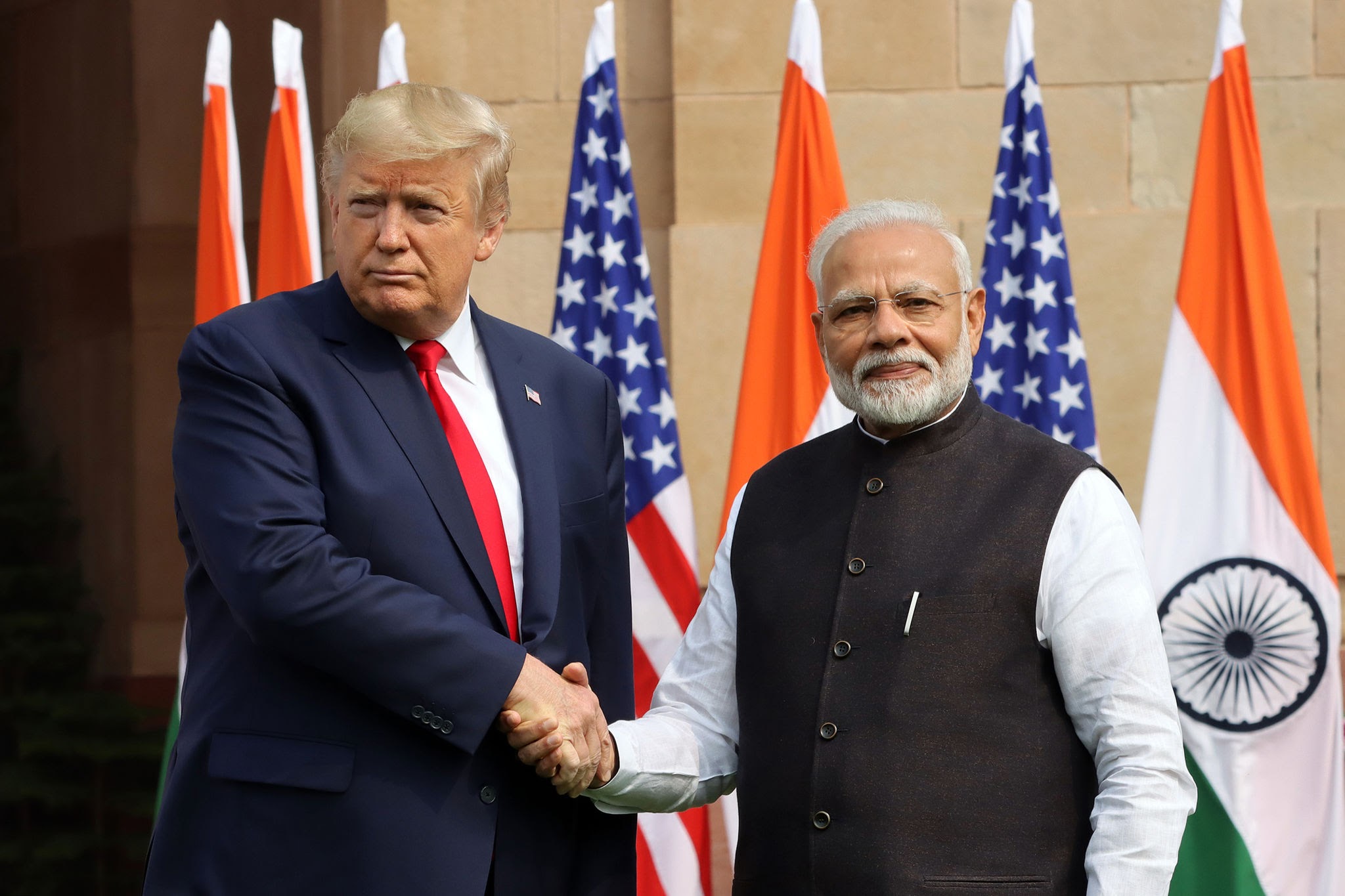
US President Donald Trump announced that the United States is moving closer to an interim trade agreement with India. The declaration comes amid critical bilateral negotiations in New Delhi targeted at resolving tariff disputes following a landmark US Supreme Court ruling and recent forced labor import enforcement under Section 301.
WASHINGTON / NEW DELHI — US President Donald Trump has confirmed that the United States is nearing a finalized interim trade agreement with India, declaring, "We will come to a deal with India on trade." The announcement comes at a pivotal moment as a senior US trade delegation wraps up intensive, three-day bilateral trade agreement (BTA) negotiations with Indian commerce officials in New Delhi.
The renewed momentum follows a period of heightened trade friction, marked by a major US Supreme Court ruling in February that struck down initial sweeping reciprocal tariffs, a subsequent temporary 10% global tariff layout, and recent Section 301 investigations. This developing trade agreement aims to lower structural market barriers, establish long-term tariff predictability, and secure significant mutual market access between the two major democracies.
High-Stakes Negotiations Begin in New Delhi
To convert executive intent into a binding legal layout, chief negotiators from both nations convened at Vanijya Bhawan, the headquarters of India's Ministry of Commerce and Industry. The US delegation, led by Assistant US Trade Representative Brendan Lynch, and the Indian team, headed by Department of Commerce Additional Secretary Darpan Jain, focused on finalizing the details of the first phase of the bilateral trade agreement.
According to Indian government officials, the current three-day round of talks is aimed specifically at locking in a predictable tariff structure before the temporary US 10% global tariff expires. While an early framework had been established in February, the legal landscape shifted dramatically when the US Supreme Court ruled against the administration’s use of the International Emergency Economic Powers Act (IEEPA) to implement broad reciprocal tariffs. Consequently, negotiators are now leveraging Section 301 provisions to structure the legal parameters of the bilateral trade agreement.
Tariff Adjustments and Energy Commitments
The core architecture of the proposed interim trade agreement rests on substantial tariff reductions and long-term commodity purchases. Under the initial framework established by President Trump and Prime Minister Narendra Modi, the US agreed to modify its import tax structures for Indian goods. After removing a 25% penal tariff in response to India's commitment to alter its external energy supply chains, the US administration proposed lowering the base reciprocal tariff on Indian goods from 25% to 18%.
In return, India has committed to expanding market access for American exporters significantly. Key aspects of the reciprocal arrangement include:
Tariff Elimination: India will eliminate or significantly reduce tariffs on all US industrial goods and an expansive array of agricultural imports, including tree nuts, fresh fruits, soybean oil, and distilled grains.
Massive Procurement: India intends to purchase over $500 billion worth of US energy products, coking coal, commercial aircraft, and data center technology over the next five years.
Digital and Tech Cooperation: Both sides will establish robust digital trade rules and significantly boost bilateral trade in high-tech components, including Graphics Processing Units (GPUs) used heavily in artificial intelligence infrastructure.
Addressing Section 301 and Forced Labor Provisions
The progress toward a final bilateral trade agreement occurs alongside a new round of regulatory pressure from Washington. The Office of the United States Trade Representative (USTR) recently issued findings under Section 301 naming 54 countries, including India, China, and Vietnam, for allegedly failing to effectively enforce prohibitions on imports manufactured using forced labor.
The USTR has proposed a parallel 12.5% tariff on affected countries, though nations that commit to enforcing reciprocal trade enforcement mechanisms against these practices could see that rate reduced to 10%. Trade experts at organizations like the Global Trade Research Initiative (GTRI) view these concurrent Section 301 investigations as strategic leverage designed to accelerate the final execution of the bilateral trade agreement.
Indian commerce ministry officials noted that while they remain actively engaged with the US legal proceedings regarding the Section 301 probe, they view the broader market access gains from the bilateral trade agreement as a separate, highly strategic priority.
Official Sources Section
Information in this report is compiled from official government releases, public corporate filings, and state declarations, including:
The White House Office of the Press Secretary Briefings and Fact Sheets.
The Ministry of Commerce and Industry (India) official negotiation updates.
The Office of the United States Trade Representative (USTR) federal notifications regarding Section 301 investigations.
The Press Information Bureau (PIB) of India joint bilateral statements.
Quote Section
Commenting on the trajectory of the high-level trade discussions, India's Commerce and Industry Minister Piyush Goyal stated:
"India and the United States have completed work on most portions of the legal framework for the first phase of our proposed bilateral trade agreement. After finalizing these core components, I am fully confident that we will conclude this first tranche as soon as possible, sign it, and immediately advance toward a more comprehensive economic partnership."
According to official White House statements released during the framework's initiation:
"The framework represents a historic milestone in our countries' partnership, demonstrating a common commitment to reciprocal, balanced trade that protects workers, expands agricultural export markets, and secures critical technology supply chains."
Why It Matters
For businesses and consumers, the finalizing of a US-India bilateral trade agreement provides much-needed regulatory clarity in a volatile global market. US agricultural producers stand to gain unprecedented, low-tariff access to India's vast consumer base, while tech companies will benefit from streamlined rules regarding data centers and GPU distribution.
For India, securing a stable 18% tariff tier ensures its vital manufacturing sectors—including textiles, jewelry, and engineering components—maintain a competitive edge over regional rivals in the critical US market, which consumes nearly 20% of India's total global exports.
Key Facts at a Glance
Targeted Procurement: India has committed to a massive $500 billion purchase plan of US energy, coal, aircraft, and information technology over five years.
Tariff Adjustments: The US plans to implement a stable 18% reciprocal tariff framework for Indian goods, down from previous higher boundaries.
Agricultural Wins: India will systematically drop non-tariff and tariff barriers on American industrial items, soybean oil, fresh fruits, and wine.
Tech Integration: The pact contains explicit legal pathways to boost joint data center hardware trade, specifically focusing on advanced Graphics Processing Units (GPUs).
FAQ Section
What is the primary objective of the US-India Bilateral Trade Agreement (BTA)?
The BTA seeks to establish a predictable, reciprocal trade layout between the US and India, lowering import duties on American agricultural and industrial goods while stabilizing tariffs on Indian exports to the US.
How does the recent US Supreme Court ruling affect the trade deal?
The Supreme Court's February decision struck down broad reciprocal tariffs enacted under emergency powers. This forced negotiators to pivot, using Section 301 provisions to legally anchor the tariff frameworks currently being negotiated in New Delhi.
What are the newly proposed 12.5% USTR tariffs?
Separately from the trade deal, the USTR has proposed a 12.5% tariff under Section 301 on 54 nations, including India, concerning forced labor import enforcement. However, countries finalizing reciprocal trade pacts or robust domestic enforcement can qualify for lower rates or distinct regulatory exemptions.
Which industries stand to benefit most from the interim trade agreement?
In the US, the energy, aerospace, and agricultural sectors will see massive export opportunities. In India, tech infrastructure, textiles, apparel, and jewelry exporters will secure more stable and competitive access to their largest destination market.
Source: The White House Statements & Releases, Ministry of Commerce and Industry India, Office of the United States Trade Representative