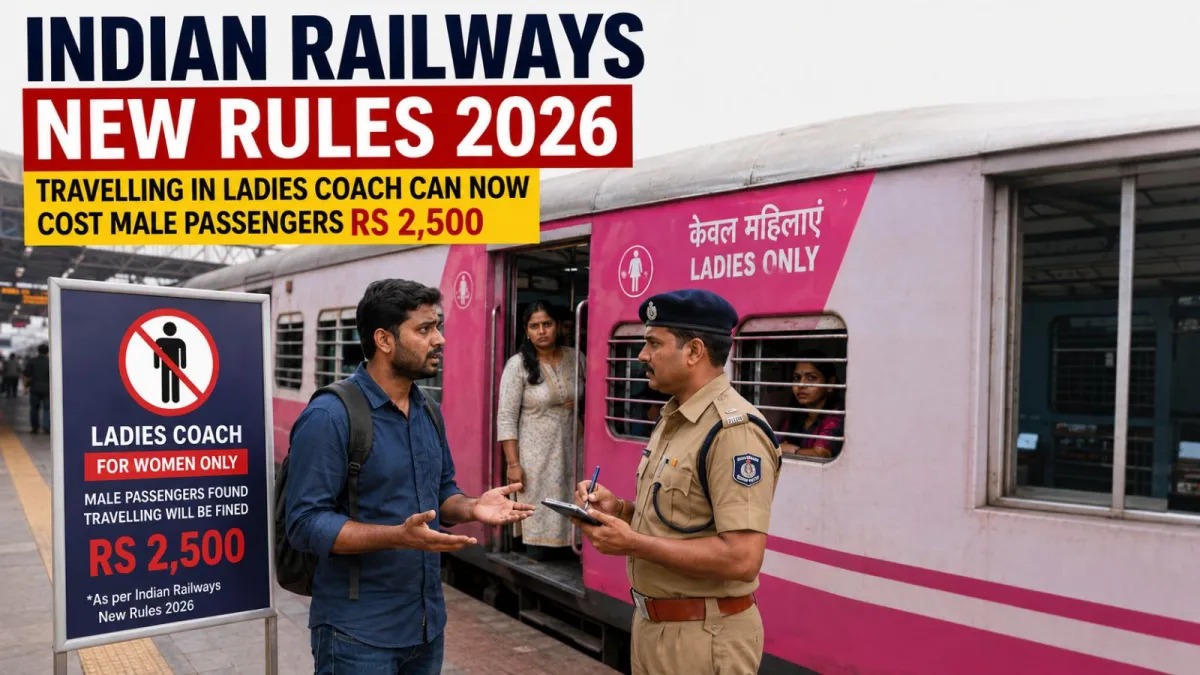
Indian Railways has increased the fine for male passengers caught in ladies' coaches from ₹500 to ₹2,500, effective June 20, 2026. This measure, introduced under the Jan Vishwas Act, aims to enhance security and comfort for female commuters by strictly enforcing reservation norms across the national rail network.
Indian Railways has officially increased the fine for male passengers found traveling in coaches or compartments reserved for women to ₹2,500. The revised penalty, implemented under the provisions of the Jan Vishwas (Amendment of Provisions) Act, 2026, represents a significant hike from the previous fine of ₹500.
The new enforcement measure, which went into effect on June 20, 2026, follows a gazette notification issued by the Ministry of Railways. The move is designed to address persistent safety and privacy concerns expressed by female commuters regarding unauthorized entry into designated compartments.
Stricter Enforcement of Railways Act
The penalty is enforced under Section 162 of the Railways Act, 1989. According to the revised guidelines, male passengers who knowingly enter or occupy a carriage, compartment, berth, or seat reserved for female passengers are now liable for the ₹2,500 fine.
Railway authorities have clarified that beyond the monetary penalty, the offender is liable to be removed from the train by any railway servant. Furthermore, if a passenger refuses to pay the penalty, they may be produced before a competent court. Upon conviction, the individual could face a fine extending up to ₹5,000.
Strengthening Passenger Safety
The decision comes as part of a broader series of updates to India's railway regulations aimed at improving commuter discipline and security. Railway officials have stated that the Railway Protection Force (RPF) will continue to conduct surprise checks and special drives to monitor compliance.
"The goal is to ensure that the spaces reserved for women remain secure and comfortable," an official source noted. The increased fine is expected to act as a significant deterrent against unauthorized entry, which has long been a source of conflict during peak travel hours on both suburban and long-distance trains.
Quote Section
According to officials, "The enhancement of the penalty is a necessary step to uphold the sanctity of reserved spaces. Unauthorized entry into ladies' coaches is a punishable offence, and the revised fine reflects the railways' commitment to passenger safety and the enforcement of established norms."
Why It Matters
For female travelers, this measure is a critical step toward ensuring that dedicated spaces remain accessible and secure. The hike in the fine serves as a clear signal that the national transporter is prioritizing the rights of women passengers to travel without harassment or crowding in their reserved compartments. For male commuters, the regulation serves as a firm reminder that unauthorized entry into protected zones carries severe financial and legal consequences.
Key Facts at a Glance
Revised Penalty: The fine for men traveling in ladies' coaches has been increased to ₹2,500.
Effective Date: The new rules came into force on June 20, 2026.
Legal Basis: Amendments were made to Section 162 of the Railways Act, 1989, via the Jan Vishwas (Amendment of Provisions) Act, 2026.
Consequences of Non-payment: Refusal to pay the fine may lead to court appearance and potential fines up to ₹5,000 upon conviction.
FAQ
1. Does the fine apply to all train types?
Yes, the rule applies across the entire Indian Railways network, including suburban local trains, express, mail, and premium services.
2. Are there any exceptions for medical emergencies?
Railway authorities handle genuine medical emergencies or cases where a male attendant is accompanying a woman with sensitivity, typically requiring verification by railway staff.
3. What happens if a passenger refuses to pay the fine?
If a passenger refuses to pay, they can be produced before a competent court, where they may face a fine of up to ₹5,000 upon conviction.
Source: Ministry of Railways (Gazette Notification), Indian Railways Official Portal