In a landmark revelation during National Space Day celebrations, the Indian Space Research Organisation (ISRO) has charted an ambitious 22-year roadmap that envisions a permanent human presence on the Moon and the deployment of 3D-printed habitats on Mars by 2047. This long-term strategy position...
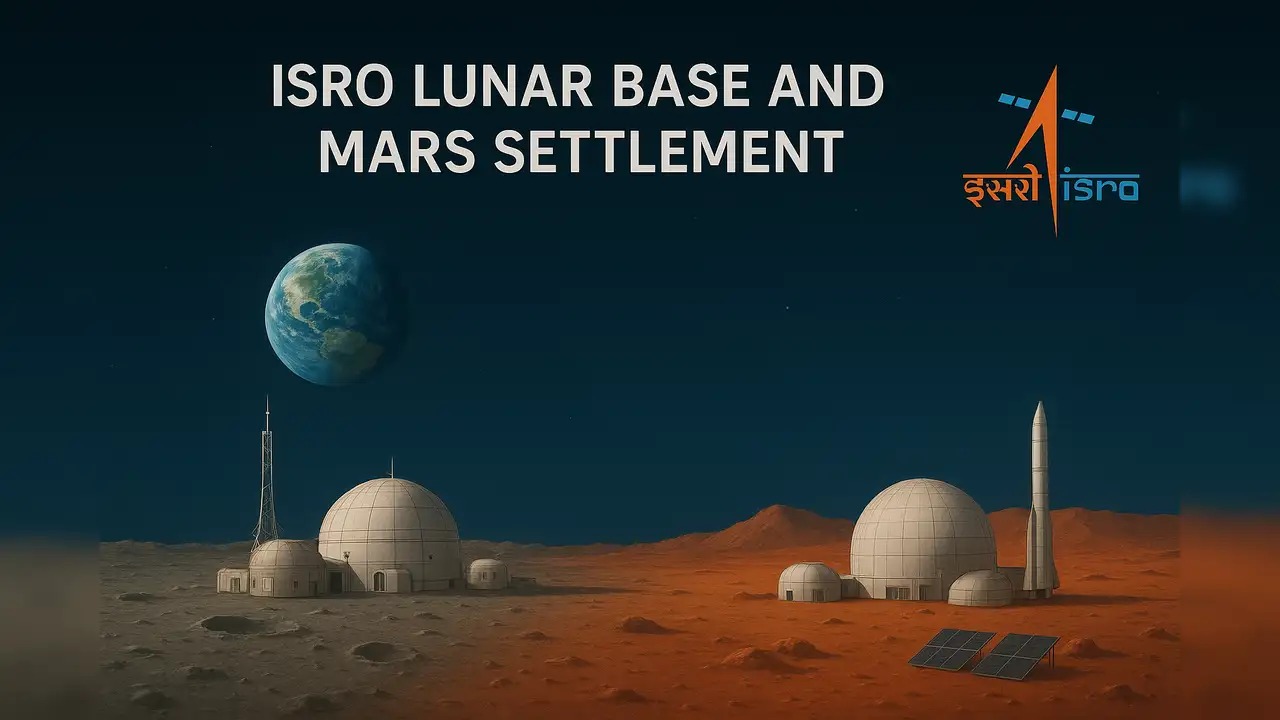
In a landmark revelation during National Space Day celebrations, the Indian Space Research Organisation (ISRO) has charted an ambitious 22-year roadmap that envisions a permanent human presence on the Moon and the deployment of 3D-printed habitats on Mars by 2047. This long-term strategy positions India as a serious contender in the global space race, with plans that stretch beyond exploration into extraterrestrial settlement and interplanetary logistics.
Vision for 2047: Moon Crew Stations and Martian Habitats
ISRO’s roadmap outlines a phased approach to building a crewed lunar base and initiating settlement infrastructure on Mars. The plan is aligned with Prime Minister Narendra Modi’s 2023 directive, which set milestones for establishing the Bhartiya Antariksha Station by 2035 and landing an Indian astronaut on the Moon by 2040.
Key highlights of the roadmap include:
- Establishment of a human outpost on the Moon by 2047, complete with crew stations, lunar terrain vehicles, and propellant depots
- Deployment of 3D-printed dwellings on Mars as a precursor to long-term colonization
- Development of deep-space human missions to expand India’s reach beyond Earth orbit
These goals reflect a shift from mission-based exploration to infrastructure-led expansion, with a focus on sustainability and long-duration habitation.
Launch Vehicle Evolution: From GSLV to LMLV
To support these ambitious missions, ISRO is developing the Lunar Module Launch Vehicle (LMLV), a super heavy-lift rocket designed to carry massive payloads into deep space. The LMLV will be a game-changer in India’s launch capabilities, dwarfing the current GSLV Mark-III in both size and capacity.
Notable specifications:
- Height: 119 metres, equivalent to a 40-storey building
- Payload capacity: 80 tonnes to low Earth orbit and 27 tonnes to trans-lunar orbit
- Target readiness: 2035
Currently, the GSLV Mark-III can lift up to 8 tonnes to low Earth orbit and 4 tonnes to geosynchronous transfer orbit. The LMLV’s enhanced capacity will enable crewed lunar missions and heavy cargo transport for Martian infrastructure.
Stepping Stones: Gaganyaan and ISS Missions
ISRO’s roadmap builds on recent milestones, including astronaut Shubhanshu Shukla’s historic stay aboard the International Space Station and the upcoming Gaganyaan crewed missions. These efforts are laying the groundwork for India’s transition from low Earth orbit operations to deep-space ventures.
Supporting developments:
- Gaganyaan mission to send Indian astronauts into orbit by 2026
- Commercial collaborations for astronaut training and life-support systems
- Ongoing research into space medicine, radiation shielding, and autonomous navigation
These foundational steps are crucial for ensuring crew safety and mission success in the harsh environments of the Moon and Mars.
Strategic Implications: Mining, Logistics, and Global Partnerships
Beyond scientific exploration, ISRO’s roadmap includes plans for resource mining, interplanetary logistics, and international collaboration. The lunar base will feature propellant depots to refuel spacecraft en route to Mars, while Martian habitats will be constructed using 3D printing technologies to reduce launch mass and enhance adaptability.
Strategic goals:
- Mineral extraction from lunar regolith and Martian soil
- Establishment of logistics hubs for interplanetary travel
- Collaboration with global space agencies and private players for technology sharing and joint missions
These initiatives could redefine India’s role in the space economy, opening avenues for commercial ventures and geopolitical influence.
Looking Ahead: A Nation’s Journey Beyond Earth
ISRO’s roadmap is not just a technical blueprint—it is a declaration of intent. By 2047, the centenary of India’s independence, the country aims to have a permanent human presence on the Moon and a foothold on Mars. This vision reflects a blend of scientific ambition, national pride, and strategic foresight.
As timelines unfold and technologies mature, India’s journey into deep space will be watched closely by the world. If realized, it will mark a transformative chapter in the nation’s history—one that reaches far beyond its terrestrial borders.
Sources: Times Now, Economic Times, Business Standard, MSN News, ISRO official statements