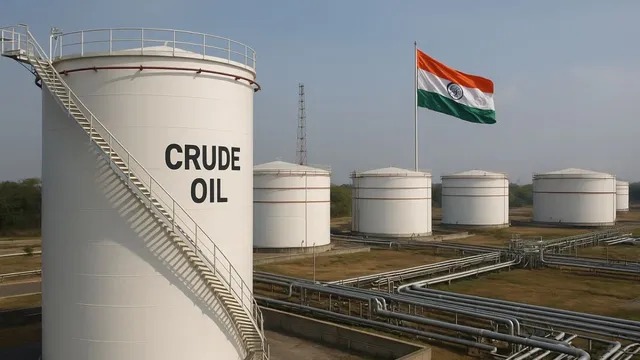
India is countering its 89% crude oil import dependence by expanding strategic reserves, diversifying energy imports, and accelerating a transition to green hydrogen, ethanol, and renewables. These measures aim to stabilize fuel prices for consumers and insulate the economy from global geopolitical shocks by 2047.
NEW DELHI — India, the world’s third-largest oil consumer and importer, is navigating a challenging energy landscape as its import dependence climbs toward 89%. With domestic production lagging behind surging demand, the government is prioritizing a dual-track strategy: bolstering strategic reserves and fast-tracking a transition toward indigenous, sustainable fuels to safeguard the economy from the shocks of the global oil market.
Domestic Reserves and Supply Security
According to the Petroleum Planning & Analysis Cell (PPAC), India holds approximately 672.07 million tonnes of estimated crude oil reserves, primarily concentrated in the western offshore, Assam, Rajasthan, and Gujarat. To mitigate the impact of international supply disruptions, Union Petroleum and Natural Gas Minister Hardeep Singh Puri recently confirmed that the nation maintains crude oil and natural gas stocks sufficient for over 60 days.
Furthermore, the government is actively expanding its Strategic Petroleum Reserve (SPR) capacity. In April 2026, the state fast-tracked the second phase of its SPR program at Chandikhol in Odisha and Padur in Karnataka to build a more robust buffer against maritime volatility in the Middle East, a primary source of India’s energy imports.
Impact on the Indian Consumer
The reliance on imported crude—purchased in U.S. dollars—makes the Indian economy highly sensitive to global price movements. When oil prices surge, the resulting "forex drain" can lead to rupee depreciation, inflationary pressures on transport and logistics, and a wider current account deficit.
To shield citizens, the central government has frequently intervened by reducing excise duties on petrol and diesel. Recent data indicates that these fiscal measures, alongside a shift toward more diverse import sources including Russia and the United States, have helped manage retail fuel costs even during periods of significant global price hikes.
A Pivot Toward Energy Autonomy
Beyond conventional fossil fuels, India is aggressively pursuing long-term structural shifts to decouple its growth from oil imports:
Renewable Expansion: As of March 2026, India reached 274 GW of non-fossil fuel capacity, achieving its 2030 target four years ahead of schedule.
Alternative Fuels: The government is promoting E25 (25% ethanol blending) and Compressed Biogas (CBG) to leverage agricultural waste as an indigenous energy source.
Green Hydrogen: With a substantial allocation in the 2026–27 Union Budget, the state is investing in green hydrogen to replace natural gas in heavy industries like steel and refining.
EV Infrastructure: Public bus fleets and freight logistics are increasingly being transitioned to electric vehicles (EVs) to reduce the systemic reliance on imported diesel.
Quote Section
"According to officials, India's energy strategy is anchored in diversification, resilience, and forward-looking transitions. Organizers stated that the government is converting geopolitical challenges into opportunities by strengthening domestic exploration and scaling up clean-energy technologies to ensure long-term energy autonomy."
Why It Matters
For the average citizen, the price of crude oil is more than a commodity statistic—it is a direct driver of household budgets. When global prices spike, the cost of transportation, logistics, and essential goods rises. By diversifying supply sources and moving toward "Round-the-Clock" renewable energy, India aims to stabilize fuel costs and prevent the "import-price shock" cycles that have historically hampered economic growth.
Key Facts at a Glance
Import Dependence: Nearly 89% of crude oil requirements are met through imports.
Strategic Buffers: India maintains crude oil and natural gas reserves sufficient for over 60 days of consumption.
Renewable Milestone: Over 50% of installed electricity capacity now comes from non-fossil fuel sources.
Diversification: India is actively diversifying its crude basket, increasingly sourcing from the U.S., Russia, and Africa to bypass regional maritime risks.
FAQ
Why is India so dependent on oil imports?
Despite significant exploration efforts, domestic crude production has not kept pace with India’s rapidly growing industrial and transportation demand, which is currently among the fastest-growing globally.
How does global oil price volatility affect my home loan or EMI?
High oil prices can lead to domestic inflation, forcing the Reserve Bank of India (RBI) to keep interest rates high to maintain stability, which in turn keeps borrowing costs like home and auto loan EMIs elevated.
Is the government planning to reduce fuel taxes?
The government has utilized excise duty cuts in the past to absorb global price shocks. Policy experts suggest that while targeted support for vulnerable groups will continue via Direct Benefit Transfer (DBT), the goal is to shift toward sustainable energy to minimize the need for recurring tax-based interventions.
Official Sources