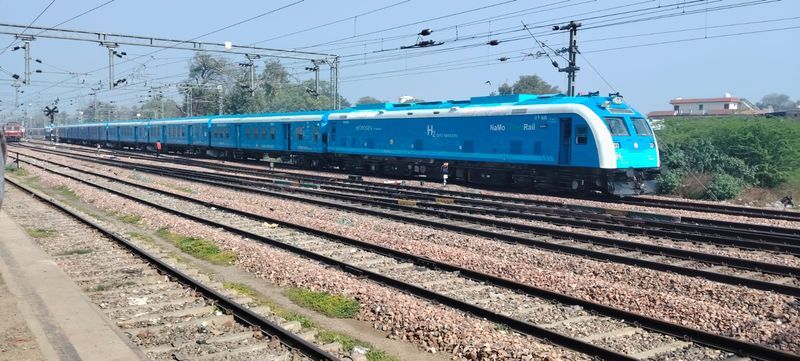
India is launching its first indigenous hydrogen-powered passenger train on July 17, 2026, between Jind and Sonipat, Haryana. This 10-coach train, capable of reaching 120 kmph, utilizes hydrogen fuel cell technology to provide a clean, zero-emission transit solution, signaling a major milestone in Indian Railways' green modernization roadmap.
India is set to launch its first indigenous hydrogen-powered passenger train service on July 17, 2026, marking a landmark achievement in sustainable rail transport.
NEW DELHI — Indian Railways is on the cusp of a technological revolution as the country prepares to operationalize its first hydrogen-powered train. Prime Minister Narendra Modi is scheduled to flag off the service on July 17, 2026, which will connect Jind and Sonipat in the state of Haryana. This deployment follows the successful completion of high-speed trials on June 26, 2026, where the train achieved speeds of 120 kmph, proving the reliability of its indigenous propulsion technology.
The 10-coach trainset represents a significant shift in India’s strategy to decarbonize its vast railway network, moving beyond traditional electrification and fossil-fuel-reliant diesel traction. By integrating advanced hydrogen fuel cell technology, Indian Railways aims to provide a cleaner, quieter, and more efficient alternative for non-electrified routes.
How Hydrogen Trains Work
Unlike conventional locomotives that burn diesel, hydrogen trains—often referred to as "hydrail"—are electric vehicles that generate their own power on board. The process utilizes hydrogen fuel cells, which facilitate a chemical reaction between hydrogen and oxygen to produce electricity.
This electricity then powers traction motors that drive the train, with water vapor and heat being the only by-products. The system is often paired with onboard batteries to handle peak loads, such as acceleration and steep gradients, ensuring efficiency and reducing strain on the fuel cell stacks.
Key Infrastructure and Testing
The Jind-Sonipat corridor was specifically selected as the pilot route due to its suitability for testing under real-world operating conditions. To support this initiative, Indian Railways has established dedicated hydrogen production, storage, and refueling facilities at Jind. The facility has received the necessary safety licenses from the Petroleum and Explosives Safety Organisation (PESO), ensuring that hydrogen handling meets rigorous safety standards, including leak detection and fire suppression systems.
The trainset itself is a massive engineering feat. Built at the Integral Coach Factory in Chennai and integrated by Medha Servo Drives, the 10-coach unit features two driving power cars at either end, providing a total power output of 2,400 kW. It is designed to carry up to 2,600 passengers, with all onboard auxiliary systems—including lighting and air conditioning—powered directly by the hydrogen fuel cell system.
Official Sources
"This new train service is a valuable step towards a carbon-neutral economy. It will significantly boost regional connectivity while reducing our dependence on imported fossil fuels," according to railway officials overseeing the project.
Why It Matters
For India, hydrogen rail is a strategic solution for regional routes where the cost of overhead electrification is prohibitively high or technically unfeasible. By deploying hydrogen technology, the country can modernize its rural and semi-urban transit corridors without the need for extensive civil works. Furthermore, this project positions India among a select few nations—such as Germany, Japan, and China—that are leading the global transition toward zero-emission passenger rail.
Key Facts at a Glance
Launch Date: July 17, 2026.
Pilot Route: Jind to Sonipat (Haryana).
Train Specs: 10-coach trainset with a capacity of 2,600 passengers.
Technology: 1,200 kW hydrogen fuel cell propulsion system at each end.
Environmental Impact: Zero carbon emissions, with water vapor as the only direct byproduct.
FAQ
What makes a train "hydrogen-powered"?
These trains use fuel cells to convert hydrogen and oxygen into electricity, which then powers the train’s electric motors, rather than burning diesel in an internal combustion engine.
Is this train environmentally friendly?
Yes, it is a zero-emission vehicle. However, its overall environmental impact depends on the source of the hydrogen. India is focusing on sustainable production methods to ensure the fuel source is as clean as the train itself.
Why is hydrogen being used instead of just electrifying more lines?
While electrification is the gold standard for high-traffic corridors, hydrogen trains are more cost-effective for low-frequency, rural, or remote lines where the infrastructure investment for overhead wires cannot be justified.
Source: India Today, Railway PRO, Malayala Manorama