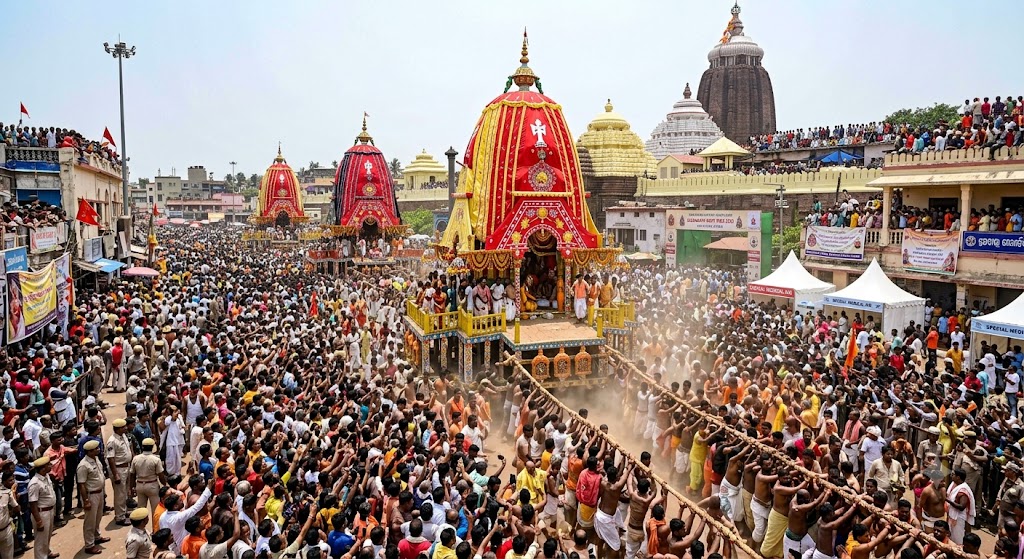
The annual Jagannath Rath Yatra 2026 commenced in Puri, Odisha, on July 16, with millions of devotees attending the nine-day chariot festival. A precise schedule has been set for key rituals like Pahandi Bije and chariot pulling. Security is tight, with 180 platoons deployed for crowd control and safety.
PURI, INDIA — The annual Jagannath Rath Yatra 2026 officially begins today, July 16, 2026, in the holy town of Puri, Odisha. This globally recognized festival, celebrating the journey of Lord Jagannath, his brother Balabhadra, and sister Subhadra from the 12th-century Shree Jagannath Temple to the Gundicha Temple, draws millions of Hindu devotees and international tourists. The nine-day event is critically important as a cultural cornerstone, requiring massive logistical planning, stringent public safety measures, and precise adherence to ancient Vedic timings, impacting transportation, commerce, and crowd management across the region today.
Detailed Schedule and Ritual Timings
The festival's core sequence follows a meticulously timed schedule announced by the Shree Jagannath Temple Administration (SJTA). While the public procession on the Grand Road (Bada Danda) is the main visible event, several crucial rituals define the initial days:
July 16: Rath Yatra (Procession Day): The day begins pre-dawn with special internal rituals. The key public events start with Pahandi Bije at approximately 9:30 AM IST. This ritual involves the deities being physically carried from the main temple to their respective chariots—Taladhwaja (Balabhadra), Darpadalan (Subhadra), and Nandighosa (Jagannath)—amidst the beating of gongs and chanting.
Chhera Panhara (July 16 Afternoon): Following Pahandi Bije, the Gajapati Maharaja of Puri, the traditional titular head, performs the Chhera Panhara ritual, sweeping the chariots with a gold-handled broom, symbolizing equality. Officials stated this ritual is expected around 2:30 PM IST.
Pulling of Chariots (July 16): The actual pulling of the three massive, decorated wooden chariots by thousands of eager devotees along the 3-kilometer Bada Danda begins after Chhera Panhara, tentatively scheduled for 3:30 PM IST.
Gundicha Temple Arrival (July 17): The deities reach the Gundicha Temple, usually by dusk on July 16, but remain on the chariots overnight. The final ceremonial Pahandi and entrance into the Gundicha Temple, their temporary abode, occur the following morning, July 17.
Hera Panchami (July 20): This significant ritual occurs on the fifth day, marked by Goddess Lakshmi’s visit to the Gundicha Temple to see Lord Jagannath, expressing her anger at being left behind.
Dakshina Moda (July 22): The three chariots are turned southward (Dakshina Moda), preparing for the return journey.
Bahuda Yatra (July 24): The return procession, known as Bahuda Yatra, commences with the deities traveling back to the main temple after their nine-day stay.
The specific times for Pahandi Bije, Chhera Panhara, and chariot pulling are subject to minor adjustments depending on the completion of earlier rituals. The SJTA confirmed that only authorized sevayats (priests and servitors) are permitted to touch the deities.
Security and Public Safety Measures
Given the expected congregation of roughly 1.5 million people, local and state authorities have implemented unprecedented security protocols. According to Odisha Police, over 180 platoons of forces and specialized anti-terror units, including the Odisha Disaster Rapid Action Force (ODRAF) and the Rapid Action Force (RAF), have been deployed in Puri.
"Our priority is seamless crowd management and ensure the safety of all devotees, especially during the crucial hours of Pahandi and Chhera Panhara," stated Dr. S. K. Priyadarshi, Puri's Additional Director General of Police. Surveillance is enhanced via 200 integrated CCTV cameras across Bada Danda and a dedicated 24-hour drone monitoring station.
Authorities have also activated comprehensive medical arrangements, with 120 first-aid centers and 80 ambulances stationed strategically. A traffic advisory remains in effect, restricting private vehicles from entering Puri town and diverting long-distance transport to designated parking zones 8 kilometers from the temple.
Historical and Cultural Context
The Rath Yatra, or "Festival of Chariots," finds mentions in ancient scriptures like the Brahma Purana and the Padma Purana, tracing its origin back hundreds of years. The process of constructing the three chariots begins fresh every year on Akshaya Tritiya (in late April or early May) using specific species of timber donated traditionally. Over 1,000 workers and artisans, whose skills are hereditary, labor for months to build them without the use of metal nails, adhering strictly to traditional design and dimensions.
The festival symbolizes the divine journey and universal brotherhood, where God comes out of the sanctum to the street to be visible to all devotees, irrespective of caste, creed, or nationality. The rituals themselves, from Pahandi to Bahuda Yatra, depict intricate mythological narratives that reinforce cultural continuity and spiritual devotion in Odisha.
Official Sources Section
According to official announcements and published directives from:
The Shree Jagannath Temple Administration (SJTA).
Odisha State Police Headquarters.
Puri District Administration (Collector and District Magistrate's office).
Notifications from East Coast Railway (ECoR) and Odisha State Road Transport Corporation (OSRTC).
Quote Section
"The Jagannath Rath Yatra 2026 is a massive undertaking, and we have left no stone unturned to ensure a smooth and peaceful experience for the millions traveling to Puri. Our focus remains on the precise execution of rituals and ensuring the health and security of all participants."stated Pramod Kumar Das, Chief Administrator, SJTA.
Why It Matters
The Jagannath Rath Yatra 2026 is crucial for travelers needing detailed schedules, businesses managing supply chains during the lockdown of Puri town, and devotees planning a safe visit. Logistically, it requires complex transport coordination with 300 special trains and 800 buses deployed to handle the massive surge in passengers today. Economically, the nine-day event is expected to inject approximately Rs 500 crore into Puri's hospitality and tourism sectors, supporting thousands of livelihoods, but also disrupting normal operations due to strict security measures.
Key Facts at a Glance
Start Date: July 16, 2026 (Bahuda Yatra on July 24).
Location: Puri, Odisha (Grand Road/Bada Danda).
Total Chariots: Three (Nandighosa, Taladhwaja, Darpadalan), built anew annually.
Security Personnel: Over 180 platoons deployed, plus specialized anti-terror units.
Expected Attendance: 1.5 million people on the first day.
FAQ Section
Q1: What are the main ritual timings for the first day, July 16?
The first public ritual, Pahandi Bije, where deities are brought to the chariots, is scheduled for approximately 9:30 AM IST. Chhera Panhara by the Puri Gajapati will occur around 2:30 PM IST, and the pulling of chariots is expected to start by 3:30 PM IST. All timings are tentative.
Q2: Is the Jagannath Rath Yatra 2026 safe for tourists?
Yes, authorities have deployed extensive security, including anti-terror units and 200 CCTV cameras, and established dedicated medical teams. However, visitors should expect extreme crowds and follow traffic and health advisories.
Q3: Are there travel restrictions in Puri during the Rath Yatra?
Yes, private vehicles are not allowed into Puri town. All vehicles must park in designated areas located about 8 kilometers away, from where shuttle services are provided. Extensive train and bus services have been arranged for travel.
Source: Shree Jagannath Temple Administration (SJTA), Odisha State Police, Puri District Administration, and East Coast Railway updates.