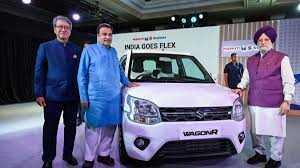
Maruti Suzuki has launched India's first production-spec mass-market flex-fuel car, a specialized variant of the Wagon R capable of running on E85 ethanol blends. To support the vehicle's rollout, the central government has initiated a development plan to establish 5,000 dedicated E85 fuel dispensing pumps across major urban centers by 2027.
NEW DELHI — In a major development for the South Asian automotive sector, Maruti Suzuki India Limited has officially launched the nation's first production-spec mass-market flex-fuel passenger car, debuting an ethanol-compatible variant of its popular Wagon R hatchback. The unveiling took place at a high-level industrial event in New Delhi on June 4, 2026, positioning biofuels as a primary pillar in India's modern energy security matrix.
Concurrently, the central government announced a massive infrastructure roadmap to support the deployment of high-blend biofuels. The Ministry of Petroleum and Natural Gas revealed a phased plan to establish approximately 5,000 specialized E85 fuel dispensing stations nationwide over the next two years. This dual development effectively addresses the long-standing "chicken-and-egg" dilemma that has historically stalled the deployment of flexible-fuel transport solutions in India.
Technical Adaptation of the Mass-Market Powertrain
According to technical briefs released by Maruti Suzuki engineers, the production-spec Wagon R Flex-Fuel operates on the company’s tested 1.2-litre, four-cylinder K12N naturally aspirated engine. However, to accommodate the corrosive nature and differing combustion metrics of high-concentration alcohol fuels, substantial structural modifications were integrated into the assembly lines.
The vehicle features upgraded, chemically resilient fuel injectors, re-engineered fuel pumps, and reinforced fuel lines capable of handling prolonged ethanol exposure. Crucially, the powertrain incorporates a newly developed, highly sensitive internal ethanol sensor linked to a re-calibrated Engine Control Unit (ECU). This sensor continuously detects the precise ethanol-to-petrol ratio entering the combustion chamber, automatically adjusting fuel injection volumes and ignition timing in real time.
National Fuel Infrastructure and the E85 Retail Roadmap
While the production variant is technically capable of operating on fuel mixtures ranging from standard E20 up to pure E100 ethanol, it has been formally homologated and certified under Indian regulatory standards to run on E85 fuel—a blend comprising 85% plant-derived ethanol and 15% conventional gasoline.
Addressing the current scarcity of retail high-blend fuel pumps, Union Minister of Petroleum and Natural Gas Hardeep Singh Puri detailed a highly structured supply pipeline during the launch. The government intends to deploy the supply ecosystem through clear operational stages to prevent retail bottlenecks.
The initial distribution framework relies on a regional rollout model, prioritizing high-volume transport zones before scaling out to the broader national grid:
| Deployment Phase | Timeline | Target Operational Outlets | Primary Geographic Focus |
| Phase I | Immediate Launch | 50 – 100 Stations | Delhi-NCR, Mumbai-Pune-Nagpur & Ahmedabad corridors |
| Phase II | December 2026 | 500 Stations | Tier-1 metropolitan perimeters & state highways |
| Phase III | Late 2027 | ~5,000 Stations | Nationwide coverage across major tier-2 urban centers |
Macroeconomic Impact on Imports and Rural Economies
According to data compiled by the Ministry of Road Transport and Highways, India currently relies on foreign imports to meet approximately 87% of its domestic crude oil requirements. A systemic shift toward localized biofuel adoption alters these macroeconomic vulnerabilities.
The widespread adoption of flex-fuel vehicles directly expands the domestic market for agricultural processing. Increased ethanol distillation utilizes surplus sugarcane, damaged food grains, and agricultural biomass, creating an internal circular economy. Financial modeling from the Petroleum Ministry indicates that transitioning a significant percentage of incoming two-wheelers and four-wheelers to flex-fuel compliance will eventually divert billions of liters of fuel demand to domestic refineries, injecting substantial additional income directly into the rural farming sector.
Official Sources Section
The corporate metrics, vehicle homologation data, and infrastructure targets presented in this dispatch are corroborated by official press releases from Maruti Suzuki India Limited, regulatory filings on the National Stock Exchange, and statements from the Ministry of Petroleum and Natural Gas.
Quote Section
"According to officials from the Ministry of Petroleum and Natural Gas, the introduction of mass-market flex-fuel choices is a crucial element in achieving the twin national objectives of reducing foreign oil import bills and lowering urban particulate emissions. The government is actively working on supportive frameworks, including competitive pricing mechanisms, to ensure E85 fuel remains substantially cheaper for consumers than current E20 petrol options."
Why It Matters
For consumers and commercial fleet operators, the launch of a mass-market flex-fuel car provides an affordable path toward clean mobility without the high upfront acquisition costs associated with battery electric vehicles (EVs). For automotive investors and component manufacturers, the development signals a definitive diversification of India's green transport policy, establishing biofuels alongside electric and hybrid drivetrains as a core component of future industrial planning.
Key Facts at a Glance
Pioneering Model: Maruti Suzuki becomes the first domestic automaker to put a mass-market flex-fuel passenger car into active production.
Fuel Capability: Certified for E85 fuel blends, with the internal capability to adjust across E20 to E100 spectrums.
Government Target: The Centre plans to establish 5,000 dedicated E85 fuel dispensing pumps across major cities by the end of 2027.
Environmental Status: NITI Aayog classifies high-blend ethanol Flex-Fuel Vehicles (FFVs) as a low-emission solution due to near-zero particulate matter output.
FAQ Section
Q1: What exactly is a flex-fuel vehicle?
A1: A flex-fuel vehicle (FFV) features a modified internal combustion engine equipped with specialized sensors, allowing it to run on regular petrol, pure ethanol, or any blend of the two mixed in a single tank.
Q2: Can I fill a standard petrol car with E85 fuel?
A2: No. Standard petrol engines are currently only calibrated to handle up to E20 fuel blends. Attempting to run higher ethanol concentrations like E85 in an unmodified car can damage standard fuel lines, injectors, and fuel pumps due to the chemical properties of alcohol.
Q3: Will the fuel efficiency of a flex-fuel car be identical to a petrol car?
A3: Ethanol contains less energy density per liter than conventional petrol, meaning fuel consumption is typically higher. However, the government has stated that E85 fuel will be priced significantly lower than normal petrol to offset the difference in mileage.
Q4: Is the new Wagon R Flex-Fuel available for individual private buyers?
A4: During the initial rollout phase, Maruti Suzuki is focusing the distribution of the production-spec Wagon R Flex-Fuel primarily within the commercial fleet and taxi sectors as the retail fuel network develops.
Source: Ministry of Petroleum and Natural Gas, Maruti Suzuki Corporate Communications, Ministry of Road Transport and Highways.