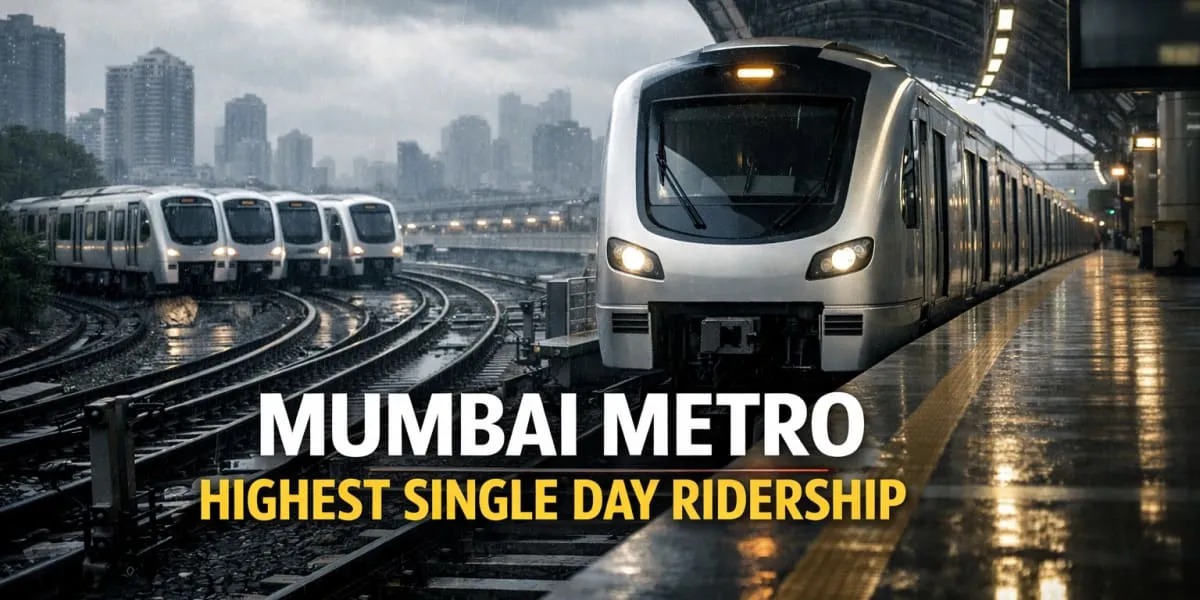
The Mumbai Metro set a new milestone by recording its highest-ever single-day ridership of 358,115 passenger journeys, driven by intense monsoon rains across the region. MMMOCL successfully managed the surge by deploying standby train rakes, showcasing the network's resilience as an essential transit alternative during heavy weather.
MUMBAI — The Maha Mumbai Metro Operation Corporation Limited (MMMOCL) officially recorded its highest-ever single day ridership milestone, logging a peak of 358,115 passenger journeys in a single 24-hour window.
The traffic surge, confirmed by transit metrics released by the operations desk on Thursday, July 2, 2026, occurred as the southwest monsoon rapidly intensified across the Mumbai Metropolitan Region (MMR). Severe waterlogging along major suburban vehicular corridors, including the Western Express Highway and primary links in Andheri and Malad, forced thousands of daily commuters to abandon private transport and local buses. The mass migration to the electrified rail network outpaced the previous operational record of 357,895 journeys logged earlier in June, proving the system's role as the city’s primary cross-suburban transit backbone during climate emergencies.
Standby Rakes Deployed to Address Monsoon Crowding
According to the official data logs released by the Maha Mumbai Metro Operation Corporation Limited, the sudden spike in footfall did not trigger system-wide service bottlenecks due to the activation of pre-planned emergency train deployments.
To accommodate the sudden structural pressure on ticketing bays and platforms, the operations control center positioned additional backup Metro rakes on active standby across all operational corridors. These standby systems were pushed into active scheduling loops beyond standard peak operating hours, successfully sustaining train frequencies between 4 to 8 minutes. The additional rolling stock allowed terminal stations like Andheri, Gundavali, and Dahisar to disperse heavy crowds smoothly, minimizing platform dwelling times even as outside rain activity disrupted parallel local suburban train lines.
Expanding Grid Links Enhance Suburban Connectivity
The rapid realization of record-breaking single-day figures highlights the compounding value of Mumbai's growing network layout. The city's transit architecture expanded to five operational corridors following the commissioning of Metro Line 9 Phase 1 by the Mumbai Metropolitan Region Development Authority (MMRDA).
The expanded network structure—which combines Line 1 (Ghatkopar-Andheri-Versova), Line 2A (Andheri West-Dahisar East), Line 7 (Dahisar East-Andheri East), Line 9, and the underground Phase 1 of Line 3 (Aqua Line)—has established critical cross-city interchange spines. Major transfer hubs at Marol, the Western Express Highway, and D.N. Nagar allow passengers to cross the city without using congested road networks. This interconnected grid has caused annual ridership on legacy corridors like Metro 1 to double from 7.6 crore during its 2014 inception to over 15.7 crore over recent fiscal periods.
Future Pipelines Move Toward Longest Regional Line
To sustain this high transit momentum, municipal execution bodies are accelerating safety reviews for upcoming network components. The Ministry of Housing and Urban Affairs confirmed that the initial phase of Mumbai Metro Line 5, spanning the Thane to Dhamankar Naka sector in Bhiwandi, has moved into its final pre-commissioning phase.
The Commissioner of Metro Rail Safety (CMRS) is scheduled to initiate strict physical infrastructure and rolling stock safety inspections over the coming days. Once fully completed, the comprehensive Line 5 corridor will extend across 34.21 kilometers, establishing it as the longest continuous rapid transit line operating in the Mumbai Metropolitan Region. This route is expected to provide substantial relief to congested suburban railway links connecting eastern industrial zones.
Official Sources Section
The operational records, passenger tallies, and infrastructural timelines detailed in this report are drawn directly from official regulatory disclosures:
MMMOCL Traffic Declarations: Official operational press statements detailing the June 23 traffic records and monsoon deployment strategies.
MMRDA Progress Journals: Infrastructure reports mapping the commissioning parameters of Line 9 and safety pipelines for Line 5.
CMRS Technical Gazettes: Operational safety inspection schedules for regional rolling stock clearances.
Quote Section
"According to officials managing the city's transit operations, the network's capacity to absorb over 3.58 lakh passenger journeys in a single day without service failure validates our infrastructure investments," stated an MMMOCL corporate representative. "Organizers stated that monitoring teams will continue to track real-time weather alerts from the meteorological department to adjust train deployments and guarantee safe travel throughout the monsoon season."
Why It Matters
For everyday commuters and business travelers, the record ridership shows that the expanded metro network provides a highly dependable transport alternative during severe monsoon disruptions. For city planners and green energy investors, the system's ability to smoothly scale up capacity highlights how modern mass rapid transit reduces urban traffic congestion and curbs carbon emissions. This operational stability protects businesses from losing work hours due to employees getting stranded by severe weather.
Key Facts at a Glance
Milestone Achieved: The Mumbai Metro hit its highest-ever ridership peak, logging 358,115 passenger journeys in a single day.
Weather Catalyst: The record turnout was largely driven by heavy monsoon rains, which prompted commuters to skip flooded roadways.
Emergency Response: MMMOCL successfully managed the crowds by keeping standby train rakes ready to deploy past regular peak hours.
Active Network Expansion: The Mumbai Metropolitan transit grid now runs five active corridors following the recent launch of Metro Line 9 Phase 1.
FAQ Section
What is the new single-day ridership record for the Mumbai Metro?
The network reached its highest-ever single-day milestone by handling 358,115 passenger journeys on June 23, 2026.
How did the metro handle the sudden passenger surge during the rains?
MMMOCL deployed extra standby train rakes across active corridors beyond typical peak hours to increase trip frequencies and reduce station crowding.
How many metro lines are currently active in Mumbai?
The network currently operates five active routes, including Line 1, Line 2A, Line 7, the underground Line 3 (Aqua Line), and the newly opened Line 9 Phase 1.
What is the significance of the upcoming Metro Line 5?
Spanning 34.21 kilometers between Thane and Bhiwandi, Line 5 is currently undergoing final pre-commissioning safety checks to become the longest metro line in the region.
Source: Maha Mumbai Metro Operation Corporation Limited Performance Disclosures, Mumbai Metropolitan Region Development Authority Press Hub, Ministry of Housing and Urban Affairs Project Bulletins.